Physical Address
4676 Railroad Street Marquette
MI 49855
Physical Address
4676 Railroad Street Marquette
MI 49855

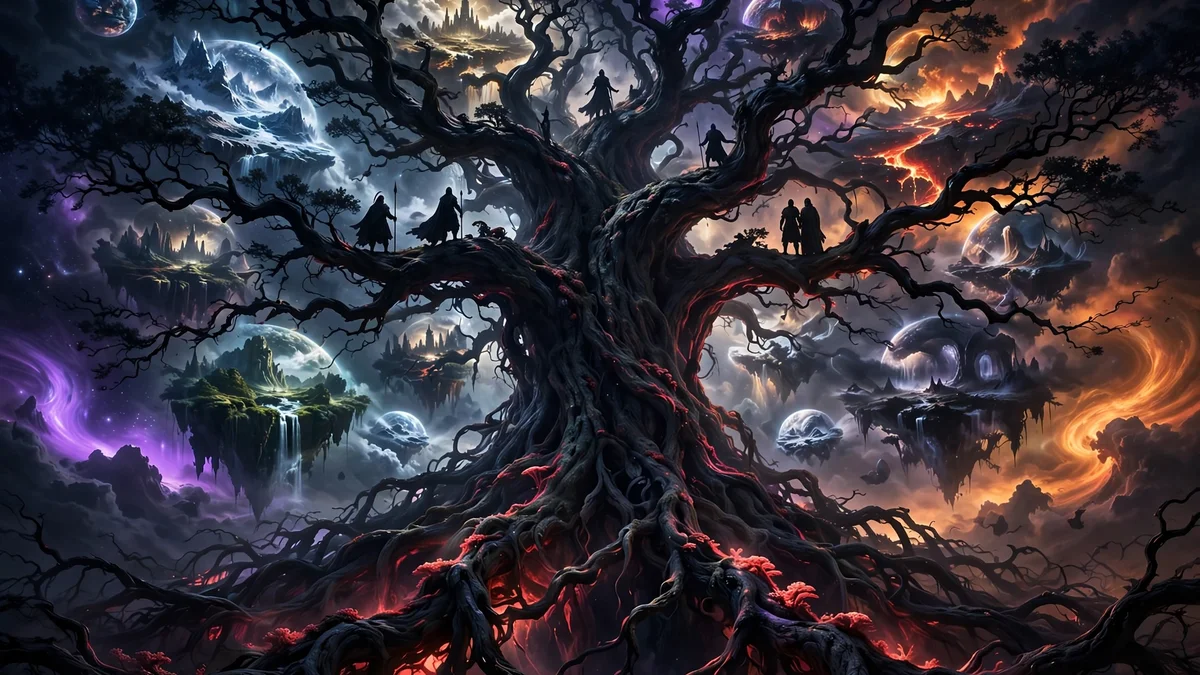
Viking mythology stories are the ancient Norse tales of gods like Odin, Thor, and Freyja, giants, monsters, and heroes across the Nine Worlds connected by the world tree Yggdrasil. The greatest legends include the creation of the world from a giant’s body, Thor’s battles with giants, Loki’s tricks, the death of Baldr, and Ragnarok — the prophesied end of the world. These stories were passed down orally for centuries before being written in the Poetic Edda and Prose Edda.
Long ago, the Vikings — the seafaring Norse people of Scandinavia — told stories of a universe far stranger than our own. Their cosmos had Nine Worlds, all connected by Yggdrasil, an enormous ash tree whose branches held the sky and whose roots reached into the underworld.
In these worlds lived the Aesir (gods of power and war, led by Odin), the Vanir (gods of nature and magic), giants, elves, dwarves, and monsters. The stories of their adventures, betrayals, romances, and battles are called Norse mythology — and they are some of the most vivid tales ever told.
This guide is your gateway to all of them.
In the beginning, there was only Ginnungagap — a vast, empty void. To the north lay Niflheim, a world of ice and mist. To the south lay Muspelheim, a world of fire. When the ice and fire met in the void, they melted into water droplets, and from those drops came Ymir, the first giant, and Audhumla, a giant cow.
Ymir sweated in his sleep, and from his sweat came more giants. Audhumla licked salty ice blocks, and from the ice emerged Buri, the first god. Buri’s grandchildren — Odin, Vili, and Ve — killed Ymir and built the world from his body. His flesh became the earth, his blood the oceans, his bones the mountains, his skull the sky, and his brains the clouds.
It is a violent, strange beginning — and it sets the tone for everything that follows.
Odin is the chief of the gods — a one-eyed wanderer obsessed with wisdom. He sacrificed his own eye for a drink from the well of wisdom, and hung himself from Yggdrasil for nine days to learn the secrets of runes. He rides the eight-legged horse Sleipnir and is followed by two ravens, Huginn and Muninn, who bring him news from all worlds.
Thor is the strongest god and the protector of both gods and humans. He wields the hammer Mjolnir, wears iron gloves, and rides a chariot pulled by goats. He spends most of his time fighting giants, who constantly threaten the ordered world.
Baldr is the most beautiful and beloved of all gods — so pure that light seems to shine from him. His death, caused by Loki’s trickery, is one of the saddest stories in all mythology and marks the beginning of the end.
Tyr is the god of war and justice who sacrificed his hand to bind the wolf Fenrir. When the gods needed someone to place their hand in the wolf’s mouth as a pledge, only Tyr was brave enough.
Heimdall guards the rainbow bridge Bifrost, the entrance to Asgard. He can see for a hundred miles, hear grass growing, and needs less sleep than a bird. At Ragnarok, he will blow the horn Gjallarhorn to summon the gods to their final battle.
Odin’s wife, Frigg, is the goddess of motherhood and foresight. She knows the future but never speaks of it. She weaves the clouds and tried desperately to save her son Baldr from his prophesied death.
Freyja is the goddess of love, beauty, war, and magic. She rides a chariot pulled by cats, wears the glowing necklace Brisingamen, and claims half of all warriors who die in battle for her own hall. She is as formidable as any male god.
Thor’s wife, Sif, is famous for her golden hair — which Loki once cut off as a prank, leading to the creation of many divine treasures.
Loki’s daughter Hel rules over the underworld that bears her name. Half her body is beautiful, half is corpse-blue. Those who die of sickness or old age go to her realm.
The giants (called Jotnar) are the oldest beings in Norse myth — older than the gods themselves. They represent wild, chaotic nature: ice, fire, storms, and wilderness. The gods represent order and civilization. This eternal conflict drives most Norse stories.
Famous giants include Ymir (whose body became the world), Thrym (who stole Thor’s hammer), Hymir (who owned the giant brewing cauldron), and Surtr (the fire giant who will burn the world at Ragnarok).
Loki cut off Sif’s hair as a prank, and to avoid Thor’s wrath, he promised to get her even better hair from the dwarves. The dwarves crafted golden hair — plus the hammer Mjolnir, the spear Gungnir, and other wonders. One prank created the gods’ greatest treasures.
When the giant Thrym stole Mjolnir, Loki suggested Thor disguise himself as the goddess Freyja to trick the giant. Thor, in a wedding dress and veil, ate an entire ox at the feast — and when the hammer was brought out to bless the marriage, he grabbed it and killed every giant present.
Frigg made everything in the world swear never to harm Baldr — except the mistletoe, which seemed too young and harmless. Loki discovered this, made a spear from mistletoe, and guided the blind god Hod to throw it. Baldr died, and the gods’ grief marked the beginning of the end.
The old prophecies foretell Ragnarok, the final battle. The wolf Fenrir will break free. The world serpent Jormungandr will rise from the sea. The fire giant Surtr will burn the world. Odin will be devoured by Fenrir. Thor will kill Jormungandr but die from its venom. The world will sink beneath the waves — then rise again, green and new.
The dwarves (also called dark elves) live underground in Svartalfheim. They are the greatest craftsmen in all the worlds, forging Mjolnir, the golden hair of Sif, the chain Gleipnir that binds Fenrir, and the ship Skidbladnir that always has fair wind. Many stories begin with someone needing something only dwarves can make.
Light elves live in Alfheim, a beautiful shining world. They are associated with beauty, light, and fertility. Dark elves (sometimes identified with dwarves) live underground. The myths say little about them, but they were clearly important to Norse belief.
Norse mythology is not only about gods. Human heroes like Sigurd the dragon-slayer (who killed the dragon Fafnir), the warrior Starkad, and the shieldmaiden Lagertha have their own epic tales. The line between gods and heroes is blurry — great humans could become almost divine.
Norse belief had multiple afterlives. Half of all warriors slain in battle go to Valhalla, Odin’s great hall, where they feast and fight all day in preparation for Ragnarok. The other half go to Freyja’s hall, Folkvangr. Those who die of sickness or age go to Hel’s gloomy underworld. This is why Vikings prized death in battle — it was the only way to the glorious halls.
No guide to Viking mythology is complete without the Valkyries — Odin’s supernatural warrior women who ride through the sky on flying horses, choosing which warriors will die in battle and escorting the bravest to Valhalla. Their name means “choosers of the slain.”
The Valkyries are both beautiful and terrifying. They appear on battlefields in shining armor, and their presence means death is coming. Yet they also serve mead to the honored dead in Valhalla, bridging the worlds of war and celebration. Famous Valkyries include Brynhildr, whose tragic love story with the hero Sigurd is one of the great romances of Norse legend.
Viking mythology stories are not just old tales. They shaped the names of our weekdays (Thursday = Thor’s day, Friday = Freyja’s day). They inspired Tolkien’s Lord of the Rings, Marvel’s Thor movies, and countless books and games. Their themes — courage, cleverness, fate, and the beauty of a world that will end — still speak to us today.
The Vikings believed the world would end in fire and ice, and that even the gods would die. Yet they also believed a new world would rise from the waters, green and beautiful. It is a mythology of endings — and beginnings.
They are essentially the same thing. “Norse mythology” is the scholarly term for the myths of the Norse people, while “Viking mythology” is the popular term. The Vikings were the seafaring Norse people of the Viking Age (roughly 793–1066 CE).
The main written sources are the Poetic Edda (a collection of old poems) and the Prose Edda (written by Snorri Sturluson around 1220 CE). These were written down in Iceland centuries after the Viking Age, preserving oral traditions.
Odin is the chief god and All-Father, but Thor was actually more popular among ordinary Vikings. Thor was the protector of common people, while Odin was associated with kings, warriors, and poets.
The Nine Worlds are Asgard (gods), Midgard (humans/earth), Jotunheim (giants), Vanaheim (Vanir gods), Alfheim (light elves), Svartalfheim (dwarves/dark elves), Niflheim (ice/mist), Muspelheim (fire), and Helheim (the dead). All are connected by Yggdrasil.
Yes. Archaeological evidence — rune stones, carvings, burial goods, and place names — confirms these myths were living religious beliefs, not just stories. The Vikings worshipped these gods for centuries before converting to Christianity.
Ragnarok is the prophesied end of the world in Norse myth — a final battle where most gods and monsters kill each other, the world burns and sinks, then rises again renewed. It is both an ending and a new beginning.
Loosely. Marvel borrowed the names and some traits but changed a great deal. In real myth, Loki is not Thor’s brother, Mjolnir cannot only be lifted by the worthy, and the stories are far stranger and darker than the movies suggest.
Start with Neil Gaiman’s “Norse Mythology” for accessible retellings, then try the Poetic Edda (Hollander or Larrington translations) for the original poems. This website’s Norse cluster articles cover individual gods, creatures, and stories in depth.