Physical Address
4676 Railroad Street Marquette
MI 49855
Physical Address
4676 Railroad Street Marquette
MI 49855

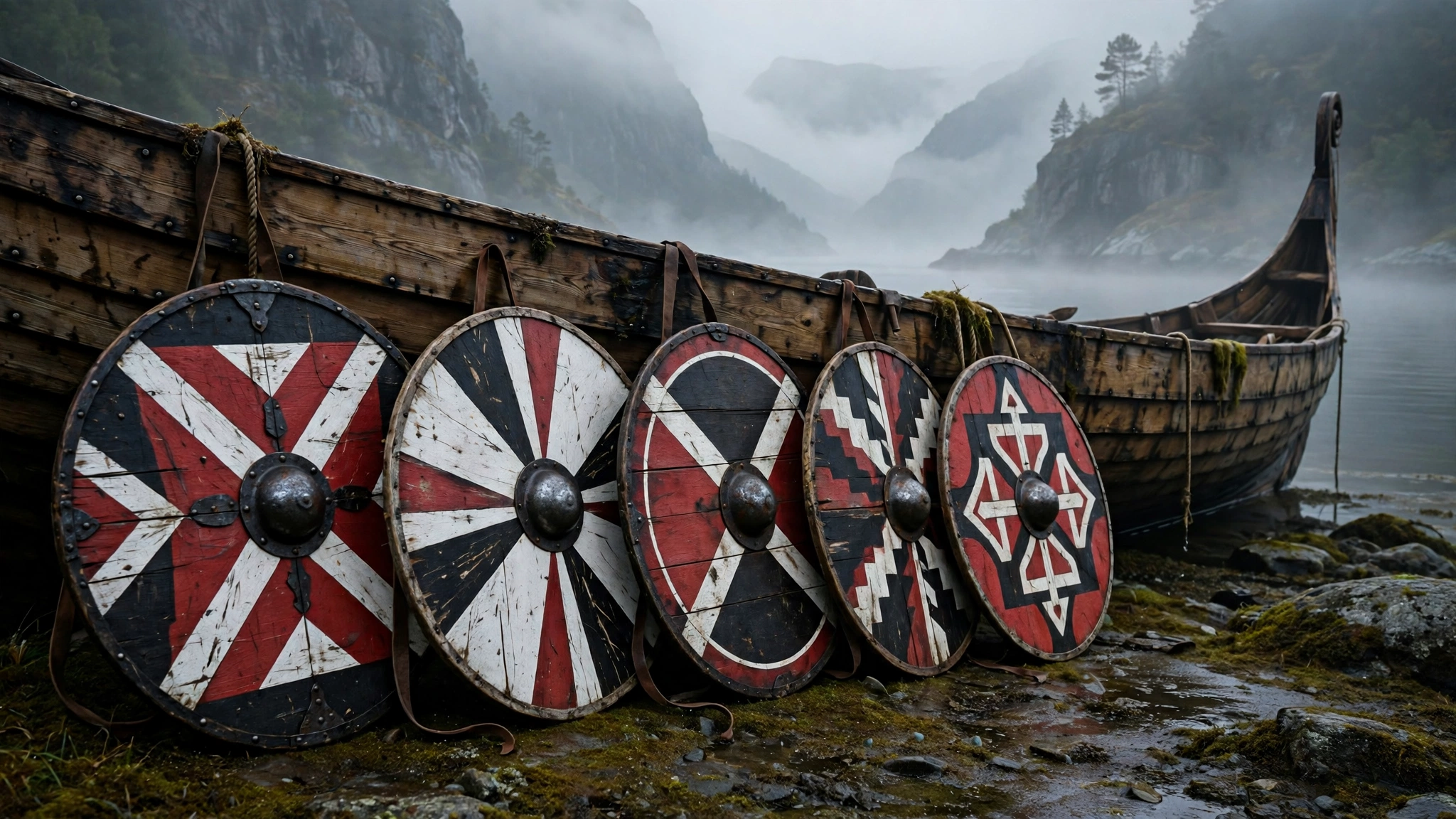
Picture a large, flat circle of wood — roughly the size of a serving tray, though heavier — with a dome of iron in the middle. That dome, called the boss or umbo, covered the hole where the warrior gripped the shield from behind. From the front, you would see painted wooden boards radiating from the iron center, often decorated in bold alternating colors.
Unlike the rectangular shields of Roman soldiers or the kite-shaped shields of later medieval knights, the Viking shield was always round. This design stayed nearly unchanged for centuries, from the 700s through the 1000s, because it worked.
A Viking shield was a clever piece of woodworking — light enough to maneuver in battle, tough enough to stop a sword or axe.
Shield makers split planks from trees like pine, fir, spruce, or linden (lime) wood. Linden was prized because it is light and does not split easily along the grain. The planks were butted edge-to-edge — usually 7 to 9 boards per shield — and sometimes glued or held together with small wooden dowels. The finished board was surprisingly thin, often just 6 to 10 millimeters thick.
At the center sat the iron boss, a dome roughly 15 cm across, riveted through the wood. The warrior’s hand gripped a bar behind the boss, so the iron dome protected the fingers from direct strikes. Bosses survive far better than wood in the ground, which is why archaeologists find hundreds of bosses but few complete shields.
The outer edge was often bound in rawhide or leather, stitched on while wet so it shrank tight as it dried. This rim kept the thin boards from splitting when struck. Shields were painted — red, yellow, black, and white were common — frequently in alternating wedge or quadrant patterns that may have identified a warrior’s group or leader.
Our clearest picture of Viking shields comes from the Gokstad ship burial in Norway, excavated in 1880. The great oak ship was buried around 890 AD with a chieftain, and along its gunwales hung 64 round shields — 32 per side, overlapping like scales.
The Gokstad shields measured about 94 cm across. Traces of yellow and black paint survived on the boards, suggesting they alternated colors along the ship’s rail — a striking display meant to impress and intimidate. The shields were thin pine boards with iron bosses, matching descriptions in the sagas.
Because they were display pieces on a burial ship, some scholars think they were made specially for the funeral. But their construction matches shield fragments found in warrior graves across Scandinavia and England, so the design was standard.
The most famous use of the Viking shield was the shield wall — the skjaldborg in Old Norse. Warriors stood shoulder to shoulder, each man’s shield overlapping his neighbor’s, forming a solid barrier of wood and iron.
The front rank locked shields and braced with spears pointing outward. Behind them stood more ranks, ready to step forward when someone fell. Breaking a shield wall meant breaking the army — battles often began with both sides shoving and stabbing at the wall, trying to create a gap.
Vikings also used a wedge formation called the svínfylking (“boar’s snout”) to punch through enemy lines. But the shield wall was their signature — the Anglo-Saxon Chronicle describes Viking armies fighting in exactly this formation at battles like Ashdown (871) and Maldon (991).
Vikings hung their shields on the rails of their longships when traveling — both for storage and as a show of strength. The Bayeux Tapestry, which depicts the Norman invasion of England in 1066, clearly shows round shields mounted along ship rails, confirming the Gokstad arrangement was real practice, not just burial decoration.
A ship arriving with painted shields gleaming along its sides sent a message before a single warrior stepped ashore: we are armed, we are many, and we are ready.
The shield held deep symbolic meaning for the Norse. In the myths, a shield named Svalinn stands before the sun, protecting the world from its burning heat. The roof of Valhalla — Odin’s hall of slain warriors — is said to be shingled with golden shields. Warriors in Valhalla were even said to fight each other daily for sport, healing by evening.
The connection between shields and identity ran so deep that Old Norse poetry uses shield imagery constantly. To learn about the gods these warriors followed, see our guide to Viking mythical animals and what Yggdrasil means in Norse mythology. For the most famous siege trick in ancient history, read the true story of the Trojan Horse.
Modern reconstructions and tests give us a good sense. A finished shield weighed roughly 3 to 5 kilograms — light enough to swing and punch with, heavy enough to absorb blows.
| Feature | Viking Round Shield | Roman Scutum | Medieval Kite Shield |
|---|---|---|---|
| Shape | Round | Rectangular, curved | Elongated teardrop |
| Size | 80–95 cm diameter | ~100 × 65 cm | ~120 cm tall |
| Material | Wood planks, iron boss | Layered plywood, iron boss | Wood, leather, steel |
| Grip | Center grip behind boss | Horizontal handle | Straps (enarmes) |
| Best used | Shield wall, duels | Tight formations | Cavalry, archers |
| Weakness | Edges could be hooked | Heavy (~10 kg) | Awkward on foot |
The round shield’s center grip allowed active, mobile defense — the warrior could angle the shield to deflect blows rather than just absorb them. Its weakness was the rim: enemies learned to hook the edge with an axe and yank it down, or to shatter the thin boards with repeated heavy strikes. Sagas describe shields being hacked to pieces in prolonged duels, with warriors discarding ruined shields mid-fight.
Norse sagas tell of shield maidens — women who fought alongside men. For centuries, scholars treated these as legends. Then in 2017, DNA analysis of a famous warrior grave at Birka, Sweden — buried with swords, axes, spears, and shields — revealed the warrior was biologically female.
Whether she fought as a “shield maiden” or held a command role is still debated, but the grave proves that at least one high-status woman was buried with a full warrior’s kit. The sagas may have preserved more truth than skeptics assumed.
The shield wall was not just a formation — it decided the fate of kingdoms.
When Vikings demanded tribute from the Anglo-Saxons, the English ealdorman Byrhtnoth allowed the raiders to cross a causeway so the armies could fight properly — and paid with his life. The Vikings’ shield wall held firm while the English line broke. The defeat was so humiliating that England began paying the Danegeld — protection money that only encouraged more raids. An Old English poem memorializes the battle’s heroic last stand.
Just weeks before Hastings, King Harold Godwinson surprised a Viking army led by Harald Hardrada at Stamford Bridge. The Vikings, caught without their armor in the heat, still formed a shield wall that held for hours. Legend says a single giant Viking held the narrow bridge alone, killing dozens of Englishmen before being speared from below. Harold’s victory was total — but it exhausted his army days before William’s invasion.
At Hastings, Harold’s English army fought behind a shield wall on a ridge — the same tactic the Vikings used. William’s Normans attacked uphill again and again, breaking against the wall of shields. Only when the Normans faked retreats, luring English soldiers to chase them and break formation, did the wall finally collapse. The shield wall nearly saved England; its breaking lost it. William’s conquest is covered in depth in our guide to medieval period kings.
Most Viking shields were 80 to 95 cm (31 to 37 inches) in diameter — about the size of a large serving tray. The Gokstad shields measured around 94 cm across.
Thin wooden planks (pine, fir, spruce, or linden), an iron boss in the center, and often a rawhide or leather rim. They were painted in colors like red, yellow, black, and white.
The shield wall (skjaldborg) was a Viking battle formation where warriors stood shoulder to shoulder with overlapping shields, creating a solid defensive barrier with spears pointing outward.
Yes. The Gokstad burial ship had 64 shields mounted on its rails, and the Bayeux Tapestry shows the same practice on real sailing ships. It served as storage, decoration, and intimidation.
Reconstructions suggest 3 to 5 kilograms (7 to 11 pounds) — light enough to maneuver actively in combat, unlike the heavier Roman shield at around 10 kg.
The boss (umbo) is the iron dome at the shield’s center. It covered the hand grip behind the shield, protecting the warrior’s fingers from direct weapon strikes.
Most evidence points to rawhide or leather rims rather than iron. Iron rims would have made the shield too heavy; rawhide shrunk tight when dried and held the boards together effectively.
Svalinn is the mythical shield that stands before the sun in Norse cosmology, protecting the world from its scorching heat — showing how deeply the shield was woven into Norse beliefs.