Physical Address
4676 Railroad Street Marquette
MI 49855
Physical Address
4676 Railroad Street Marquette
MI 49855

Quick Answer: The Sea Peoples theory is not fully debunked, but historians have seriously revised it. Egyptian records prove foreign attackers existed and fought Ramesses III around 1178 BC. However, modern scholars doubt the Sea Peoples single-handedly caused the Bronze Age collapse — they were likely one factor among many, possibly refugees themselves rather than a coordinated invasion force.
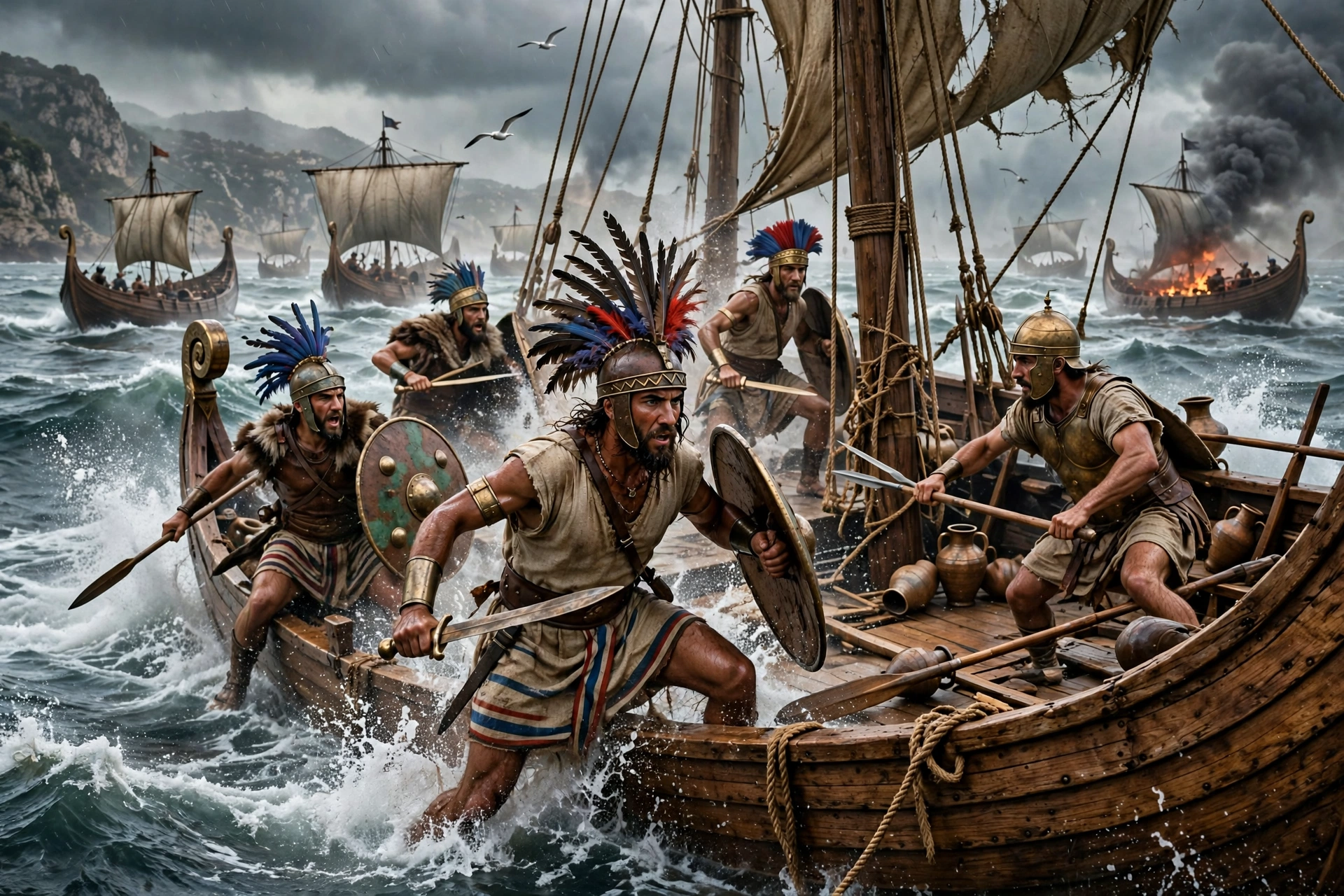
Around 1178 BC, Pharaoh Ramesses III of Egypt faced a terrifying threat. According to carvings on his temple at Medinet Habu, waves of foreign invaders attacked Egypt by land and sea. The Egyptians called them by strange names: the Peleset, Tjeker, Shekelesh, Denyen, and Weshesh.
For over a century, historians identified these attackers as the Sea Peoples — mysterious seafaring raiders blamed for destroying civilizations across the eastern Mediterranean and triggering the Bronze Age collapse.
But in recent decades, scholars have questioned this story. Was there really a coordinated invasion? Were the Sea Peoples even a real, unified group? Or did historians invent a simple explanation for a complex disaster?
The Sea Peoples theory took shape in the late 1800s when archaeologists translated Egyptian inscriptions. The Medinet Habu carvings described Ramesses III’s victories in dramatic terms: “The foreign countries made a conspiracy in their islands… No land could stand before their arms.”
Early scholars connected these Egyptian accounts with destruction layers found at cities across the region — Ugarit, Hattusa, and Mycenaean palaces all burned around the same time. The conclusion seemed obvious: seaborne invaders swept through the Mediterranean, destroying everything in their path.
By the mid-1900s, the Sea Peoples were the standard explanation for the Bronze Age collapse. Textbooks described them as a vast confederation of raiders from the Aegean, western Mediterranean, or beyond. They were blamed for:
It was a simple, dramatic story. And for a long time, almost everyone believed it.
Whatever else is debated, the Egyptian evidence is genuine. The Medinet Habu inscriptions are not myths — they are contemporary records carved during Ramesses III’s reign. They describe real battles with named foreign groups.
Egyptian art shows these enemies distinctly: some wear feathered helmets, others horned helmets. They came in ships and in ox-carts with families — suggesting whole peoples on the move, not just raiding parties.
Additional Egyptian texts, including the Papyrus Harris, confirm that Ramesses III fought major battles against foreigners around 1178 BC. Something real happened.
One Sea Peoples group, the Peleset, is widely identified with the Philistines of the Bible. After the collapse period, the Philistines established five cities on the southern coast of Canaan. Their pottery, architecture, and culture show Aegean influences — consistent with newcomers from the west.
This is strong evidence that at least some “Sea Peoples” were real migrants who settled in new lands.
Cities really did burn around 1200–1175 BC. Ugarit’s destruction was sudden and total. Hattusa was set ablaze. These were not gradual declines — they were violent ends. Someone attacked these cities, even if we debate exactly who.
Pharaohs were not objective reporters. Egyptian royal inscriptions were propaganda designed to glorify the king. Ramesses III had every reason to exaggerate the threat he defeated — the bigger the enemy, the greater his victory.
Some scholars argue the “invasion” may have been smaller and less organized than the carvings suggest. A few thousand raiders can look like a vast horde in royal propaganda.
The traditional theory imagines the Sea Peoples sweeping through like a tsunami. But archaeology shows the destructions happened over decades, not all at once. Some cities burned in 1200 BC, others in 1180, others in 1150.
A single invading force does not explain destructions spread across 50+ years. The pattern looks more like a long period of instability than one invasion.
Some destroyed cities show no evidence of foreign attackers. At Hattusa, the Hittite capital, there are signs the city was abandoned before it burned — possibly by its own people. Some Mycenaean palaces may have been destroyed in local conflicts, not by outsiders.
If the Sea Peoples destroyed everything, why do some destructions look like inside jobs?
Despite 150 years of research, no one has found the Sea Peoples’ homeland. Were they from Sardinia? The Aegean? Western Anatolia? Every theory has problems.
Some scholars now suggest the “Sea Peoples” were not a unified group at all, but a mix of different peoples — mercenaries, refugees, pirates, and migrants — lumped together by Egyptian scribes who did not distinguish between them.
Here is the most radical revision: what if the Sea Peoples were refugees fleeing the same disasters that destroyed the great kingdoms? Drought, famine, and earthquakes may have driven people from their homes. Desperate and hungry, they migrated, raided, and fought — not as conquerors, but as survivors.
In this view, the Sea Peoples were a symptom of the collapse, not its cause.
Archaeological evidence increasingly supports this perspective. Studies of ancient pollen and sediment show a severe centuries-long drought gripped the eastern Mediterranean right when the destructions began. Crops failed. Wells dried up. Entire regions could no longer feed their people.
When farmers cannot grow food, they have three choices: starve, submit to whoever has food, or move. Many chose to move. Armed groups of hungry migrants would look exactly like invaders to the kingdoms they descended upon — even if they started as desperate families.
Egyptian art itself hints at this. The famous Medinet Habu reliefs do not just show warriors — they show ox-carts loaded with women, children, and household goods. This is not what a professional invasion army looks like. It looks like entire communities on the move, carrying everything they owned because they had nowhere to go back to.
This does not mean the Sea Peoples were harmless. Desperate people can be extremely dangerous. A starving army with nothing to lose fights with terrifying ferocity. The cities they attacked experienced real violence and real destruction. But understanding their possible desperation changes the moral of the story — from one of evil invaders versus noble kingdoms to a tragedy where climate disaster turned neighbors into enemies.
Most historians today have not abandoned the Sea Peoples entirely — they have put them in context. The current consensus looks something like this:
1. Foreign attackers were real. Egyptian records and the Philistine settlements prove that migrations and attacks happened.
2. But they were not the sole cause. Drought, earthquakes, internal rebellions, and economic breakdown all played roles.
3. There was no single invasion. The crisis unfolded over decades with many different actors.
4. The Sea Peoples may have been diverse. Not one people, but many groups moving for different reasons.
Many scholars now favor a systems collapse explanation. The Bronze Age kingdoms were highly interconnected — like a row of dominoes. When one fell (due to drought, earthquake, or rebellion), it disrupted trade that others depended on. Those kingdoms weakened, making them vulnerable to attacks, rebellions, or further disasters.
In this model, the Sea Peoples were one falling domino among many — important, but not the whole story.
| Aspect | Traditional Theory (1900s) | Modern Scholarship |
|---|---|---|
| Who they were | Unified confederation of raiders | Diverse groups: migrants, mercenaries, refugees |
| Their role | Main cause of the collapse | One factor among many |
| Timeline | Single invasion wave | Decades of instability |
| Organization | Coordinated military campaign | Uncoordinated movements |
| Motivation | Conquest and plunder | Possibly desperation and survival |
| Evidence base | Egyptian inscriptions taken literally | Egyptian + archaeological + climate data |
| Certainty | Presented as established fact | Acknowledged as partly speculative |
The Sea Peoples debate is really about how we understand historical disasters. The old theory offered a simple villain: mysterious invaders destroyed civilization. The new understanding is messier — climate, economics, politics, and migration all interacting.
This matters because we face similar complex crises today. Understanding that the Bronze Age collapse had many causes helps us think about our own vulnerabilities.
The Sea Peoples theory was appealing because it was simple. But simplicity can be misleading. By blaming everything on invaders, earlier historians overlooked droughts, earthquakes, and internal problems that may have been more important.
Good history requires holding multiple causes in mind at once — even when a single dramatic explanation is more exciting.
Yes — Egyptian inscriptions from Ramesses III’s reign describe battles with foreign groups, and the Philistines (likely the Peleset) settled in Canaan afterward. But they were probably not the unified invasion force older textbooks described.
It means scholars have seriously challenged the traditional claim that the Sea Peoples were the main cause of the Bronze Age collapse — not that foreign attackers never existed.
Unknown. Egyptian records name groups (Peleset, Tjeker, Shekelesh, Denyen, Weshesh) but no individual leaders. This is one reason scholars doubt they were a unified force.
The Philistines were likely one Sea Peoples group (the Peleset). They settled on Canaan’s coast and built five cities. But the Philistines were just one group among several mentioned in Egyptian records.
Possibly, but the evidence is unclear. Some Mycenaean destructions might have been caused by outsiders, but others look like local conflicts. There is no definitive proof linking specific Greek destructions to the Sea Peoples. For the fuller picture of how these mysterious raiders operated, see our article on how the Sea Peoples toppled great empires.
Most scholars now favor multiple causes: drought and famine, earthquakes, internal rebellions, breakdown of trade networks, AND attacks by groups including the Sea Peoples. No single cause explains everything. Our overview of what happened after the Bronze Age collapse traces the full aftermath.
It was simple, dramatic, and based on impressive Egyptian monuments. It took decades of new archaeological discoveries and climate research to build a more complex picture.
Absolutely. Archaeology is always evolving. New excavations, better dating techniques, or translated texts could reshape our understanding. That is how good history works. Mysterious ancient puzzles like the Nazca Lines remind us how much we still have to learn about the ancient world.