Physical Address
4676 Railroad Street Marquette
MI 49855
Physical Address
4676 Railroad Street Marquette
MI 49855

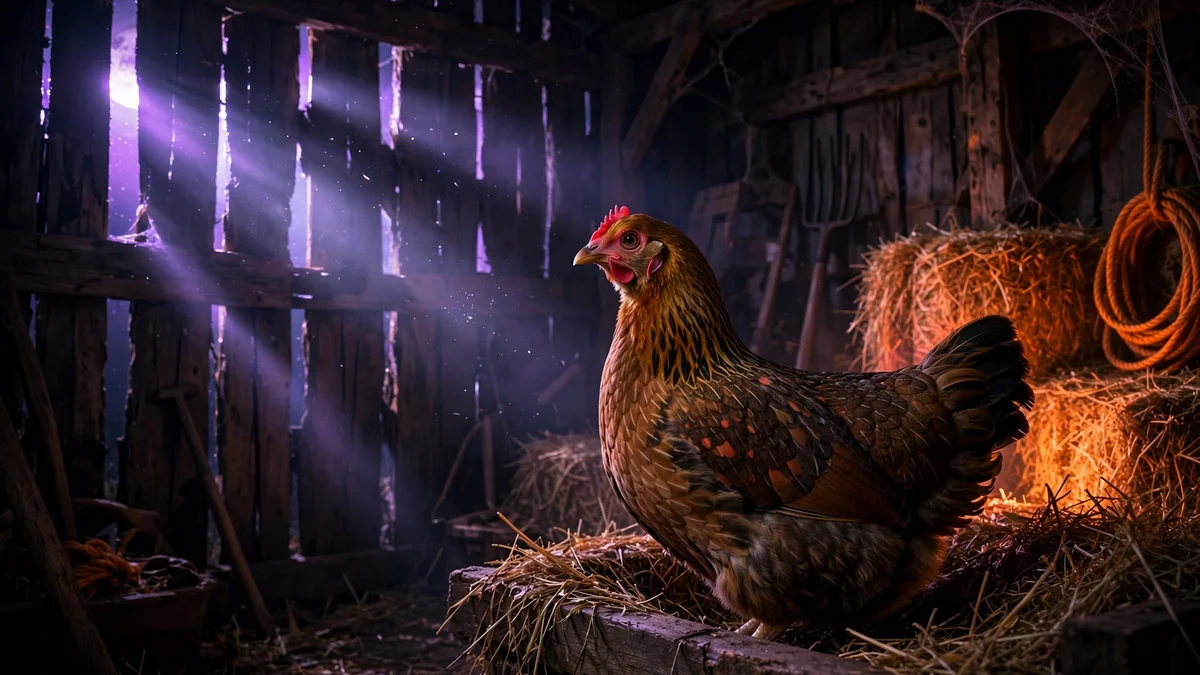
No — chickens see very poorly in the dark. They have few rod cells for dim light and are essentially blind after sunset. But in daylight their vision is extraordinary: four color channels including ultraviolet, flicker detection humans can’t perceive, and nearly panoramic sight. That’s why they roost before dusk.
If you’ve ever tried to move a chicken after dark, you know the truth: they freeze. A chicken in darkness becomes still, quiet, and helpless. You can pick one up off its perch at midnight and it barely reacts.
This isn’t stubbornness — it’s biology. Chickens have very few rod cells in their retinas, the photoreceptors responsible for low-light vision. Where an owl packs 56,000 rods per square millimeter, a chicken has only a fraction of that. When light fades, their visual world simply switches off.
Farmers have known this forever. It’s why chicken coops don’t need locks the way you’d expect — once it’s dark, the birds are immobilized by their own vision. Predators like foxes and raccoons know this too, which is why secure housing matters so much.
Chickens descend from the red junglefowl of Southeast Asia — a forest bird active by day. Their ancestors foraged on the forest floor in daylight, roosted in trees at night, and never needed night vision.
Evolution invests in what a species uses. For junglefowl, daylight color vision for finding food and spotting mates mattered far more than seeing in the dark. Night was for hiding, not hunting. So their eyes optimized for bright-light performance and let night vision atrophy.
Domestication didn’t change this. Eight thousand years of living with humans — who also sleep at night — only reinforced the pattern. A chicken that can’t see in the dark is a chicken that stays put, stays safe, and is easy to manage.
What chickens lose at night, they more than gain by day. Chicken vision is, in several ways, superior to human vision.
Tetrachromatic color vision. Humans have three types of cone cells (red, green, blue). Chickens have four — including one sensitive to ultraviolet light. This means chickens see colors we can’t even imagine, plus UV patterns on flowers, insects, and each other’s feathers that are invisible to us.
Flicker detection. Humans see a light flickering above about 60 times per second as steady. Chickens detect flicker up to 100+ times per second. This is why fluorescent lights, which flicker imperceptibly to us, can stress chickens — they see the strobing clearly.
Near-panoramic view. A chicken’s eyes sit on the sides of its head, giving roughly 300 degrees of vision — nearly all the way around. Only a small blind spot exists directly behind the head. This wide field helps spot predators approaching from any direction.
Independent eye movement. Chickens can move each eye separately, scanning different areas simultaneously. One eye watches the ground for food while the other scans the sky for hawks.
Chickens have a light-sensitive pineal gland on top of the brain — sometimes called the “third eye.” In reptiles and birds, this gland detects light levels directly through the thin skull, even with eyes closed.
The pineal gland drives the chicken’s circadian rhythms: when to wake, when to forage, when to roost, when to lay eggs. It’s exquisitely sensitive to dawn and dusk light changes, which is why chickens operate on such a strict solar schedule.
This is also why artificial lighting manipulates laying. Commercial farms extend “daylight” with lamps to trick the pineal gland into thinking days are longer, keeping hens laying through winter. The third eye can’t tell the difference.
Watch chickens in the late afternoon and you’ll see urgency. As the light fades, they hurry toward the coop or their favorite roosting branches, jostling for the best spots. Stragglers run. This isn’t random — it’s survival instinct.
A chicken caught on the ground after dark is defenseless. It can’t see predators, can’t find shelter, can’t navigate. Every instinct screams: get high, get inside, get settled BEFORE the light fails.
The roosting order follows the pecking order. Dominant birds claim the highest, safest perches. Lower-ranking chickens take what’s left. Once settled, they tuck heads, fluff feathers, and go still — conserving energy until dawn restores their vision.
If you lock chickens out accidentally at dusk, you’ll find them huddled against the coop door in the morning — they spent the night frozen in place, too blind to move.
The transition isn’t instant. Chickens go through a twilight phase where vision degrades gradually:
This gradient is why the pre-sunset rush looks panicked. The birds can feel their vision failing in real time and know exactly what’s coming.
Interestingly, chickens see better in the blue-ish light of early dawn than the orange light of dusk, because their UV-sensitive cones respond more to short wavelengths. Dawn feels “brighter” to them than dusk at the same light level.
A chicken’s night blindness is the single biggest reason for coop security. Common nighttime predators all exploit it:
A sleeping chicken can’t detect any of them until contact. This is why hardware cloth (not chicken wire), locked doors, and solid floors matter. The birds cannot protect themselves after dark — the coop must do it for them.
Motion-sensor lights help somewhat. A sudden bright light can startle a predator and may partially wake chickens, but don’t rely on it — a truly dark-adapted predator recovers fast.
Baby chicks hatch with functional but immature vision. Their cone cells develop over the first weeks, and color discrimination sharpens with age.
Newly hatched chicks are even more light-dependent than adults. They need bright light to find food and water — this is why brooders use heat lamps that also provide illumination. In dim conditions, chicks peep distress calls and huddle instead of eating.
By 4 to 6 weeks, a chick’s vision approaches adult capability, including the UV sensitivity. But night blindness is present from day one — chicks freeze in the dark just like adults.
Not really. Night vision is hardware-limited by rod cell count, and no diet or supplement changes retinal anatomy.
What you CAN do:
| Feature | Chickens | Owls |
|—|—|—|
| Night vision | Nearly none | Exceptional |
| Color channels | 4 (incl. UV) | ~1-2 (poor color) |
| Rod density | Very low | Extremely high |
| Eye position | Side (300° view) | Front (binocular) |
| Flicker detection | 100+ Hz | Lower |
| Active hours | Day | Night |
They’re mirror images — each perfect for its lifestyle, useless for the other’s.
The most alien part of chicken vision is the fourth cone — the one sensitive to ultraviolet light. Humans can’t see UV at all, so imagining a chicken’s world requires some creativity.
Many things look completely different in UV. Flowers display bold landing-strip patterns for pollinators that are invisible to us — and chickens see them. Insects that look dull brown to us may blaze with UV markings. Even chicken feathers themselves carry UV patterns: a rooster that looks plain red-brown to us displays shimmering UV signals to hens, who use them to judge his health and quality as a mate.
Researchers have shown that hens prefer roosters with stronger UV reflectance, and they can spot the difference between a healthy bird and a sick one partly through these invisible channels. What looks like a plain barnyard to us is, to a chicken, a world painted in colors we don’t have names for.
This UV vision also helps chickens find food. Many seeds and berries reflect UV strongly against green foliage, making them pop out like neon signs. A chicken pecking with precision at tiny seeds is partly navigating by ultraviolet beacons we can’t perceive.
Essentially yes. They have so few rod cells that once light drops below twilight levels, they can’t navigate or detect threats. They freeze in place until dawn.
Instinct. They feel their vision fading and know darkness means helplessness. The pre-dusk rush is a survival behavior — get to safety while you can still see.
In some ways, yes. Their four cone types (including UV) let them see colors and patterns invisible to us. A rooster’s feathers, dull to human eyes, blaze with UV patterns to a hen.
A dim light on a timer can help, but chickens also need dark rest for healthy sleep and laying cycles. Most keepers use no light or a brief dusk-extension timer, not all-night illumination.
Partly calm, partly a freeze response. Being lifted mimics predator capture, and many chickens go still with eyes half-closed. Gentle handling and regular contact reduce this reaction.
No — the pineal gland detects light levels for circadian rhythms, but it doesn’t form images. It tells the chicken whether it’s day or night, not what’s around them.
They experience REM-like sleep states, so probably. Sleeping chickens twitch and make soft sounds, similar to other birds. What a chicken dreams about — corn? hawks? — remains a mystery.
Chickens detect flicker up to 100+ times per second; cheap fluorescents flicker at 100-120 Hz, visible to chickens as strobing. This causes stress. LEDs with high-frequency drivers or incandescent bulbs are kinder.




[…] Can Chickens See In The Dark […]