Physical Address
4676 Railroad Street Marquette
MI 49855
Physical Address
4676 Railroad Street Marquette
MI 49855

Ask a farmer if chickens can fly and you might get a laugh. Chickens are the classic flightless farm bird, right? They waddle around the barnyard, peck at the ground, and sleep in a coop. Flying seems about as likely as a pig doing ballet.
But the truth is more interesting. Chickens can fly. They have wings, feathers, and all the basic equipment. What they lack, thanks to thousands of years of human breeding, is the body design for sustained flight. A chicken’s flight is short, low, and a little bit panicked. But it is real flight, and in the right circumstances, it can surprise you.
Let us look at what chickens can actually do in the air, why domestication clipped their wings (figuratively), and which chickens fly best.
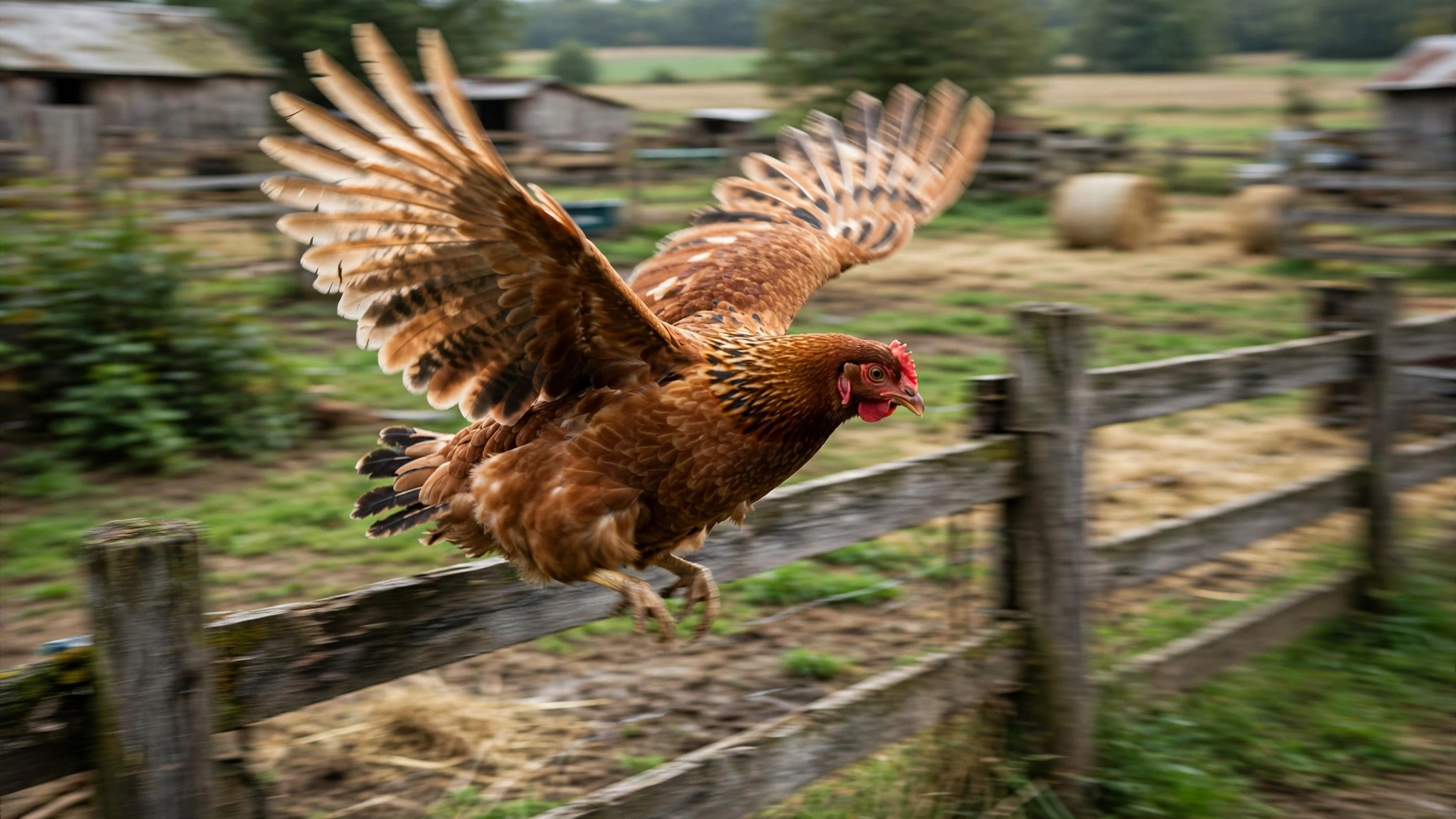
When a chicken “flies,” it is not soaring like an eagle or gliding like a bird in V-formation. It is an explosive, flapping burst. The chicken launches itself upward with powerful wingbeats, rises 10 to 15 feet into the air, travels 30 to 50 feet forward, and then more or less falls back to earth in a semi-controlled landing.
The whole thing lasts a few seconds. It is loud, frantic, and not particularly graceful. But it gets the job done. A chicken that needs to escape a dog, reach a high roost, or get over a fence can absolutely do it.
Farmers know this well. Anyone who has kept chickens has a story about a hen that cleared a six-foot fence “even though chickens can’t fly.” They can. They just prefer not to, most of the time.
The exact numbers depend on the breed, the individual bird, and its motivation. A frightened lightweight hen might burst 15 feet up and sail 50 feet or more. A heavy meat breed might manage a two-foot hop and call it a day.
Wild red junglefowl, the undomesticated ancestor of all chickens, are notably better fliers. They roost in trees at night to escape predators, flying up 20 to 30 feet without trouble. Domestication has dulled this ability, but the basic machinery is still there.
Young chickens fly better than old ones. Lighter breeds fly better than heavy ones. And a chicken with a full set of flight feathers, unclipped and healthy, will always outperform one that has been trimmed.
Chickens were domesticated from red junglefowl around 8,000 years ago in Southeast Asia. From the start, humans selected birds for the traits they wanted: more meat, more eggs, calmer temperaments. Nobody was selecting for flight ability. In fact, poor fliers were probably preferred, since they were easier to keep contained.
Over thousands of generations, this selection reshaped the chicken’s body. Breast muscles grew enormous relative to wing size. Body weight increased dramatically. The wings stayed roughly the same size, which meant the ratio of weight to wing area, called wing loading, skyrocketed.
High wing loading is the enemy of flight. It is why a jumbo jet needs a long runway and why a sparrow can take off vertically. Modern chickens, especially meat breeds, have some of the highest wing loading of any bird their size. Their wings simply cannot generate enough lift for sustained flight.
A red junglefowl weighs about 2 pounds. A modern broiler chicken, bred for meat, can weigh 8 to 10 pounds at slaughter age, on wings barely larger than its wild ancestor’s. That is like asking a human to fly with the wings of a large eagle. The physics do not work.
Egg-laying breeds are lighter, usually 4 to 6 pounds, and they fly somewhat better. But even the lightest domestic chicken is a heavyweight compared to wild birds of similar wingspan. Domestication traded flight for food, and the trade was permanent.
This is a common pattern in domestic animals. Just as cats kept their hunting instincts but changed in other ways, chickens kept the shape of a flying bird but lost the performance.
Not all chickens are equally grounded. Some breeds retain far more flight ability than others. The best fliers tend to be small, light, active breeds close to the wild type.
Leghorns, the classic white egg-laying breed, are excellent fliers by chicken standards. They are light, nervous, and athletic. A Leghorn that wants over a fence will get over a fence. Anconas, Minorcas, and many bantam breeds are similarly capable.
Bantams deserve special mention. These miniature chickens, often under 2 pounds, have a much better weight-to-wing ratio. Some bantams can fly genuinely well, covering 100 feet or more and reaching the tops of trees. Owners of bantams often need covered runs because the birds simply will not stay put otherwise.
At the other end of the scale are the heavy breeds. Orpingtons, Brahmas, Cochins, and especially Cornish Cross broilers are barely capable of getting airborne. A large Brahma rooster might weigh 12 pounds. Its flight consists of jumping onto a low perch and feeling proud of itself.
These breeds were designed for maximum meat on minimum movement. Flight was the opposite of what breeders wanted. The result is a bird that is essentially flightless in practice, even though its wings look normal.
| Breed Type | Typical Weight | Flight Ability | Max Height | Max Distance |
|---|---|---|---|---|
| Wild junglefowl | ~2 lbs | Good | 20-30 ft | 100+ ft |
| Light layers (Leghorn) | 4-5 lbs | Moderate-good | 10-15 ft | 40-60 ft |
| Bantams | 1-2 lbs | Good-excellent | 15-20 ft | 80-100 ft |
| Dual-purpose (Rhode Island Red) | 6-8 lbs | Poor-moderate | 5-10 ft | 20-40 ft |
| Heavy meat breeds | 8-12 lbs | Very poor | 2-4 ft | 10-20 ft |
Because even mediocre fliers can clear fences, many chicken keepers clip one wing. This involves trimming the long primary flight feathers on a single wing. With lift unbalanced, the chicken cannot get airborne. It is painless, like trimming fingernails, and the feathers grow back after molting.
Clipping one wing rather than both is deliberate. A chicken with one clipped wing flies in circles and gives up. A chicken with both wings clipped evenly can sometimes still manage a balanced, if weak, flight. Asymmetry is the key.
This is a routine part of backyard chicken keeping. It does not hurt the bird, does not affect egg laying, and prevents the heartbreak of a hen wandering into traffic or a neighbor’s dog.
Chickens do not seem distressed by clipped wings. They go about their business, perhaps attempting the occasional doomed takeoff before remembering the situation. Since most domestic chickens rarely try to fly far anyway, the practical impact on their daily lives is small.
This is very different from the debate over pinioning flamingos, which is permanent. Wing clipping in chickens is temporary and reversible, and the birds’ welfare does not appear to suffer.
To understand what chickens lost, look at the red junglefowl. These wild birds, still found in the forests of Southeast Asia, are recognizably chicken-like but distinctly wilder. They are smaller, leaner, and far more alert than any barnyard hen.
Red junglefowl fly to roost every night. As dusk falls, they burst from the forest floor into the trees, sometimes 30 feet up, and settle on branches to sleep safe from ground predators. In the morning, they glide back down. This daily commute is something no domestic chicken could manage.
They also fly to escape danger. A junglefowl surprised by a predator explodes into the air with a cackle, flying 100 feet or more through the forest before landing and running. It is quick, agile flight, nothing like the barnyard flutter.
The transformation from junglefowl to modern chicken is one of the most dramatic in domestication. Body weight tripled or quadrupled. Breast muscle mass exploded. Temperament shifted from flighty to docile. Egg production went from a dozen a year to 300.
Flight ability was collateral damage. Nobody set out to create a flightless chicken. It just happened as a side effect of selecting for everything else. The wings stayed, the instinct to flap stayed, but the physics stopped working.
The longest recorded chicken flight lasted 13 seconds and covered about 300 feet. That is the official record, set by a bantam hen. Thirteen seconds does not sound like much, but for a bird that most people think cannot fly at all, it is impressive.
Chickens have also been known to fly into some odd places. There are reports of hens landing on roofs, in trees, and once, memorably, in the cockpit area of a small parked airplane. The chicken was unharmed and, according to the pilot, “looked pleased with herself.”
Even poor-flying chickens retain the ancient instinct to roost off the ground. Given the chance, most chickens will climb or flutter up to the highest perch available to sleep. This is a leftover from wild days when the ground meant danger after dark.
Chicken keepers use this instinct by providing roosting bars in coops. The birds hop up at dusk and settle in a row, just as their wild ancestors settled on branches. It is one of the most unchanged behaviors in the domestic chicken.
Yes, but not well. Most domestic chickens can flutter 10 to 15 feet high and travel 30 to 50 feet in a short burst. They cannot sustain flight like wild birds because centuries of breeding made their bodies too heavy for their wings.
It depends on the breed. Light breeds like Leghorns can reach 10 to 15 feet. Bantams may reach 15 to 20 feet. Heavy meat breeds struggle to get more than 2 to 4 feet off the ground. Wild junglefowl can fly 20 to 30 feet up into trees.
Domestication is the reason. Humans bred chickens for large bodies and heavy breast muscles for meat, and for high egg production. The wings did not grow proportionally, so the birds became too heavy to generate enough lift for sustained flight.
Light, active breeds fly best: Leghorns, Anconas, Minorcas, and most bantam breeds. Bantams, being miniature, have the best weight-to-wing ratio and some can fly 80 to 100 feet. Heavy breeds like Orpingtons, Brahmas, and Cornish Cross are the worst fliers.
Many backyard keepers clip one wing to prevent escapes over fences. It involves trimming the long flight feathers on one side, which unbalances the bird so it cannot take off. It is painless, like trimming nails, and feathers regrow after molting.
The red junglefowl, the wild ancestor of domestic chickens, is a capable flier. It flies up into trees to roost every night and can cover 100 feet or more when escaping predators. Domestication, not nature, took this ability away from farm chickens.
The recorded record is 13 seconds, covering about 300 feet, set by a bantam hen. Typical domestic chickens stay airborne for 2 to 5 seconds during their short bursts. They are sprinters, not marathoners, in the air.
Chickens do not seem to seek out flying for fun, but they retain the instinct to get to high places to roost and to escape danger. Most are content on the ground, which is where their food is. Their limited flight is a tool, not a joy.