Physical Address
4676 Railroad Street Marquette
MI 49855
Physical Address
4676 Railroad Street Marquette
MI 49855

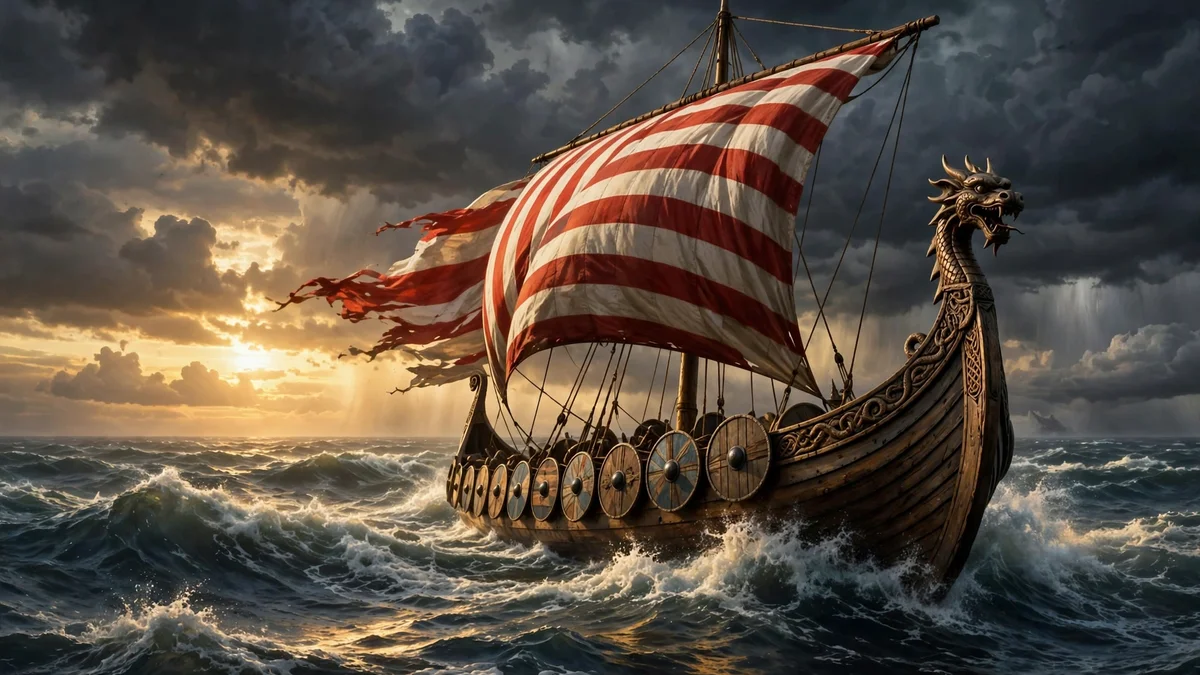
Viking longships were long, narrow wooden ships built with overlapping oak planks riveted together in the clinker method, giving them a light, flexible hull. With a shallow draft of about one meter, a single square sail, and oars, they could cross oceans yet land on beaches and sail up rivers. The Gokstad ship, built around 890 AD and 24 meters long, is the finest surviving example of this technology that let Vikings raid, trade, and explore from America to Central Asia.
The Viking Age was a ship age. Without the longship, there would have been no raids on England, no settlement of Iceland, no voyage to America, no trade routes to Baghdad. The ship was the technology that made everything else possible.
What made the longship special was not any single feature but the combination. It was fast under sail and maneuverable under oars. It could cross the open Atlantic yet float in a meter of water. It was strong enough for ocean storms yet light enough to be carried over land. No other ship of the 800s could do all of these things.
The Vikings understood this. Their laws valued ships above almost all other property. Their poetry praised ships as living things. Their richest men were buried in them. The ship was the center of Viking civilization.
The defining feature of Viking shipbuilding was the clinker-built hull. Instead of fastening planks edge to edge over a frame, Viking shipwrights overlapped the planks like the siding of a house, riveting them together with iron nails.
Construction began with the keel, a single massive oak timber that formed the ship’s backbone. Then the shipwrights added the planks, called strakes, working upward from the keel on each side. Each strake overlapped the one below it, and iron rivets, clenched over small square washers called roves, held them fast. The seams were caulked with animal hair or moss soaked in tar to keep water out.
Only after the shell was complete did the builders add the internal frames and crossbeams, fitting them to the hull rather than building the hull around them. This shell-first method was the opposite of later Mediterranean shipbuilding, and it gave the hull a crucial quality: flexibility.
A clinker-built hull could flex and twist with the waves instead of fighting them. In a North Atlantic storm, this flexibility was the difference between survival and destruction. The ship moved with the sea rather than against it. Modern reconstructions have proven how seaworthy these vessels were, crossing the Atlantic in replica voyages.
The planks themselves were works of art. Shipwrights split oak logs along the grain with wedges rather than sawing them, producing planks that followed the wood’s natural strength. A single strake could run the length of the ship, and the finest planks were thin, light, and incredibly tough.
A classic longship like the Gokstad ship measured about 24 meters long and 5 meters wide. It carried 32 pairs of oars, meaning a crew of at least 64 rowers plus officers and lookouts. It was double-ended, with graceful curving stem and stern posts that rose high above the water.
The keel was shallow and the hull had almost no deep keel fin. This gave the ship its famous shallow draft: about one meter. A longship could sail in water barely deeper than a man’s waist. This meant it could land directly on beaches, slip up shallow rivers, and escape into waters where deeper enemy ships could not follow. It was the key to the Viking raiding strategy: strike without warning from the sea, then vanish.
Propulsion came from two sources. The primary power was a single square sail, woven from wool and often dyed in red and white stripes. A large sail might measure 90 to 120 square meters. The mast was a single pine trunk, stepped in a massive oak block called the keelson, and could be lowered when rowing or passing under bridges.
When the wind failed or maneuvering was needed, the crew rowed. Oars passed through oar holes cut in the upper strake, fitted with small wooden shutters. A well-trained crew could row the ship at 5 to 7 knots; under sail in good wind, replicas have reached 11 knots or more, astonishing speed for the age.
Steering was done with a single side rudder, a large oar mounted on the right side of the stern. The Old Norse word was stjórnarði, “steer-board,” and it is the origin of our word “starboard.” The left side, the side turned toward the dock when the steerboard was on the far side, became “port.”
Three great Viking ships survive, all found in Norwegian burial mounds, and each tells a different story.
The Oseberg ship, discovered in 1904, was built around 820 AD. At 22 meters long, it is the most beautiful, with exquisite carved decoration on its stem and stern. But it was lightly built, a royal yacht rather than a warship. It held the burial of two women, one likely a queen, with a rich array of grave goods: beds, chests, tools, and even a cart.
The Gokstad ship, found in 1880, was built around 890 AD and is the classic ocean-going longship. At 24 meters with 32 oar pairs, it was a true warship and cargo carrier. It held the burial of a powerful chieftain, laid in a bedchamber built on the deck, surrounded by his weapons, horses, dogs, and even a peacock. A replica of the Gokstad ship crossed the Atlantic in 1893, proving the design’s ocean capability.
The Tune ship, found in 1867, survives only in fragments but was similar in size and date to the others.
These ships were preserved by the blue clay of their burial mounds, which sealed out air and decay. They are among the greatest archaeological treasures of the Viking world.
Not every Viking ship was a longship. The Norse built several types for different purposes.
The snekkja, or “snake,” was a smaller, faster warship, the workhorse of raiding fleets. The skeið, or “skid,” was a larger warship, the battleship of its day, sometimes carrying over 100 men.
The knarr was the cargo ship: shorter, broader, deeper, and slower, built to carry goods rather than warriors. Knarrs carried settlers and livestock to Iceland, Greenland, and beyond. The voyage to America was almost certainly made in knarrs, not longships, since colonists needed cargo space.
The byrðing and ferja were smaller coastal traders and ferries. The Vikings had a ship for every purpose, and their shipwrights adjusted the design with the skill of modern engineers.
How did the Vikings navigate the open sea without compasses or charts? The question has fascinated scholars for generations, and the answer combines practical seamanship with some remarkable techniques.
By day, they sailed by the sun. A simple but effective tool was the sun compass: a wooden disc with a central pin, whose shadow traced curves that indicated direction. A fragment of such a device was found in Greenland.
The most debated tool is the sunstone, or sólarsteinn, mentioned in the sagas. Some researchers believe it was a crystal of calcite, Iceland spar, which can locate the sun by polarization even through clouds or after sunset. Experiments have shown the method works, and a calcite crystal was found in an Elizabethan shipwreck, though no Viking Age example has been confirmed. The sunstone remains plausible but unproven.
By night, they steered by the stars, particularly the North Star. They also read the sea itself: the flight of birds, the behavior of whales, the color and smell of the water, the pattern of waves around distant land. A skilled navigator could smell land before seeing it and read the sky like a book.
Most Viking voyages were not blind leaps into the unknown. They followed known routes, hopping from landmark to landmark: Norway to Shetland, Shetland to the Faroes, the Faroes to Iceland. Each leg was short enough that a mistake would not be fatal. The great voyages of exploration extended these routes step by step.
No complete Viking shipbuilding tradition survived into the modern age, but experimental archaeology has revived it. Shipwrights using only Viking Age tools have built full-size replicas, including the famous Sea Stallion from Glendalough, a reconstruction of the Skuldelev 2 warship.
These projects revealed how much skill the original builders had. Splitting planks from oak with wedges, shaping them with axes and adzes, riveting thousands of iron nails, all without plans or measurements, was master craftsmanship. A large longship represented thousands of hours of expert labor and the resources of a chieftain or king.
The reconstructions also proved the ships’ performance. Replicas have crossed the Atlantic, rounded the North Cape, and sailed the old routes to Dublin and beyond. The Viking shipwrights knew exactly what they were doing.
They were clinker-built: overlapping oak planks riveted with iron nails, constructed shell-first around a single oak keel, then fitted with internal frames. Seams were caulked with tarred animal hair. The method produced a light, flexible hull ideal for northern seas.
The Gokstad ship, the classic example, was about 24 meters (79 feet) long and 5 meters wide, with 32 pairs of oars. Sizes varied: small raiding snekkjas were shorter, while great warships could exceed 30 meters.
Under sail in good wind, reconstructions have reached 11 knots or more. Under oars, 5 to 7 knots was typical. This made them among the fastest ships of their age.
Viking ships were steered with a large oar on the right side, called the stjornardi or “steer-board” in Old Norse. English “starboard” descends directly from this word. The left side became “port” because it faced the dock.
No magnetic compasses. They navigated by the sun, stars, landmarks, and reading natural signs like birds and wave patterns. The debated “sunstone” (a polarizing crystal) may have helped find the sun through clouds, but this is unproven.
Yes. The Gokstad replica crossed the Atlantic in 1893, and modern reconstructions have repeated the feat. The Norse settled Iceland, Greenland, and briefly North America, which required reliable ocean crossings.
The longship was long, narrow, and fast, built for war and raiding. The knarr was shorter, broader, and deeper, built to carry cargo and settlers. Colonization voyages used knarrs, not warships.