Physical Address
4676 Railroad Street Marquette
MI 49855
Physical Address
4676 Railroad Street Marquette
MI 49855

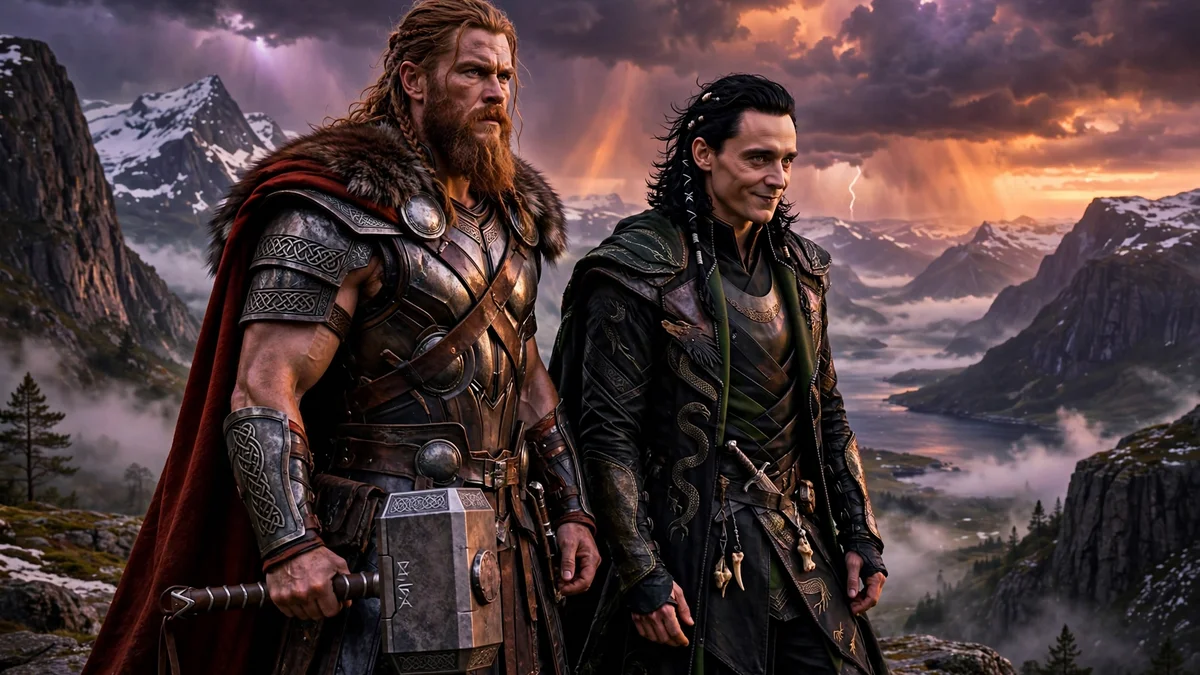
Thor and Loki are Norse mythology’s most famous pair — the mighty thunder god and the cunning trickster who journey together through the Nine Worlds. Their best stories include Loki cutting Sif’s hair, Thor dressing as a bride to win back his stolen hammer Mjolnir, their fishing trip to catch the world serpent Jormungandr, and their visit to the giant king Utgarda-Loki. These tales mix comedy, danger, and deep lessons about pride, cleverness, and friendship.
Thor is the strongest god in Asgard. He swings the hammer Mjolnir, rides a chariot pulled by goats, and smashes giants with terrifying ease. Loki is the opposite — slim, silver-tongued, and always scheming. He is not evil, exactly, but he cannot resist a clever trick, even when it puts everyone in danger.
Yet these two travel together constantly. In the old Norse poems, Thor almost never goes on a journey without Loki at his side. It is one of mythology’s strangest partnerships: the hammer and the whisper, the muscle and the mind. And their stories together are some of the funniest, wildest tales ever told.
Thor could crush any enemy, but he could not outsmart a locked door. Time and again, the myths show Thor charging into trouble that only Loki’s cunning can solve. Loki, for his part, needs Thor’s protection — because his tricks constantly anger people far stronger than he is.
Their dynamic is simple: Loki causes the problem, Thor suffers through it, and together they fix it. This pattern repeats across nearly every story they share. It is comedy gold, but it also says something real about how strength and cleverness need each other.
One night, Loki sneaks into Thor’s bedroom and shaves off all of Sif’s beautiful golden hair — just as a prank. Thor wakes up, sees his wife bald, and grabs Loki by the throat. He threatens to break every bone in Loki’s body unless he fixes it.
Terrified, Loki promises to get Sif even better hair — real gold that grows like normal hair. To do this, he must visit the dwarves, the master craftsmen who live underground. This one prank sets off a chain of events that leads to the creation of Thor’s hammer, Odin’s spear, and many of the gods’ greatest treasures.
What it teaches: Even “harmless” pranks have consequences, and clever people must clean up their own messes.
The giant Thrym steals Thor’s hammer Mjolnir and hides it deep underground. He demands the goddess Freyja as his bride in exchange. The gods hold a council, and Loki comes up with a plan: Thor will dress as Freyja, wearing a bridal veil, and Loki will go along as his “bridesmaid.”
Thor is horrified. The mighty thunder god in a wedding dress? But he has no choice — without his hammer, Asgard is defenseless. At the wedding feast, “Freyja” eats an entire ox, eight salmon, and drinks three barrels of mead. Thrym is suspicious, but Loki quickly explains that the bride has been fasting for eight days out of excitement.
When Thrym finally brings out the hammer to bless the marriage, Thor grabs it — and slaughters every giant in the hall.
What it teaches: Pride must sometimes bend to necessity, and the best plans come from unlikely minds.
Thor and Loki visit the giant Hymir. Thor, in disguise, asks to join Hymir on a fishing trip. Once they row far out to sea, Thor baits his line with the head of an ox and casts it into the deep. Something enormous takes the bait — the world serpent Jormungandr, so huge it wraps around the entire earth.
Thor pulls with all his might. His feet burst through the bottom of the boat. He hauls the serpent’s head above the waves, eyes blazing, venom dripping. Just as Thor raises his hammer for the killing blow, Hymir panics and cuts the line. The serpent sinks back into the sea.
Thor is furious — he was moments from killing his destined enemy. (The myths say they will meet again at Ragnarok, where they will kill each other.)
What it teaches: Some battles are destined for another day, and fear can rob you of glory.
Thor and Loki travel to the castle of the giant king Utgarda-Loki (no relation to Loki — the name means “Loki of the Outer Lands”). The giant king challenges them to contests. Loki enters an eating contest against a giant named Logi — and loses, because Logi is actually wildfire itself, which consumes everything.
Thor then tries three challenges: drinking from a horn (which is secretly connected to the ocean — he lowers the sea level), lifting a cat (which is actually Jormungandr in disguise — he lifts one paw off the ground), and wrestling an old woman (who is Old Age itself — he is forced to one knee).
Thor leaves humiliated, but Utgarda-Loki admits he used magic trickery. Thor’s feats were actually astonishing — no one else could have done what he did.
What it teaches: Failure against impossible odds is not shameful, and appearances deceive.
A mysterious builder offers to construct an impenetrable wall around Asgard in one winter, asking for the sun, the moon, and Freyja as payment. Loki convinces the gods to agree, thinking the builder cannot finish in time. But the builder’s stallion, Svadilfari, hauls stones at incredible speed, and the wall is nearly done.
The gods threaten Loki — fix this or die. Loki transforms into a mare and lures Svadilfari away into the forest. The builder fails to finish on time. Thor then kills him (he was a giant in disguise). Months later, Loki returns — having given birth to an eight-legged foal: Sleipnir, who becomes Odin’s legendary horse.
What it teaches: Desperate promises lead to desperate solutions, and Loki’s tricks always cost him personally.
Thor’s chariot is pulled by two magical goats, Tanngrisnir and Tanngnjostr. Each night, Thor kills and eats them, then resurrects them from their bones the next morning — as long as no bones are broken.
One night, staying with a peasant family, Thor shares the goat meat. The farmer’s son, Thjalfi, cracks open a leg bone to suck out the marrow. Next morning, one goat limps. Thor is enraged — but instead of killing the boy, he takes Thjalfi and his sister Roskva as his servants. Thjalfi becomes one of the fastest runners in the Nine Worlds.
What it teaches: Even gods show mercy, and mistakes can lead to unexpected honor.
Not every Thor and Loki adventure involves grand quests. In one tale, the giant Geirrod captures Loki (who was flying in falcon form) and forces him to promise to bring Thor to his hall — without Mjolnir, without his iron gloves, without his belt of strength. It is a death trap.
Loki, having no choice, leads Thor into the trap. But on the way, they stop at the home of the giantess Grid, who takes pity on Thor. She lends him her own iron gloves, her belt of power, and her magical staff. At Geirrod’s hall, Thor is offered a seat — which suddenly begins rising toward the ceiling, trying to crush him against the rafters.
Scholars believe Thor and Loki represent two sides of the Norse worldview. Thor is the ideal Viking — strong, direct, honorable, protective of his people. Loki is the outsider — clever, unpredictable, living by his wits in a world that values muscle.
Together, they show that survival requires both. Brute force alone fails (Thor constantly needs rescue by wit). Cleverness alone fails (Loki constantly needs rescue by force). The myths are funny, but they carry a serious message: the best teams combine different strengths.
At Ragnarok, the end of the world, Thor and Loki end up on opposite sides. Loki leads the army of giants and monsters against the gods. Thor kills Jormungandr but dies from its venom. Loki fights the god Heimdall, and they kill each other.
The oddest friendship in mythology ends the way it lived — together, in chaos, changing the world forever.
Thor braces Grid’s staff against the roof and pushes down with all his might. The chair slams down so hard that Geirrod’s two daughters, who were hiding beneath it, have their backs broken. Geirrod then throws a molten iron bar at Thor. Thor catches it with the iron gloves and hurls it back with such force that it passes through Geirrod, through a pillar, and deep into the earth.
Even stripped of his famous weapons, Thor prevails — with a little help from unexpected kindness.
What it teaches: True strength is not in your tools but in yourself, and kindness to strangers can save your life.
What makes Thor and Loki stories endure is their perfect comic balance. Thor is the ultimate straight man — earnest, literal, easily confused. Loki is the trickster who talks his way into and out of everything. Their dialogue in the old poems is genuinely funny, full of insults, excuses, and absurd situations.
But beneath the comedy, these stories wrestle with real questions. When is it okay to break the rules? Does the end justify the means? Can people who are fundamentally different truly be friends? The Vikings didn’t offer easy answers — they offered stories that let listeners decide for themselves.
No. In the original Norse myths, Thor and Loki were not brothers — Loki was Odin’s blood-brother (sworn through a ritual), which made him Thor’s uncle by oath, not by blood. The Marvel version made them adopted brothers, but that is a modern invention.
Thor needed Loki’s cleverness to solve problems that strength alone could not fix, and Loki needed Thor’s protection because his tricks constantly angered powerful enemies. They were a practical partnership.
Most people pick the bridal disguise story, where Thor dresses as the goddess Freyja to trick the giant Thrym. The image of the mighty thunder god in a wedding veil, eating an entire ox at the feast, is pure comedy.
Loki genuinely helped many times. He recovered Thor’s stolen hammer through clever planning, guided Thor through giant lands, and his prank on Sif indirectly led to the creation of Mjolnir itself. His help was real — it just usually came after he caused the problem.
They fought on opposite sides. Thor killed the world serpent Jormungandr but died from its venom after nine steps. Loki battled the god Heimdall, and they killed each other. Their partnership ended in mutual destruction.
Many are, with some editing. The bridal disguise, the fishing trip, and the goat story are fun for kids. Some details (like Loki giving birth to Sleipnir) may need simplified explanations for younger audiences.
The main sources are the Poetic Edda (especially “Thrymskvitha” for the bridal story and “Hymiskvitha” for the fishing trip) and the Prose Edda written by Snorri Sturluson in the 1200s. These are the original medieval sources.
Yes. The Norse people told these myths as both entertainment and moral teaching for centuries before they were written down. Archaeological finds like rune stones and carvings confirm the stories were widely known across Scandinavia.