Physical Address
4676 Railroad Street Marquette
MI 49855
Physical Address
4676 Railroad Street Marquette
MI 49855

Quick Answer: Norse mythology is full of bizarre stories: Thor once disguised himself as a bride to get his hammer back, Loki transformed into a mare and gave birth to an eight-legged horse, the gods brewed magical poetry from a murdered god’s blood, and Thor went fishing for the world-encircling serpent Jormungandr using an ox head as bait.
Greek myths have their drama. Egyptian myths have their grandeur. But Norse myths? Norse myths are weird — gloriously, unapologetically strange. The gods cross-dress, shapeshift, get drunk, make terrible deals, and suffer the consequences in stories that feel less like scripture and more like the world’s darkest comedy.
Here are the strangest tales the Vikings told.
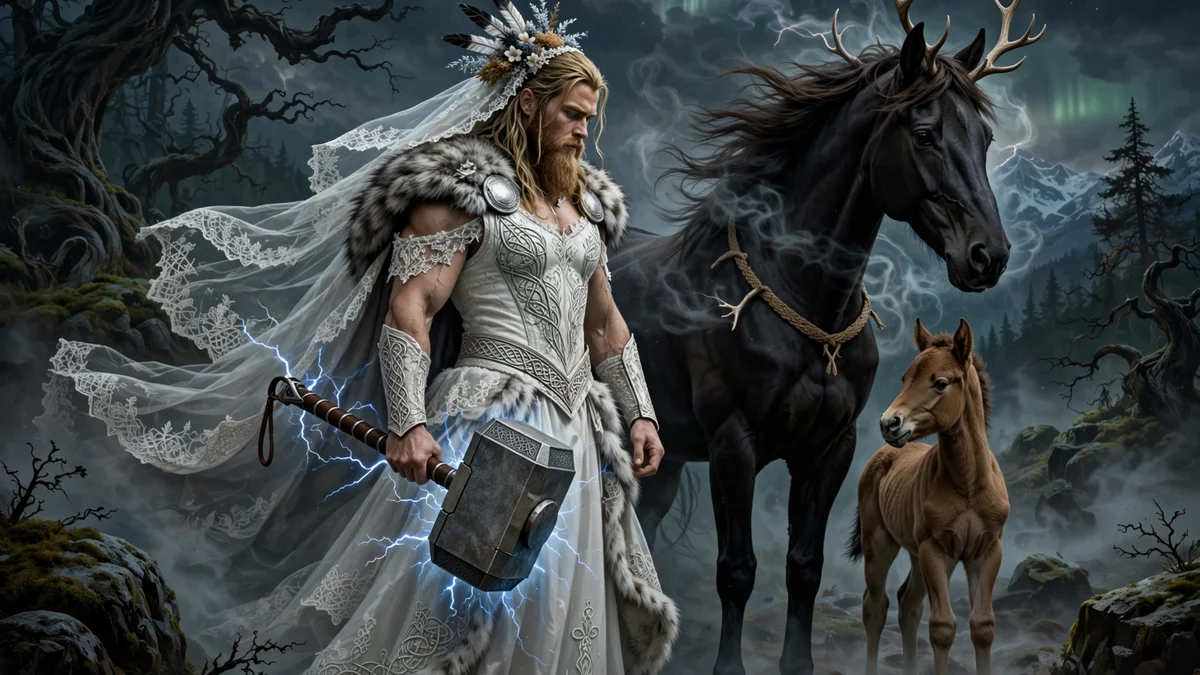
One morning Thor woke up and his hammer, Mjolnir, was gone. This was a catastrophe — Mjolnir was the gods’ main weapon against the giants. Loki investigated (in his defense, he didn’t steal it this time) and discovered the thief: Thrym, king of the frost giants, who had buried the hammer eight miles underground.
Thrym’s ransom demand? The goddess Freyja’s hand in marriage.
Freyja was furious at the suggestion. So the gods hatched a plan: Thor would dress as Freyja — bridal gown, veil, jewelry, the works — and Loki would go along disguised as his handmaiden. At the wedding feast, “Freyja” ate an entire ox, eight salmon, and drank three barrels of mead. When Thrym expressed surprise at his bride’s appetite, Loki smoothly explained that “she” hadn’t eaten for eight days from lovesickness.
Then Thrym called for the hammer to be brought in to bless the marriage — and the moment Mjolnir touched Thor’s hands, the thunder god ripped off the veil and flattened every giant in the hall.
The gods once hired a giant builder to construct a defensive wall around Asgard. The price: the sun, the moon, and Freyja. Loki, who had suggested the deal, convinced the gods to accept — but with a condition. The builder had to finish in one winter, working alone with only his stallion, Svadilfari, to help.
The builder was impossibly fast. With three days left and the wall nearly done, the gods panicked and threatened Loki with death if he didn’t fix his mess. So Loki did what Loki does: he turned himself into a beautiful mare, lured Svadilfari away into the forest, and stayed gone all night.
The builder lost. The gods kept their sun, moon, and Freyja.
Months later, Loki returned — leading an eight-legged foal. That foal was Sleipnir, who grew up to become Odin’s magnificent steed, the fastest horse in all the worlds. Yes: Loki is Sleipnir’s mother.
Kvasir was the wisest being in existence, born from the mingled spit of the gods. He traveled the world sharing knowledge — until two dwarfs, Fjalar and Galar, murdered him and drained his blood into vats.
From Kvasir’s blood, mixed with honey, the dwarfs brewed the Mead of Poetry — a drink that turned anyone who tasted it into a brilliant poet and scholar.
The mead changed hands through murder and trickery until it reached the giant Suttungr, who hid it in a mountain guarded by his daughter Gunnlod. Odin, wanting the mead, seduced Gunnlod, spent three nights with her, then drank all three vats in three gulps, turned into an eagle, and flew back to Asgard with giants in pursuit.
During the chase, Odin… spilled some. The mead that dribbled from the front became true poetic inspiration. The mead that leaked from the back became the inspiration of bad poets. The Vikings had an explanation for terrible poetry, and it was magnificent.
Thor and the giant Hymir went fishing. Thor, wanting impressive bait, ripped the head off Hymir’s best ox and rowed them far out to sea — past the point where Hymir dared go.
Thor baited his massive hook with the ox head, cast it deep, and waited. Then the line went taut. Up from the depths rose Jormungandr, the Midgard Serpent — so enormous it encircles the entire world, biting its own tail.
Thor hauled the serpent’s venom-dripping head to the surface. The two stared at each other — god and world-serpent, destined to kill each other at Ragnarok. Thor raised Mjolnir for the killing blow…
…and Hymir, terrified, cut the line. The serpent sank back into the deep. Thor, furious, threw Hymir overboard (in some versions) and waded home.
They would meet again at Ragnarok. Thor would kill Jormungandr — and die from its venom nine steps later.
The wall story deserves its own entry because the details are even stranger than the summary. The giant builder wasn’t just fast — his stallion Svadilfari was doing the work of a hundred horses, dragging entire mountains of stone.
When Loki-as-mare lured Svadilfari away, the two horses were gone all night. The builder, enraged at being tricked, revealed his true form as a frost giant — which meant the gods were now free to kill him, since the deal was with a “builder,” not a giant. Thor arrived and did what Thor does.
The wall was completed anyway (by the gods themselves, presumably). And somewhere in the forest that night, between a mare and a stallion, the strangest romance in mythology produced the greatest horse that ever lived.
Thor traveled in a chariot pulled by two goats: Tanngrisnir and Tanngnjóstr (“Teeth-barer” and “Teeth-grinder”). When Thor got hungry on the road, he would kill and eat his own goats — then resurrect them the next morning by blessing their bones with Mjolnir.
It worked perfectly, every time — until once, when staying with a peasant family, Thor shared the goat meat and told them not to break the bones. The family’s son, Thjalfi, cracked one anyway to suck out the marrow.
The next morning, one goat rose with a limp. Thor was furious — his eyebrows probably did something thunderous — and as compensation, he took Thjalfi and his sister Roskva as his servants forever.
The moral, presumably: don’t break the god’s goat bones.
This one is less funny and more haunting. Odin wanted to drink from Mimir’s well, whose waters held all wisdom and knowledge of the past and future. Mimir’s price: one of Odin’s eyes.
Odin paid it. He tore out his own eye and dropped it into the well, where it remains — staring up from the depths, seeing everything.
But Odin wasn’t done sacrificing for wisdom. He later hung himself from Yggdrasil, the World Tree, for nine days and nights — pierced by his own spear, without food or water — to win the secret of the runes. He died, in a sense, and came back with writing itself.
The king of the Norse gods is a one-eyed former corpse who traded body parts for knowledge. That tells you everything about what the Vikings valued: not comfort, not safety — understanding, at any cost.
Scholars have theories. The Norse lived in a harsh, unpredictable world — long dark winters, dangerous seas, thin margins between survival and starvation. Their gods reflect that: powerful but flawed, doomed (they know Ragnarok is coming), and coping with cosmic horror through dark humor.
There’s also a simpler explanation: these stories were entertainment. Told around fires on winter nights that lasted 18 hours, a story about Thor in a wedding dress gets a bigger laugh than a solemn hymn. The Vikings liked their gods the way they liked their lives — intense, funny, and more than a little unhinged.
Here’s what gets me: the Vikings knew their gods would die. Ragnarok isn’t a possibility — it’s a prophecy, scheduled and certain. Odin will be eaten by Fenrir. Thor will die of serpent venom. The world will burn and sink.
And they worshipped these doomed gods anyway — not because the gods would save them, but because courage in the face of certain doom was the highest virtue. That’s not just weird. That’s profound.
The Norse dwarfs were master craftsmen who forged nearly every legendary treasure — Mjolnir, Odin’s spear Gungnir, Freyr’s ship Skidbladnir, the golden hair of Sif. But they never gave anything away for free, and their prices were always strange.
When Loki cut off Sif’s hair as a prank, he had to replace it — so he went to the dwarfs. The sons of Ivaldi made Sif’s new golden hair, plus Skidbladnir and Gungnir. Then Loki, being Loki, bet his own head that another pair of dwarfs — Brokkr and Sindri — couldn’t make three finer gifts.
Brokkr and Sindri took the bet. Working with Loki (in fly form) biting Brokkr’s neck to sabotage them, they forged three treasures: the golden boar Gullinbursti, the multiplying gold ring Draupnir, and Mjolnir itself — with its famously short handle, because Loki’s fly-biting had distracted them at the critical moment.
Loki lost the bet but argued the dwarfs couldn’t take his head without damaging his neck, which wasn’t part of the wager. So they sewed his mouth shut instead. The myths never say for how long — but given Loki, probably not long enough.
Thor disguising himself as the bride Freyja to retrieve his stolen hammer Mjolnir is often cited — complete with a wedding feast where “the bride” eats an ox and drinks three barrels of mead.
Yes — in the myth of Asgard’s wall, Loki transformed into a mare to distract the giant builder’s stallion. Months later, Loki returned with the eight-legged foal Sleipnir, who became Odin’s horse.
A magical drink brewed by dwarfs from the blood of Kvasir, the wisest being. Whoever drank it became a brilliant poet. Odin stole it by seducing the giant’s daughter guarding it.
In the myths, Thor went fishing with the giant Hymir, used an ox head as bait, and pulled up the world-encircling Midgard Serpent. Hymir cut the line before Thor could strike.
To drink from Mimir’s well of wisdom. He later also hung himself from Yggdrasil for nine nights to win the runes. The Norse valued knowledge above comfort or safety.
They’re mythology — sacred stories, not history. But they reveal how the Vikings saw the world: harsh, funny, doomed, and worth facing with courage.
Mainly the Poetic Edda and Prose Edda (13th-century Icelandic texts), plus runestones, carvings, and place names across Scandinavia.
Candidates include Sleipnir (eight-legged horse), Jormungandr (world-encircling serpent), Ratatoskr (a gossip-carrying squirrel on Yggdrasil), and Loki’s children: a wolf, a serpent, and a half-corpse queen of the dead.