Physical Address
4676 Railroad Street Marquette
MI 49855
Physical Address
4676 Railroad Street Marquette
MI 49855

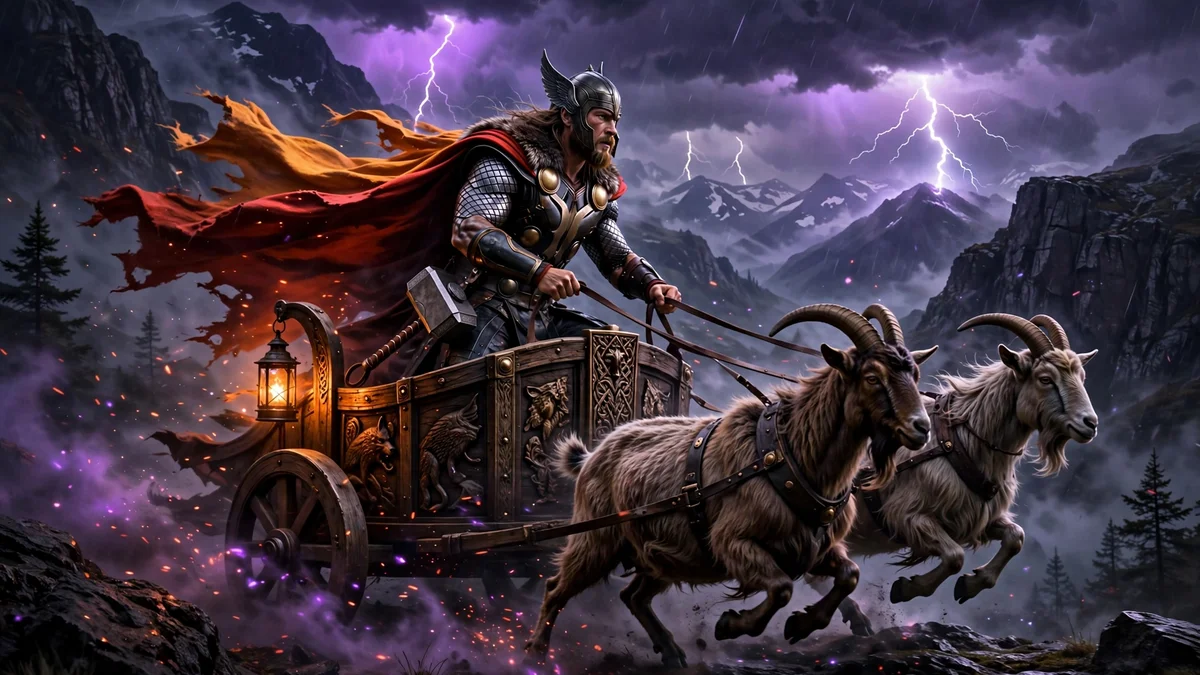
Thor’s journeys in Norse myth take the thunder god across the Nine Worlds — mostly to Jotunheim, land of the giants, where he battles monsters and matches wits with trickster kings. His most famous adventures include the fishing trip where he nearly caught the world serpent Jormungandr, the humiliating contests at Utgarda-Loki’s castle, the bridal disguise to recover his stolen hammer, and his journey to Geirrod’s hall. Each journey tests not just his strength but his character.
Unlike Odin, who wanders in disguise seeking wisdom, Thor travels for simpler reasons: giants threaten the world, and someone has to smash them. Most of Thor’s journeys follow the same pattern — he hears of a threat, grabs his hammer Mjolnir, and heads for Jotunheim, the giants’ realm.
But these are not simple smash-and-grab stories. Again and again, Thor’s journeys humble him, trick him, or teach him lessons that strength alone cannot. The thunder god’s travels are as much about character as combat.
Thor hears that the giant Hymir owns an enormous brewing cauldron the gods need. He and Tyr (in some versions, Loki) travel to Hymir’s hall disguised as young men. Hymir, suspicious, sets impossible tasks — including catching a whale for dinner.
The next morning, Thor asks to join Hymir’s fishing trip. They row far out to sea. Thor baits his hook with an ox head and casts deep. The line goes taut — impossibly taut. Thor braces his feet so hard they burst through the boat’s hull. Slowly, terribly, the world serpent Jormungandr rises from the depths, venom dripping from its fangs, eyes burning with ancient hate.
Thor hauls the monster to the surface and raises Mjolnir for the killing blow. But Hymir, terrified, cuts the line. The serpent sinks away. Thor, enraged, throws Hymir overboard (or kills him, in some versions) and rows home alone.
The myths say Thor and Jormungandr are destined to kill each other at Ragnarok. This journey was a preview — and a missed chance.
Thor, Loki, and Thor’s servants Thjalfi and Roskva travel east into giant country. They arrive at a vast castle belonging to Utgarda-Loki, a giant king skilled in magic. He challenges them to contests — and every contest is rigged by illusion.
Loki enters an eating contest against Logi — and loses, because Logi is actually wildfire, which devours even the trough. Thjalfi races against Hugi — and loses, because Hugi is Thought itself, faster than any runner. Thor then faces three trials:
Thor leaves feeling humiliated. But Utgarda-Loki admits the truth: had he known Thor’s real strength, he never would have let him inside. Every “failure” was actually a miraculous feat against impossible forces.
The giant Thrym steals Mjolnir and demands Freyja as ransom. The gods refuse to give up Freyja, so Loki proposes a desperate plan: Thor will disguise himself as the bride.
Thor is appalled. But Heimdall points out there is no other way. So the thunder god dons a bridal dress, veil, and jewelry, with Loki as his “maid.” At the wedding feast in Jotunheim, “Freyja” devours an ox, eight salmon, and three barrels of mead. When Thrym lifts the veil for a kiss and sees burning eyes, Loki quickly claims the bride has not slept for eight nights from excitement.
Finally, Thrym orders Mjolnir brought out to bless the union. The moment Thor’s fingers close around the hammer’s handle, the disguise is over. He slaughters Thrym, his entire family, and every giant present.
It is Thor’s most embarrassing journey — and one of his most triumphant.
The giant Geirrod invites Thor to visit — a trap arranged by Loki (who was captured by Geirrod and promised to deliver Thor hammerless as ransom). Thor, unusually, agrees to come without Mjolnir, his iron gloves, or his belt of strength.
On the way, Thor stays with the giantess Grid, who warns him of the trap and lends him her own iron gloves, belt, and staff. At Geirrod’s hall, Thor is seated on a chair that begins rising toward the ceiling, pressing him against the rafters. He braces Grid’s staff against the ceiling and pushes back with all his might — driving the chair (with Geirrod’s daughters on it) down so hard their backs break.
Geirrod then hurls a red-hot iron bar at Thor. Thor catches it with the iron gloves and hurls it back — straight through Geirrod, through a pillar, and deep into the earth.
Even without his famous weapons, Thor’s journey proves his true strength was never just the hammer.
The giant Hrungnir, drunk at a feast in Valhalla, boasts he will kill all the gods and carry off Freyja and Sif. Thor is summoned. They agree to meet for a formal duel at the border of giant-land.
Hrungnir arrives with a heart of stone (literally — triangular and hard) and a shield of stone. He also brings a clay giant, Mokkurkalfi, as his second — but the clay giant panics when it sees Thor and wets itself.
Thor hurls Mjolnir. Hrungnir hurls his whetstone weapon. They collide mid-air; the whetstone shatters, and a fragment lodges in Thor’s forehead (where it remains forever). Mjolnir continues on and smashes Hrungnir’s stone skull. The giant topples — landing with his leg across Thor’s neck.
No one can lift the leg until Thor’s three-year-old son Magni arrives and casually tosses it aside. Thor gives Magni the giant’s golden-maned horse as reward — to Odin’s visible annoyance.
The sea giant Aegir wants to host a feast for the gods but lacks a cauldron large enough to brew ale for everyone. Thor and Tyr journey to Hymir’s hall (the same trip as the fishing expedition) to steal the giant’s mile-deep cauldron.
After the fishing adventure, Thor simply picks up the enormous cauldron, puts it on his head like a hat, and walks away with it. The giants pursue, but Thor’s glare alone sends them fleeing.
It is a short journey but a satisfying one — Thor being Thor, solving problems through overwhelming confidence.
Across all these adventures, patterns emerge:
Thor is brave but not clever. He charges into every trap, falls for every illusion, and needs others (usually Loki) to plan. His journeys show that courage without wisdom is incomplete.
Thor is humble (eventually). He is humiliated at Utgarda-Loki’s castle, embarrassed by the bridal disguise, and outwitted repeatedly. But he endures it all for the greater good — a kind of humility rare in gods.
Thor protects the vulnerable. His journeys are almost always defensive — stopping giants who threaten gods or humans. He is not a conqueror; he is a guardian.
Every journey foreshadows Ragnarok. The near-miss with Jormungandr, the humiliation by illusions, the giants’ constant scheming — all point toward the final battle where Thor will finally face his destiny.
Not all of Thor’s journeys ended in clear victory. On one expedition with Loki, Thor encountered the giant Geirrod — but this time, Loki had been captured by Geirrod and forced to lure Thor into a trap. Thor arrived without his hammer, gloves, or belt.
What saved him was not strength but the kindness of a stranger. The giantess Grid, pitying Thor, lent him her magical equipment. Armed with borrowed gear and his own indomitable will, Thor turned the trap back on the trappers.
This journey is often overlooked, but it reveals something important: Thor’s greatest asset was never Mjolnir. It was his refusal to give up, his willingness to accept help, and his ability to turn any situation into a fight he could win. The hammer was a tool; the warrior was the weapon.
If you trace all of Thor’s journeys on a mythic map, they form a pattern. He almost always travels east — toward Jotunheim, toward chaos, toward the unknown. He is the force of order pushing back against entropy. Every journey is a small Ragnarok: the forces of destruction rise, Thor confronts them, and order is restored — temporarily.
The Vikings who told these stories were themselves great travelers, sailing east to Russia, west to America, south to Africa. Thor’s mythic journeys mirrored their real ones: dangerous, unpredictable, sometimes humiliating, but always worth attempting. The god who never stayed home inspired a people who never stayed home either.
The fishing trip for Jormungandr is the most dramatic — Thor nearly pulls the world serpent from the sea. The Utgarda-Loki contests are the most psychologically rich, and the bridal disguise is the funniest.
Yes. He was humiliated (through trickery) at Utgarda-Loki’s castle, failed to kill Jormungandr on the fishing trip, and got a whetstone fragment stuck in his forehead during the Hrungnir duel. His myths are honest about his limitations.
Jotunheim is the giants’ realm, and giants constantly threatened the gods and humans. As the gods’ champion and protector of Midgard (Earth), Thor was essentially on permanent giant-fighting duty.
Loki was his most frequent companion, providing the cunning Thor lacked. His servants Thjalfi and Roskva also traveled with him. Occasionally Tyr or other gods joined specific expeditions.
Tanngrisnir and Tanngnjostr pulled his chariot. Thor would kill and eat them each night, then resurrect them from their bones each morning — as long as no bones were broken. (Thjalfi once broke a bone, laming one goat.)
Not a literal one, but the myths describe a consistent cosmology: Asgard (gods) connected to Jotunheim (giants, east), Midgard (humans, middle), and other worlds via Yggdrasil. Thor’s journeys mostly go east to giant country.
Yes. They often involved quests for needed items (the cauldron, information), rescue missions, or preemptive strikes against growing threats. Thor was not a wandering thug — he was Asgard’s defense force.
Thor’s final “journey” is to the battlefield of Vigrid, where he faces Jormungandr. He kills the serpent with Mjolnir but takes nine steps before collapsing dead from its venom. His journeys end where they were always heading.