Physical Address
4676 Railroad Street Marquette
MI 49855
Physical Address
4676 Railroad Street Marquette
MI 49855
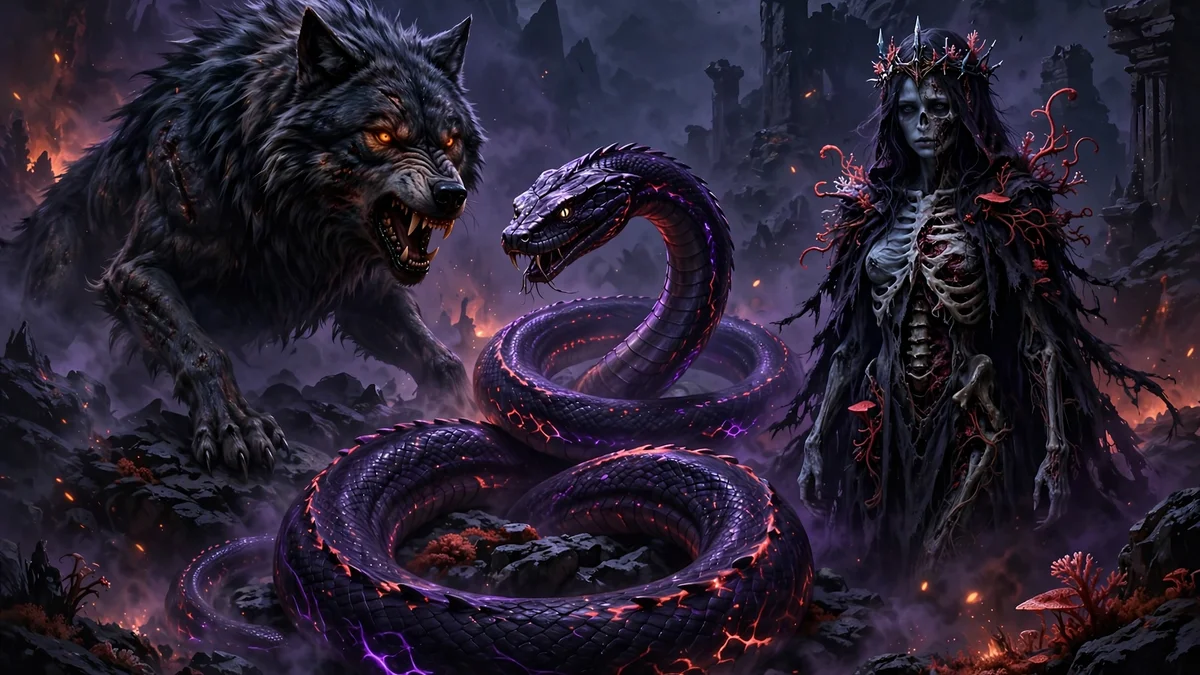
Loki’s children are among the most famous monsters in Norse mythology: Fenrir the giant wolf who will devour Odin at Ragnarok, Jormungandr the world serpent so huge it encircles the Earth, Hel the half-corpse queen of the underworld, and Sleipnir the eight-legged horse ridden by Odin. Three were born to the giantess Angrboda; Sleipnir was born when Loki transformed into a mare. Each child plays a crucial role in the doom of the gods.
Loki’s love life was as chaotic as everything else about him. With the giantess Angrboda (“She Who Brings Sorrow” — an ominous name), he fathered three children who would become the most feared beings in all the Nine Worlds. In a separate bizarre incident, Loki himself gave birth to a fourth child — an eight-legged horse.
The gods saw these children growing in Jotunheim and received dark prophecies about them. They decided to act — with consequences that guaranteed the very doom they feared.
Fenrir was born a wolf pup, but he grew at a terrifying rate. The gods received prophecies that this wolf would one day kill Odin himself. Rather than killing the pup outright (which might have been wiser), they decided to raise him in Asgard and keep him under watch.
As Fenrir grew enormous, the gods decided he must be bound. Twice they challenged him to break great chains as a test of strength — and twice he snapped them like thread. The gods then commissioned the dwarves to forge Gleipnir, a magical ribbon made from six impossible ingredients: the sound of a cat’s footstep, a woman’s beard, a mountain’s roots, a bear’s sinews, a fish’s breath, and a bird’s spit.
Gleipnir looked like a silken ribbon but was unbreakable. The gods challenged Fenrir to try it, but the wolf was suspicious. He agreed only if one god would place a hand in his mouth as a pledge of good faith. Only Tyr, the bravest god, volunteered. When Fenrir realized he was trapped, he bit off Tyr’s hand.
Fenrir remains bound on a lonely island, a sword propping his jaws open, drooling the river Von. But the prophecies say at Ragnarok, he will break free, devour Odin, and be slain in turn by Odin’s son Vidar — who will tear the wolf’s jaws apart.
What his story teaches: Trying to control fate through fear often creates the very disaster you wanted to prevent.
When the gods saw the infant serpent Jormungandr, Odin picked him up and hurled him into the ocean surrounding Midgard (Earth). It seemed like a solution — out of sight, out of mind.
It was a terrible miscalculation. In the deep sea, Jormungandr grew and grew until he was so enormous that he could wrap his entire body around the world and bite his own tail. He became the living boundary of the Earth, encircling all human lands.
Thor and Jormungandr are destined enemies, and their encounters are legendary:
The Cat Contest: At Utgarda-Loki’s castle, Thor was challenged to lift a “cat.” He strained with godly might and lifted one paw. The cat was Jormungandr in disguise — and lifting even one paw off the ground was a miraculous feat.
The Fishing Trip: Thor rowed out to sea with the giant Hymir, baited his hook with an ox head, and caught the world serpent. He hauled its venom-dripping head above the waves and raised Mjolnir — but Hymir cut the line in terror.
At Ragnarok, Thor and Jormungandr will meet for the last time. Thor will kill the serpent with his hammer — then take nine steps and collapse dead from its venom. Their mutual destruction is one of the most poignant moments in all mythology.
What his story teaches: Some enemies cannot be thrown away; they grow in the dark until they surround you.
Hel is Loki’s daughter, but she is no monster in the rampaging sense. She is half beautiful woman, half blue-black corpse — split down the middle. The gods gave her dominion over the underworld (also called Hel), where those who die of sickness, old age, or dishonor go.
Hel’s realm is not a place of torture — it is a place of dreary monotony. The dead sit in cold halls, eating from dishes called “Hunger” with knives called “Famine.” It is not agony but endless grayness — which to the Vikings, who prized glorious action, was punishment enough.
After Loki caused Baldr’s death, the gods sent Hermod to Hel’s realm to beg for Baldr’s return. Hel agreed — on one condition: every living thing must weep for Baldr. Everything wept except one giantess (who was Loki in disguise). So Baldr stayed dead.
Hel’s cold logic — grief must be universal, no exceptions — shows her as a figure of implacable rules rather than cruelty.
Interestingly, Hel is one of the few major figures who may survive Ragnarok. Some versions suggest her realm endures, continuing to receive the dead in the renewed world. Death, after all, does not end.
What her story teaches: Not all power is violent; some of the most formidable forces are quiet, patient, and inevitable.
Sleipnir’s origin is pure Loki chaos. When the gods needed to stop a giant builder from finishing Asgard’s wall, Loki transformed into a beautiful mare and lured the builder’s stallion Svadilfari away. The plan worked — but Loki stayed in horse form long enough to become pregnant.
Months later, Loki returned to Asgard leading a gray foal with eight legs. This was Sleipnir, who grew into the fastest, finest horse in all the worlds — able to gallop through air, across water, and even into the land of the dead.
Odin claimed Sleipnir as his own horse, and the two became inseparable. Sleipnir carries Odin on his wisdom quests, into battle, and on his journeys between worlds. The eight legs are often interpreted as representing the horse’s supernatural speed — moving so fast it seems to have extra limbs.
Sleipnir is depicted on rune stones and in ancient carvings, showing how important he was to Norse belief. Unlike his monstrous siblings, Sleipnir serves the gods faithfully.
What his story teaches: Even the strangest beginnings can produce something magnificent.
The gods’ fear was partly prophetic and partly self-fulfilling:
If the gods had raised Fenrir with kindness instead of binding him, would he still have killed Odin? The myths suggest the gods created their own doom through fear. It is one of Norse mythology’s deepest lessons.
At the end of the world, Loki’s children take center stage:
Loki’s family — born from mischief, raised in fear — becomes the instrument of the world’s end. Yet from that end, a new world rises.
This is the question scholars and storytellers keep asking. What if the gods had chosen differently?
What if they had raised Fenrir with kindness? The wolf was a pup when they took him. Had they treated him as a companion rather than a prisoner-in-waiting, might he have become Asgard’s guardian instead of its doom? The myth suggests yes — Fenrir only became monstrous after betrayal.
What if they had left Jormungandr alone? Hurling a baby serpent into the sea seems cruel even by mythic standards. Had they simply watched from a distance, the serpent might never have grown so enormous — or so resentful.
What if they had honored Hel instead of exiling her? Giving her the underworld was actually the least hostile act — it was a position of real authority. And indeed, Hel is the least vengeful of the three Angrboda children. Perhaps respect, even in a gloomy realm, prevented the worst.
The myths don’t answer these questions directly. But they linger over the gods’ choices with a sense of tragic irony, suggesting that wisdom might have prevented what force guaranteed. It is a profoundly human lesson wrapped in a divine story.
Loki’s monstrous family has captured modern imagination:
Each adaptation simplifies the originals, but the core appeal remains: these are family members — children — who became monsters through a mixture of nature and nurture, prophecy and parenting. Their stories resonate because they are, at heart, about family gone wrong.
The giantess Angrboda (“She Who Brings Sorrow”) is the mother of Fenrir, Jormungandr, and Hel. Sleipnir’s “mother” is Loki himself, who gave birth to the horse while in the form of a mare. The stallion Svadilfari was the father.
The myths don’t fully explain this. Possibly the gods feared the consequences of killing prophesied beings, or believed they could control them through binding and exile. Their half-measures proved worse than either kindness or decisiveness would have been.
Fenrir is neither — he is a force of nature raised in captivity and betrayal. He was a playful pup who grew into a monster because the gods treated him as one. His story is tragic more than villainous.
Scholars see Jormungandr as representing the ocean’s vast, unknowable power — the boundary of the known world. His circular form (biting his own tail) also echoes the ouroboros, an ancient symbol of cycles and eternity.
No. Hel is stern and implacable but not cruel. She follows rules fairly — when the gods met her condition for Baldr’s release (almost), she would have complied. She represents death’s inevitability, not malice.
Sleipnir is described as the best and fastest horse among gods and men, able to travel between worlds — including to Hel’s realm and back. His eight legs symbolize supernatural speed beyond any natural horse.
Fenrir appears as a giant wolf in “Thor: Ragnarok” (though Hela, not Loki, is presented as his mother in the films). Jormungandr and Hel have not prominently appeared. Marvel simplifies and changes the family relationships significantly.
That fear-based control backfires, that how you treat someone shapes who they become, and that trying to prevent a prophecy often causes it. The gods’ mishandling of these children is a masterclass in self-fulfilling doom.