Physical Address
4676 Railroad Street Marquette
MI 49855
Physical Address
4676 Railroad Street Marquette
MI 49855

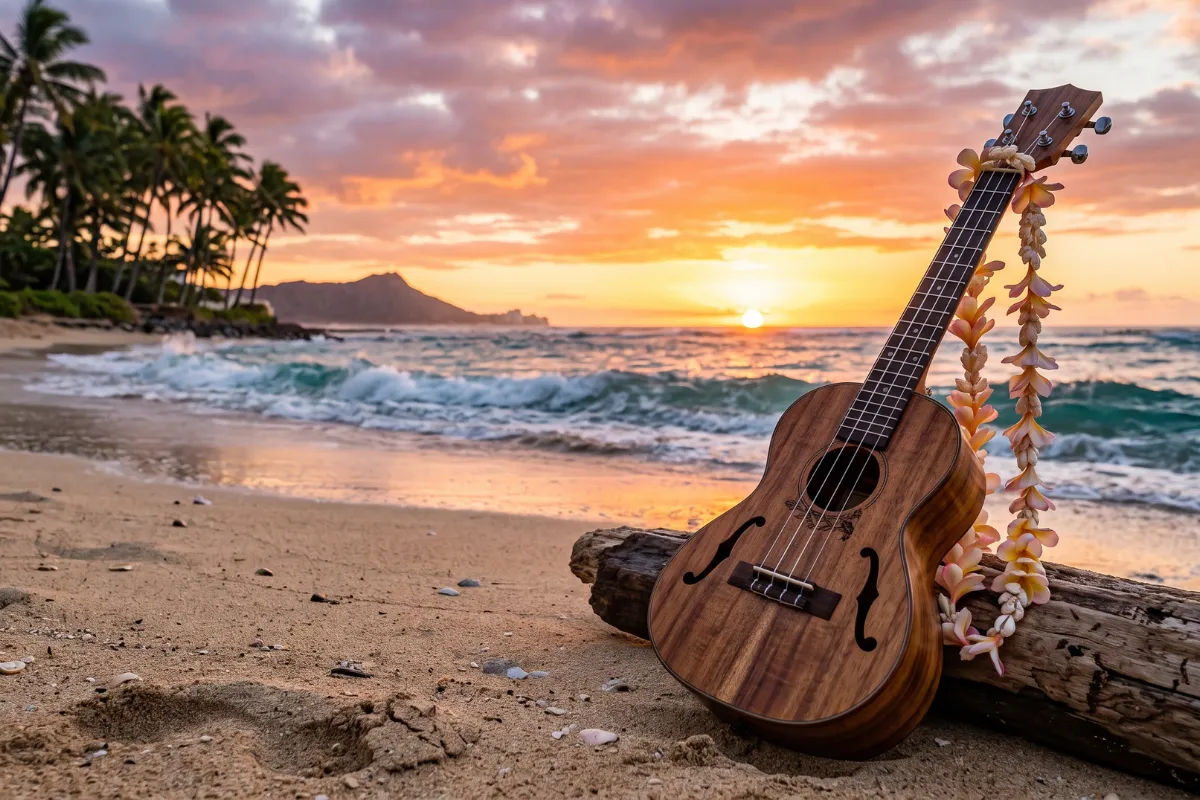
The ukulele’s history is one of music’s greatest stories. Most people link it with Hawaii today, but this small four-stringed instrument began in Portugal. It reached the world through migration, skilled craftsmen, and cultural exchange.
Beginners learn their first chords on it. Professionals play it on world stages. Millions of people play the ukulele now. Here is the full story: its Portuguese roots, its Hawaiian rebirth, its spread across the globe, and its modern comeback.
The ukulele is a four-stringed instrument in the lute family. It looks like a small guitar, but it has its own tuning, sound, and playing style. Its nylon strings make a warm, bright, cheerful tone that is hard to mistake for anything else.
Today people play it in Hawaiian music, folk, pop, jazz, classical, country, and school music classes. It’s easy to carry and friendly for beginners — one of the simplest instruments to learn. A child can hold it comfortably, and an adult can learn basic chords in a single afternoon.
Part of its charm is its modesty. The ukulele never tries to be the loudest instrument in the room. It is the sound of back porches, beach gatherings, and classrooms — music made for joy rather than show.
The story starts in 1879. Portuguese immigrants from the island of Madeira sailed to Hawaii on the ship Ravenscrag to work on sugar plantations. They brought their music — and small stringed instruments called the machete, braguinha, and rajão.
Three Madeiran craftsmen — Manuel Nunes, Augusto Dias, and José do Espírito Santo — started building instruments in Hawaii. They mixed Portuguese woodworking skill with native Hawaiian koa wood. Their shops made the first true ukuleles.
The timing mattered. Hawaii’s sugar plantations were drawing workers from all over the world — Portuguese, Chinese, Japanese, Filipino. Each group brought its own music, and Honolulu became a melting pot of sounds. The little Portuguese instruments stood out because they were loud enough for outdoor playing, cheap to build, and easy to learn. Plantation workers played them after long days in the fields, and the music spread from the camps to the towns.
The Hawaiian word usually translates as “jumping flea.” Two stories explain it:
Historians still debate it, but “jumping flea” remains the accepted meaning. Either way, the name captures the instrument’s personality: quick, lively, and impossible to sit still to.
King Kalākaua (reigned 1874–1891) loved music. He made the ukulele a star of royal celebrations, festivals, and ceremonies. That sealed it as a symbol of Hawaiian culture. It also became tied to hula — its rhythmic strumming is a perfect match for the traditional dance.
Kalākaua was known as the “Merrie Monarch” for good reason. He played the ukulele himself and included it in royal court music alongside traditional Hawaiian instruments. When the king of Hawaii plays your instrument at state events, people notice. Within a decade, the ukulele went from a plantation novelty to a national symbol.
Early ukuleles were handcrafted from native koa wood with simple designs. Old koa ukuleles are now prized by collectors. Modern ones use mahogany, spruce, cedar, maple, mango, acacia, carbon fiber, and laminates. Each wood changes the tone and how long the instrument lasts.
Not all ukuleles are the same size. The four standard types each have their own sound and feel:
| Size | Length | Sound | Best For |
|---|---|---|---|
| Soprano | ~21 inches | Bright, classic Hawaiian | Traditional sound, kids, travel |
| Concert | ~23 inches | Fuller, more room for fingers | Beginners with larger hands |
| Tenor | ~26 inches | Rich, loud, deep | Performers and professionals |
| Baritone | ~30 inches | Deep, guitar-like | Guitar players switching over |
People often ask how the ukulele compares to the guitar. Here is the simple version:
| Feature | Ukulele | Guitar |
|---|---|---|
| Strings | 4 (nylon) | 6 (nylon or steel) |
| Learning curve | Easy — basic songs in days | Moderate — weeks for clean chords |
| Size & weight | Tiny and light | Larger and heavier |
| Cost | Good ones from $50 | Good ones from $150+ |
| Finger pain | Very little (soft nylon) | More (especially steel strings) |
That is why music teachers love the ukulele for kids and adult beginners. It gives you the joy of making music fast, without the sore fingers and frustration that make many guitar beginners quit.
The 1915 Panama-Pacific International Exposition in San Francisco brought Hawaiian music to mainland America. By the 1920s, the ukulele was a full craze. Radio, theaters, and music publishers spread it nationwide. It was cheap, portable, and perfect for group singing. Schools adopted it for music classes — a role it still fills today.
The craze had a soundtrack. Tin Pan Alley songwriters churned out ukulele-friendly hits, and vaudeville stars carried the little instrument onto every stage in the country. Sears sold ukuleles by mail order for a few dollars. College students strummed them on campuses. For a few wild years, the ukulele was as American as jazz itself.
If the history has you tempted, here is the good news: the ukulele is one of the easiest instruments on Earth to start. Most beginners learn their first song within a week.
Standard tuning is G-C-E-A (from top string to bottom). The fun quirk: the top G string is tuned higher than the C below it. This “reentrant” tuning is what gives the ukulele its bright, bouncy sound.
Three chords unlock hundreds of songs. Learn C, F, and G7 and you can play “You Are My Sunshine,” “I’m Yours,” and countless others. Add Am and you are unstoppable.
Tips for new players: start with a concert-size ukulele if you have adult hands; use a clip-on tuner (they cost under $15); practice 15 minutes a day rather than two hours once a week; and learn songs you actually love — motivation beats method every time.
After World War II, electric guitars stole the spotlight and the ukulele’s sales faded. Rock and roll wanted volume and attitude, and the gentle ukulele did not fit the mood. But it never left Hawaiian culture. TV entertainers kept it in view through the mid-20th century.
The 21st century brought a remarkable comeback, driven by:
The pandemic gave it another push. Stuck at home, millions picked up affordable instruments — and the ukulele, cheap and cheerful, was the perfect lockdown companion. Sales spiked, and online ukulele communities exploded.
A ukulele is simple, but it still needs basic care. Keep it away from extreme heat and dryness — wood cracks when it dries out. Wipe the strings after playing to slow corrosion. Store it in a case or on a stand, not leaning against a radiator.
Nylon strings stretch and go dull over time. Changing them every few months (or when they sound dead) makes a huge difference, and a set costs less than a pizza. If the action feels high or the intonation drifts, a music shop can set it up in minutes.
It’s now played on every continent. Huge communities exist in the United States, Japan, Canada, Australia, the UK, Germany, Brazil, the Philippines, and New Zealand. Festivals, workshops, and online groups keep growing.
The instrument has also found a home in holiday music — its bright strum shows up in Christmas recordings and seasonal performances, part of the same joyful tradition captured in the history of Christmas traditions. From luau to living room to holiday stage, the little jumping flea keeps finding new places to land.
Modern tools — digital tuners, electric models for big stages, home recording — changed how people learn and perform. Yet the instrument stays what it always was: small, joyful, and welcoming to beginners.
Not Hawaii — Portugal. Portuguese immigrants from Madeira brought small stringed instruments (the machete, braguinha, and rajão) to Hawaii in 1879 aboard the ship Ravenscrag. Three Madeiran craftsmen — Manuel Nunes, Augusto Dias, and José do Espírito Santo — began building them in Hawaii.
The Hawaiian word usually translates as ‘jumping flea.’ One story says players’ fingers moved so fast across the strings they looked like a fleeing flea; another says it mocked a lively British officer, Edward Purvis. Historians still debate it, but ‘jumping flea’ remains the accepted meaning.
King Kalākaua, who reigned from 1874 to 1891, loved music and made the ukulele a star of royal celebrations, festivals, and ceremonies. It became tied to hula — its rhythmic strumming is a perfect match for the traditional dance — and a lasting symbol of Hawaiian culture.
Soprano — the smallest and most traditional, with a bright, classic Hawaiian sound. Concert — bigger body, more room for your fingers. Tenor — richer tone and volume, the choice of many professionals. Baritone — the largest, with a deep, guitar-like sound.
After fading post-WWII when electric guitars took over, the ukulele came back thanks to thousands of free online tutorials, social media performances reaching millions, affordable instruments, and viral moments — from Israel Kamakawiwoʻole’s beloved “Over the Rainbow” medley to virtuoso Jake Shimabukuro.
No — it is one of the easiest instruments to start. With just three chords (C, F, and G7) you can play hundreds of songs, and most beginners play their first full song within a week. Soft nylon strings mean almost no finger pain.
A decent beginner ukulele costs $50 to $100. Mid-range solid-wood instruments run $150 to $400, while professional Hawaiian koa ukuleles can cost $800 or more. For most beginners, a $70 concert-size ukulele is a great start.
Standard tuning is G-C-E-A (top to bottom string). Unusually, the top G string is tuned higher than the C below it — called “reentrant” tuning — which gives the ukulele its bright, bouncy sound.