Physical Address
4676 Railroad Street Marquette
MI 49855
Physical Address
4676 Railroad Street Marquette
MI 49855


Here is something they don’t mention at the Christmas pageant. Almost nothing about the modern Christmas comes from the Bible — not the date, the tree, Santa, the stockings, or the mistletoe. Every tradition was borrowed, invented, or renamed along the way, taken from Roman festivals, Norse myths, German forests, and one very bold 19th-century marketing campaign. (Christmas even has a frightening folklore figure of its own — Krampus, the Christmas demon.)
Quick Answer: Almost every Christmas tradition was borrowed from somewhere else. December 25 was chosen in 336 CE to overlap with the Roman festivals of Saturnalia and Sol Invictus. The tree came from 16th-century Germany, Santa evolved from the 4th-century Saint Nicholas through Dutch settlers and American cartoonists, and stockings, mistletoe, and the Yule log all trace to pagan European customs.
This is the real story of where your Christmas came from.
The Bible never gives a date for Jesus’s birth. Not a hint. In fact, one detail argues against December. The Gospel of Luke describes shepherds “keeping watch over their flock by night.” Experts note this would be odd in the cold Judean winter — sheep were usually in the fields in spring.
So why December 25? The first recorded Christmas celebration on that date comes from Rome in 336 CE. Historians debate the exact reason, but the leading ideas all point to the same plan: take over the competition.
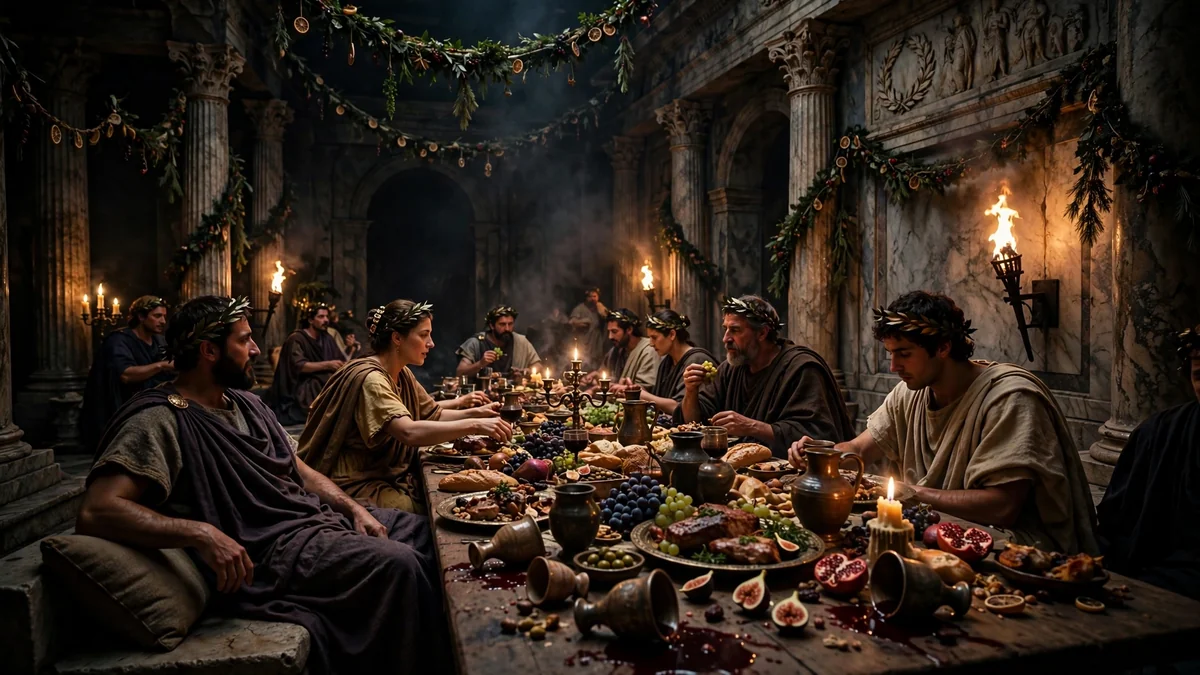
Late December was already party season in the Roman world:
By placing Christmas on December 25, the early Church gave converts a Christian reason to keep celebrating at the darkest, coldest time of year — the same deep winter when many animals are in hibernation. It was brilliant marketing — and it worked so well that we forgot it was marketing.
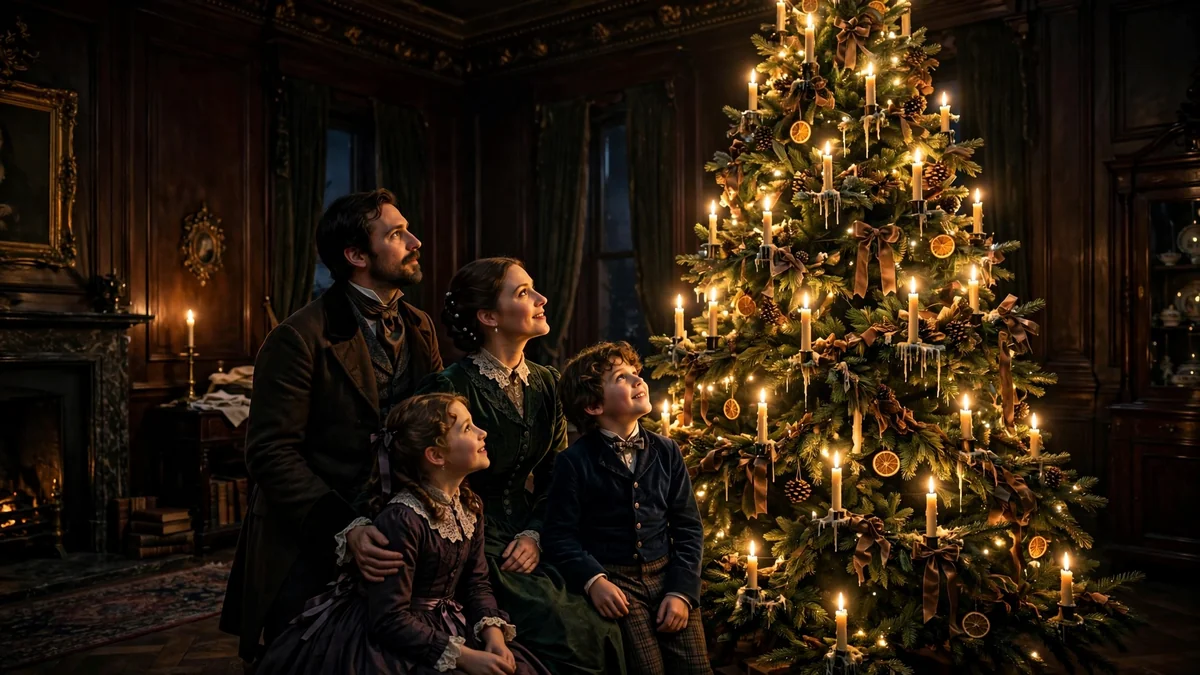
The decorated evergreen tree comes from 16th-century Germany, where devout Christians brought trees inside and decorated them. Martin Luther often gets credit for adding candles — legend says he was inspired by stars shining through evergreen branches — though this story cannot be proven.
The Baltic cities of Riga and Tallinn both claim the “first” public Christmas tree (1510 and 1441), and historians still argue about it. What is not debated is how the tree conquered the English-speaking world: Prince Albert.
When the German-born Prince Albert married Queen Victoria, he brought the Christmas tree custom to Windsor Castle. In 1848, the Illustrated London News published an engraving of the royal family gathered around a glittering tree. Victorian England copied everything the royals did — and went tree-mad overnight. American magazines reprinted the image (carefully editing out Victoria’s crown and Albert’s mustache to make it look American), and German immigrants carried the tradition across the United States.
From a German living room to a global industry in one royal engraving.
Santa’s story starts with a real person: Saint Nicholas, a 4th-century bishop in Myra (modern-day Turkey), famous for secret gift-giving. The best-known legend says he tossed bags of gold through a poor man’s window. Some landed in stockings drying by the fire. It was so the man’s daughters could afford dowries.
The true details of his life are hazy — part history, part legend. For the full story of the man behind the myth, see the real story of Santa Claus.
The Dutch carried “Sinterklaas” to New Amsterdam (New York), where the English mangled the name into “Santa Claus.” Then came three makeovers:
Which brings us to the most stubborn Christmas myth of all: Coca-Cola did not invent Santa’s red suit. Coke’s famous 1930s ads, painted by Haddon Sundblom, absolutely cemented the modern image of Santa — but the red suit predates them by half a century. Coke just had the bigger advertising budget.
Straight from the St. Nicholas dowry legend — the gold that landed in drying stockings. Kids hanging stockings by the fireplace are replaying a 1,600-year-old story about a Turkish bishop.
This one is gloriously pagan. In Norse mythology, the god Baldur was killed by an arrow made of mistletoe — the one plant his mother forgot to make promise not to harm him. Her tears of grief supposedly became the plant’s white berries, and mistletoe became a symbol of love and peace. The Druids also honored it, harvesting it with golden sickles. Somewhere along the way, standing under it meant you had to kiss — a tradition first recorded in 18th-century England. For more winter myths, see the Norse winter myths of Yule.
“Yule” was the Norse/Germanic midwinter festival. Burning a huge log through the longest nights was both practical heating and spiritual symbolism — fire pushing back the dark. The French turned it into the bûche de Noël cake, because the French turn everything into cake.
| Tradition | Origin | Era |
|---|---|---|
| December 25 date | Roman festivals of Saturnalia and Sol Invictus | 336 CE |
| Gift-giving | St. Nicholas legends; Roman Saturnalia gift exchange | 4th century |
| Mistletoe | Norse Baldur myth; Druidic ritual | Pagan antiquity |
| Yule log | Norse/Germanic midwinter festival | Pagan antiquity |
| Christmas tree | Germany; popularized by Prince Albert | 16th century / 1848 |
| Santa’s sleigh & reindeer | 1823 poem “‘Twas the Night Before Christmas” | 1823 |
| Christmas cards | Sir Henry Cole, London | 1843 |
| Red-suited Santa | Thomas Nast cartoons; cemented by Coca-Cola ads | 1860s / 1930s |
The first commercial Christmas card was ordered in London in 1843 by Sir Henry Cole, who was too busy to write individual holiday letters. He had artist John Calcott Horsley design 1,000 cards showing a family toasting the holidays. Then he promptly sold them for a shilling each. The design was a bit shocking at the time: it showed a small child sipping wine with the adults. The Christmas card industry was born from one man’s laziness — and one controversial toast.
As for carols: “Silent Night” was first performed on Christmas Eve 1818 in Oberndorf, Austria — supposedly because the church organ was broken, so it was written for guitar. “O Come, All Ye Faithful” dates to the 18th century. Most carols we sing are younger than the United States.
The holiday looks wildly different depending on where you are. In Mexico, families celebrate Las Posadas (December 16–24), reenacting Mary and Joseph’s search for shelter, ending with piñatas. In the Philippines — which has one of the world’s longest Christmas seasons, starting in September — giant handmade parol star lanterns light up the streets. Iceland has thirteen Yule Lads instead of one Santa, mischievous troll-like figures who visit children in the thirteen nights before Christmas. In Japan, where Christmas is not a religious holiday, the quirky tradition is eating KFC on Christmas Eve — the result of a brilliant 1974 marketing campaign. And in Ethiopia, Christmas (called Genna) falls on January 7, following the ancient Orthodox calendar.
Same holiday, completely different costumes — proof that Christmas is less a fixed tradition and more a framework every culture fills in its own way.
Christmas is the world’s most successful cultural remix. Roman festivals, Norse myths, German trees, a Turkish bishop, Dutch sailors, American cartoonists, and a soda company — all layered into one holiday. None of it was planned. All of it stuck. And the season rolls straight on into New Year’s Eve.
Worth remembering: traditions aren’t ancient because they’re old. They’re ancient because someone, somewhere, decided to keep doing them.
The Bible gives no date. December 25 was likely chosen in the 4th century to line up with the Roman festivals of Saturnalia and Sol Invictus, giving converts a Christian reason to celebrate in midwinter.
The custom began in 16th-century Germany. It spread to England after Prince Albert’s tree appeared in the Illustrated London News in 1848, and to America via German immigrants.
No. The red-suited Santa was created by cartoonist Thomas Nast in the 1860s–1880s, building on the 1823 poem “‘Twas the Night Before Christmas.” Coke’s 1930s ads cemented the image but didn’t invent it.
From the legend of St. Nicholas secretly dropping bags of gold for a poor man’s daughters — some landing in stockings drying by the fire.
Yule was the Norse and Germanic midwinter festival. Many of its customs — the Yule log, feasting, evergreens — were absorbed into Christmas.
Mistletoe was sacred to Norse and Druidic traditions (the Baldur myth made it a symbol of love). The kissing custom was first recorded in 18th-century England.
The first commercial Christmas card was commissioned in London in 1843 by Sir Henry Cole, who had 1,000 printed and sold them for a shilling each.
A 1974 KFC Japan marketing campaign (“Kentucky for Christmas”) turned fried chicken into a beloved Christmas Eve tradition in a country where Christmas is not a religious holiday.