Physical Address
4676 Railroad Street Marquette
MI 49855
Physical Address
4676 Railroad Street Marquette
MI 49855
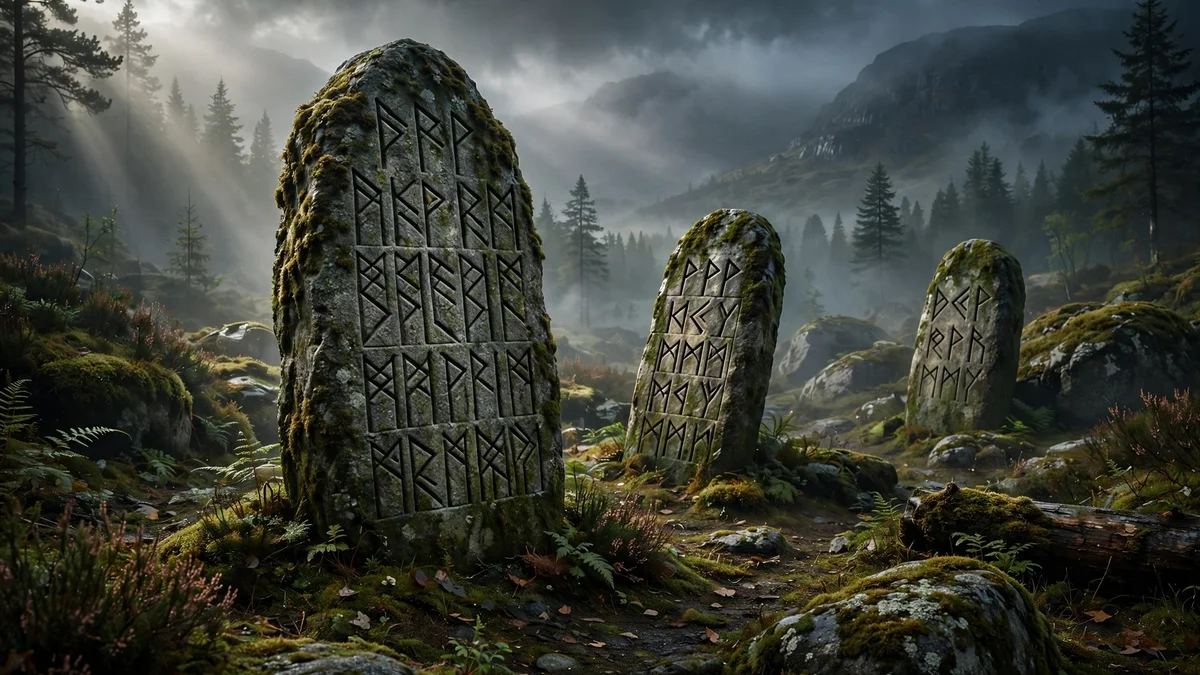
Quick Answer: Viking runes were the letters of the Norse alphabet. The earliest set, Elder Futhark, had 24 runes; the later Viking Age set, Younger Futhark, had 16. Each rune had a name and meaning — for example, Fehu meant “cattle” or “wealth” and Ansuz meant “god” or “Odin.” Vikings carved runes on stone, wood, bone, and weapons for messages, memorials, and magic spells.
Long before the Vikings used the Latin alphabet, they wrote with runes — sharp, angular letters designed to be carved into wood, stone, and metal. The word “rune” comes from an old Germanic word meaning “secret” or “mystery,” which hints at how the Norse saw writing itself: not just communication, but something with power.
The Vikings didn’t invent runes. The earliest runic alphabet, called Elder Futhark, appeared around 150 AD among Germanic peoples — centuries before the Viking Age began (roughly 793–1066 AD). By the time Viking ships were raiding and trading across Europe, a shorter, sharper version called Younger Futhark was in use.
Elder Futhark is named after its first six runes: Fehu, Uruz, Thurisaz, Ansuz, Raidho, Kenaz — F-U-TH-A-R-K. It had 24 characters, and each one carried a name and a meaning tied to Norse life and belief.
Runes were grouped into three “aettir” (families) of eight. The first aett:
Around 800 AD, just as the Viking Age was beginning, the 24-rune Elder Futhark was simplified into Younger Futhark — only 16 runes. This seems backward (fewer letters for more sounds), but the Old Norse language had actually simplified, merging several sounds together.
Younger Futhark came in two main styles:
The 16 Younger Futhark runes: Fe (wealth), Ur (drizzle/aurochs), Thurs (giant), As/Oss (god), Reidh (ride), Kaun (ulcer), Hagall (hail), Naud (need), Is (ice), Ar (plenty/year), Sol (sun), Tyr (god Tyr), Bjarkan (birch), Madr (man), Logr (water), Yr (yew/bow).
Because 16 runes had to cover more sounds, a single rune could stand for several different sounds. The rune ᚢ (ur), for example, could mean u, o, y, or even w depending on context. Viking readers figured it out from context — much like we do with English words that have multiple meanings.
Forget the image of Vikings writing epic poems in runes (they mostly didn’t — poetry was spoken and memorized). Real runic inscriptions are wonderfully ordinary:
The longest known runic inscription — over 700 characters carved around 800 AD. It references heroic legends, possibly including Theodoric the Great, and riddles about Norse myth. Scholars are still debating parts of it.
Raised by King Harald Bluetooth in the 900s, these are sometimes called “Denmark’s birth certificate.” The larger stone declares that Harald “won all of Denmark and Norway and made the Danes Christian.” It also bears one of the earliest depictions of Christ in Scandinavia.
Found in 1898, it claims Norse explorers reached Minnesota in 1362. Most scholars consider it a 19th-century hoax, but it shows how deeply runes capture the imagination.
Modern books on “rune magic” and divination often claim ancient authority, but here’s what we actually know:
Confirmed: Vikings carved runes on amulets and weapons for protection. The Eddas describe runes as powerful. Some inscriptions are clearly charms or curses.
Uncertain: Whether Vikings cast runes like dice for fortune-telling. The Roman writer Tacitus described Germanic tribes casting marked lots, but whether those marks were runes is unknown.
Modern invention: Most rune divination systems (drawing runes from a bag, rune spreads like tarot) were created in the 20th century. They’re spiritually meaningful to modern practitioners, but they aren’t Viking Age practices.
You can learn to read Younger Futhark in an afternoon. The shapes are simple, and many inscriptions are formulaic. Try this one (a real Viking Age memorial formula):
“þorstin : uk : iurun : þau : litu : risa : stain : þino : eftiR : faþur : sin”
Transliterated, that’s: “Thorstein and Jorunn had this stone raised in memory of their father.” Once you know the rune shapes, the memorial stones of Scandinavia start speaking to you directly — messages from people who lived a thousand years ago.
Runic writing wasn’t confined to Viking homelands. As Norse traders, raiders, and settlers traveled, they carried runes with them — and left inscriptions in surprising places.
In Istanbul (then Constantinople), Viking mercenaries serving as the Byzantine Emperor’s Varangian Guard carved runes into the marble balustrade of the Hagia Sophia. One reads “Halfdan was here” — the world’s oldest known graffiti tag, roughly a thousand years old. Another, fainter inscription may say “Ari made these runes.”
Runic graffiti also appears in a Viking Age burial chamber in Orkney, Scotland (Maeshowe), where Norse visitors carved jokes, boasts, and one memorable line: “Haakon alone bore treasure from this mound.” Someone else carved a response nearby. Even a thousand years ago, people couldn’t resist replying to graffiti.
In Russia and Ukraine, along the great river trade routes to Constantinople, runestones and runic inscriptions mark the path of the Rus — the Norse traders and warriors who gave Russia its name. The Berezan stone, found on an island in the Black Sea, memorializes a Gotlander who died far from home: “Grani made this coffin in memory of Karl, his partner.”
These far-flung inscriptions prove something important: runes weren’t just for kings and priests. They were the everyday writing of ordinary Norse people — merchants, soldiers, travelers — used wherever they went.
Runes are one of the few windows we have into how ordinary Vikings thought and spoke. Kings left sagas; farmers left runestones. A rune carved into a comb or a dock piling is a voice from the Viking Age, unfiltered by later storytellers.
And the idea behind runes — that letters themselves carry power — never really left us. We still “spell” words. We still carve initials into trees. The Vikings would have understood perfectly.
Elder Futhark has 24 runes; Younger Futhark (used during the Viking Age) has 16. The Anglo-Saxons later expanded their version, Futhorc, to 33 runes.
It comes from an old Germanic word meaning “secret,” “mystery,” or “whisper.” The Norse believed writing itself was magical knowledge won by Odin.
Yes — runes were carved on amulets, weapons, and memorials for protection and power. However, most modern “rune divination” systems were invented in the 20th century, not practiced by Vikings.
Elder Futhark (24 runes, ~150–800 AD) was used by early Germanic peoples. Younger Futhark (16 runes, ~800–1100 AD) was the simplified alphabet of the Viking Age.
Yes! Younger Futhark has only 16 characters with simple shapes. Many online guides and apps teach the basics in a few hours.
The Rök Stone in Sweden has the longest inscription (700+ characters). The Jelling Stones in Denmark are called “Denmark’s birth certificate.”
Yes — runes were used centuries before Latin letters arrived with Christianity around 1000–1100 AD. The two systems overlapped for centuries.
They were designed for carving into wood, stone, and metal. Straight strokes are easy to cut; curves are not. (This is also why early runes avoid horizontal lines — they’d get lost in wood grain.)