Physical Address
4676 Railroad Street Marquette
MI 49855
Physical Address
4676 Railroad Street Marquette
MI 49855

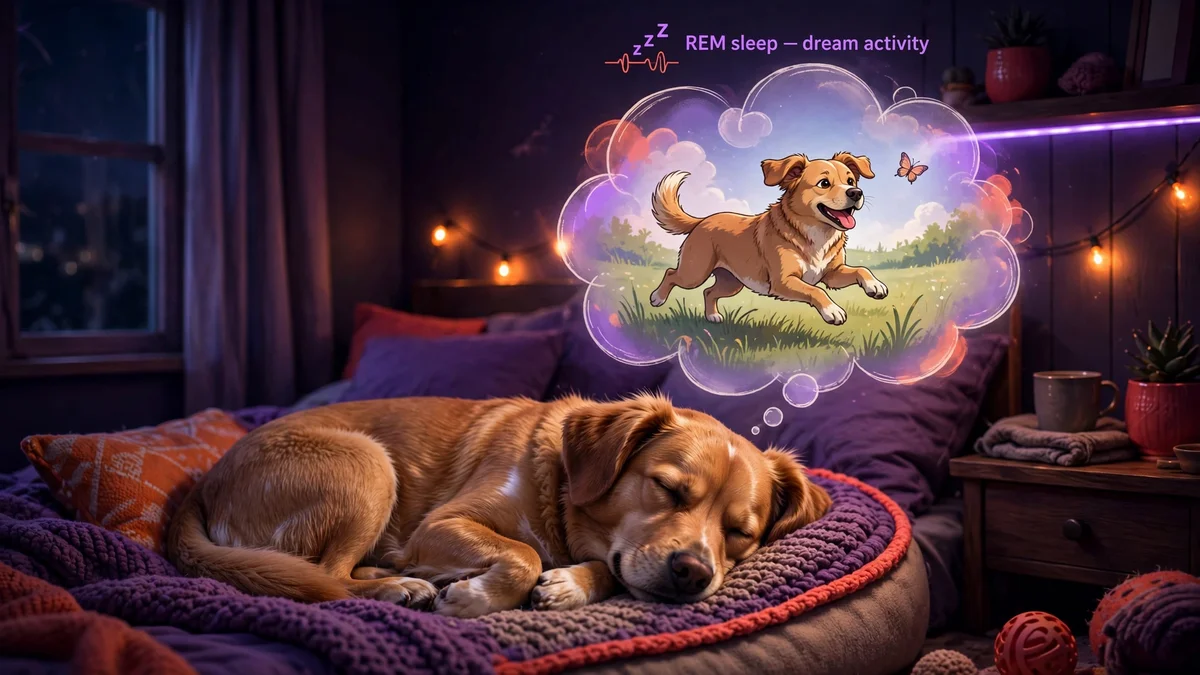
Do dogs dream? Science says yes — dogs have REM sleep and dream about daily life. Twitching, whimpering, and what studies show, explained simply.
Quick Answer: Dogs dream because their brains work much like ours during sleep. Brain scans show dogs pass through the same sleep stages as humans, including REM sleep, the stage where vivid dreams happen. When dogs twitch or whimper in their sleep, their brains are likely replaying memories of the day — games, walks, and their favorite people.
If you have ever watched your dog sleep, you have probably seen the signs. The paws start paddling as if running. The nose twitches. A soft whimper or a quiet bark escapes. The tail thumps against the bed. It looks exactly like dreaming — and science says that is exactly what it is.
Researchers have studied the brains of sleeping dogs using EEG, a method that records the brain’s electrical activity. What they found is striking: dogs go through the same stages of sleep that humans do. Their brains slow down, then speed up again in a repeating cycle, just like ours. One of those stages is REM sleep — the stage where humans have their most vivid dreams. When a dog’s brain enters REM, its eyes move under the eyelids and its body twitches, matching what we see in dreaming humans. The evidence points to one clear answer: yes, dogs dream.
Human sleep is not one flat state. We drift through light sleep, deep sleep, and dream sleep in repeating cycles through the night. Dogs do the same thing, which tells us their brains are built on the same basic plan.
Scientists who measured dogs’ brain waves found that dogs spend their sleep time in stages very much like ours. They are alert for part of it, drowsy for part of it, in deep slow-wave sleep for part of it, and in REM sleep for about 12 percent of it. The pattern rises and falls through the night just as it does in people.
This similarity makes sense when you look at the brain itself. A dog’s brain has the same basic structures as a human brain — the same regions for memory, emotion, and processing the senses. Since the hardware is so alike and the sleep stages match, scientists are confident that the experiences are alike too. When your dog’s brain enters REM sleep, it is almost certainly dreaming.
REM stands for “rapid eye movement,” and it is the most active stage of sleep. During REM, the brain wakes up inside the sleeping body. Brain waves look almost the same as when the animal is awake and alert. The eyes dart back and forth under closed lids. This is when humans have long, story-like dreams — and dogs appear to do the same.
During REM sleep, the brain replays the day. It sorts through what happened, files away important memories, and connects new experiences with old ones. In humans, this replay creates dreams. In dogs, the brain activity looks so similar that scientists believe the same thing is happening: the sleeping dog’s mind is running through the events of its day.
Think of it like a nightly highlight reel. The morning walk, the game of fetch, the squirrel at the fence, the taste of dinner — the brain reviews the footage. That is why a dog’s paws paddle during REM: the brain is running the day’s chase scenes again.
Here is a puzzle: if the brain is so active during REM sleep, why doesn’t the dreaming dog leap up and run around the room? The answer is a clever safety system built into the brain.
During REM sleep, the brain sends a signal that temporarily switches off the large muscles of the body. Scientists call this “REM atonia” — a fancy way of saying the body goes limp and still while the mind races. This muscle lock is what keeps us from acting out our dreams. Without it, a person dreaming about running would actually jump out of bed and run.
Dogs have the same safety lock. When your dog enters REM sleep, its brain paralyzes its big muscles so the body stays put on the bed while the mind runs wild. The twitches and small movements you see are tiny signals that slip through the lock — little leaks of the dream breaking through into the body. The system works well, but it is not perfect, and those small leaks are how we get to peek at the dream.
One of the most famous sleep experiments ever done helped prove that animals act out their dreams when the safety lock is removed. In the 1950s and 60s, a French scientist named Michel Jouvet studied a part of the brainstem called the pons. The pons is the control center that tells the muscles to stay still during REM sleep.
Jouvet disabled the pons in sleeping cats — in a careful laboratory setting — and watched what happened. The results were amazing. When the cats entered REM sleep without the muscle lock, they started moving as if they were awake. They lifted their heads, stalked invisible prey, pounced, and even acted as if they were defending themselves from attackers. Their bodies were revealing exactly what their dreaming minds were doing.
This experiment showed two things at once. First, it proved the pons is what keeps sleeping animals still. Second, it proved that the sleeping brain is running full, lifelike scenes — hunting, chasing, fighting — that the body wants to act out. Dogs have the same pons and the same lock, so the same dreaming must be happening behind their twitching paws.
Another landmark study showed that sleeping brains replay real memories. In 2001, a neuroscientist named Matthew Wilson at MIT recorded the brain activity of rats as they ran through mazes during the day. Tiny sensors picked up the exact pattern of brain cells firing while each rat learned its route.
Then the rats went to sleep — and something remarkable happened. During sleep, the same brain cells fired again in the same order. The rats’ brains were replaying the maze runs, step by step, as if the rats were running the maze again in their dreams. The replay was so exact that scientists could tell which part of the maze the sleeping rat was “visiting.”
This was strong evidence that dreams are built from real memories. The sleeping brain was practicing and storing the day’s experiences. Dogs have far more complex brains than rats, with richer memories and deeper emotions. If a rat’s brain replays a simple maze, a dog’s brain is almost certainly replaying the park, the backyard, and the people it loves.
Now we can put the pieces together and explain what you actually see. When your dog’s paws paddle, its brain is running a dream about moving — chasing a ball, running through the grass, racing another dog. The muscle lock holds most of the movement back, but small twitches slip through, and the paws make tiny running motions.
Whimpering, soft barking, and growling work the same way. The dreaming brain is living through an exciting or emotional scene, and a little sound escapes. A quiet “woof” might be a dream bark at a passing stranger. A whimper might be dream excitement or even a dream worry. The famous dog researcher Stanley Coren summed it up with vivid examples: Pointers may point at dream birds, and Dobermans may chase dream burglars. The body leaks the dream.
Even tail wagging in sleep has a meaning. Some owners call it “sleep wagging.” If the tail thumps during a dream, the dog is probably living through something happy — a greeting, a game, a treat. The dream feels good, and the tail shows it.
Nobody can ask a dog what it dreamed, but scientists can make a very good guess. The rule seems simple: dogs dream about dog things — the same way humans dream about human things.
A dog’s day is full of rich material for dreams. The walk around the block with all its smells. The game of fetch. The chase after a squirrel. Rolling in the grass. Greeting the family at the door. Learning a new trick and earning a treat. All of these experiences get replayed and processed during REM sleep.
Harvard dream researcher Deirdre Barrett explains that across all mammals, the dreaming stage of sleep looks very similar — and dreams are built from the animal’s real-life experiences. A dog does not dream about paying bills or missing a train. It dreams about the life it actually lives: smells, games, friends, food, and the people it loves. When your dog’s paws run in its sleep, it is probably chasing something wonderful.
This is the question every dog owner really wants answered — and the science gives a heartwarming answer. Probably yes.
Dogs spend most of their waking hours with their humans. You are the center of your dog’s world: you feed it, walk it, play with it, and comfort it. Since dreams are built from the strongest memories and emotions of the day, it would be strange if you did not appear in them.
Deirdre Barrett of Harvard Medical School has said that dogs most likely dream about their owners — their faces, their voices, their smells. A dog’s sense of smell is its strongest sense, so its dreams may be full of scents in a way human dreams are full of sights. Your smell, the smell of home, the smell of the park — these are the landmarks of your dog’s inner world.
So the next time your dog twitches and sighs in its sleep, picture this: it might be dreaming of you, right there beside it, on the best walk of its life.
Not all dogs dream on the same schedule. Size makes a difference, and the pattern is charming.
According to the research described by Stanley Coren, small dogs tend to slip into REM sleep more often — which means they have more dreams, but each dream is short. A tiny terrier might dream many quick dreams through the night. Large dogs work the opposite way: they enter REM less often, but when they do, their dreams last longer. A big Labrador might have fewer dreams, but each one is a full-length feature.
Nobody knows exactly why size changes the dream schedule, but it likely connects to how sleep cycles scale with body size in mammals. Smaller animals generally cycle through sleep stages faster. The practical result for owners is fun to watch: little dogs twitch and dream in frequent short bursts, while big dogs settle into long, deep dream sessions.
Either way, the dreaming itself is the same. Big or small, every dog’s brain takes its nightly trip through REM — just on a different timetable.
If you have ever watched a sleeping puppy, you know they are the twitchiest sleepers of all. There is a reason for that: young brains dream more.
Puppies spend a much larger share of their sleep in REM than adult dogs do. Their brains are growing fast, building new connections every day, and learning the world at an incredible pace. All that new information needs to be sorted and stored — and REM sleep is when the sorting happens. More learning means more dreaming, which means more twitching, paddling, and squeaking in sleep.
Senior dogs dream a lot too, but for a different reason. Older dogs simply sleep more hours per day, so they pass through more REM cycles. Their sleep can also be lighter and more broken, which makes their dreaming easier to notice. If your old dog twitches and murmurs in its sleep, it is likely replaying a lifetime of walks, games, and naps — a highlight reel many years in the making.
If dogs can have happy dreams, it is natural to wonder whether they can have bad ones too. Most scientists who study dog sleep believe the answer is yes.
Stanley Coren, who has written extensively about dog dreams, believes dogs can have nightmares just as humans do. A dog that whimpers, cries, or seems distressed in its sleep may be living through a frightening dream — perhaps a memory of a scary thunderstorm, a harsh scolding, or a run-in with an aggressive animal. The brain replays bad experiences as well as good ones, and the sleeping dog feels them again.
This is worth knowing because it changes how you respond. A dreaming dog that seems upset does not need to be shaken awake — sudden waking can startle any sleeping animal. Instead, you can speak softly or gently stroke the dog once it stirs on its own. Most dog dreams, like most human dreams, are ordinary or pleasant. Nightmares seem to be the exception, not the rule. A well-loved dog with a safe, happy life mostly dreams a safe, happy life.
The old saying “let sleeping dogs lie” turns out to be good advice — especially when the dog is dreaming.
Waking a dog suddenly from deep REM sleep can startle it. A startled dog may snap or bite without meaning to, simply because it woke up confused in the middle of a vivid dream. This is true for any dog, but it matters most with older dogs, anxious dogs, or dogs that are new to your home.
If you must wake a sleeping dog — for a vet visit, a walk, or an emergency — do it gently. Say the dog’s name in a soft, calm voice from a short distance away. Let it wake up on its own and figure out where it is before you touch it. Never shake a dreaming dog or shout right next to its ear.
Most of the time, though, the kindest choice is to do nothing at all. Watch the paws paddle, smile at the sleepy whimpers, and let the dream play out. Your dog is busy in there — running, playing, and probably dreaming about you.
As far as scientists can tell, yes. All dogs go through REM sleep, and REM sleep is when dreaming happens. Puppies, adults, and seniors all dream — just on different schedules.
It depends on the dog’s size. Small dogs have shorter, more frequent dreams. Large dogs have longer, less frequent dreams. A single REM period in a dog usually lasts a few minutes.
A sleep bark is a small piece of a dream leaking out. Your dog is probably barking at something in its dream — a visitor at the door, another animal, or an exciting moment of play.
True night terrors are a human sleep disorder, and there is no proof dogs get them. But dogs can have bad dreams that make them whimper or seem upset, which is the closest dog version of a nightmare.
Dogs see the world in shades of blue and yellow rather than full color, so their dreams are probably built from the same limited palette. But smell likely plays a much bigger role in dog dreams than it does in ours.
Yes, especially for puppies. Twitching, paddling, and soft sounds during REM sleep are all normal. Only worry if the twitching happens while the dog is awake, or if it looks like a seizure rather than gentle dreaming movements.
We cannot know for sure. But the whole point of dream sleep seems to be storing memories, so in a sense the dream’s work — filing the day’s events into long-term memory — stays with the dog after waking.
Puppies begin showing REM sleep within the first weeks of life. Newborn puppies spend most of their sleep in REM because their rapidly growing brains have so much learning to process.