Physical Address
4676 Railroad Street Marquette
MI 49855
Physical Address
4676 Railroad Street Marquette
MI 49855

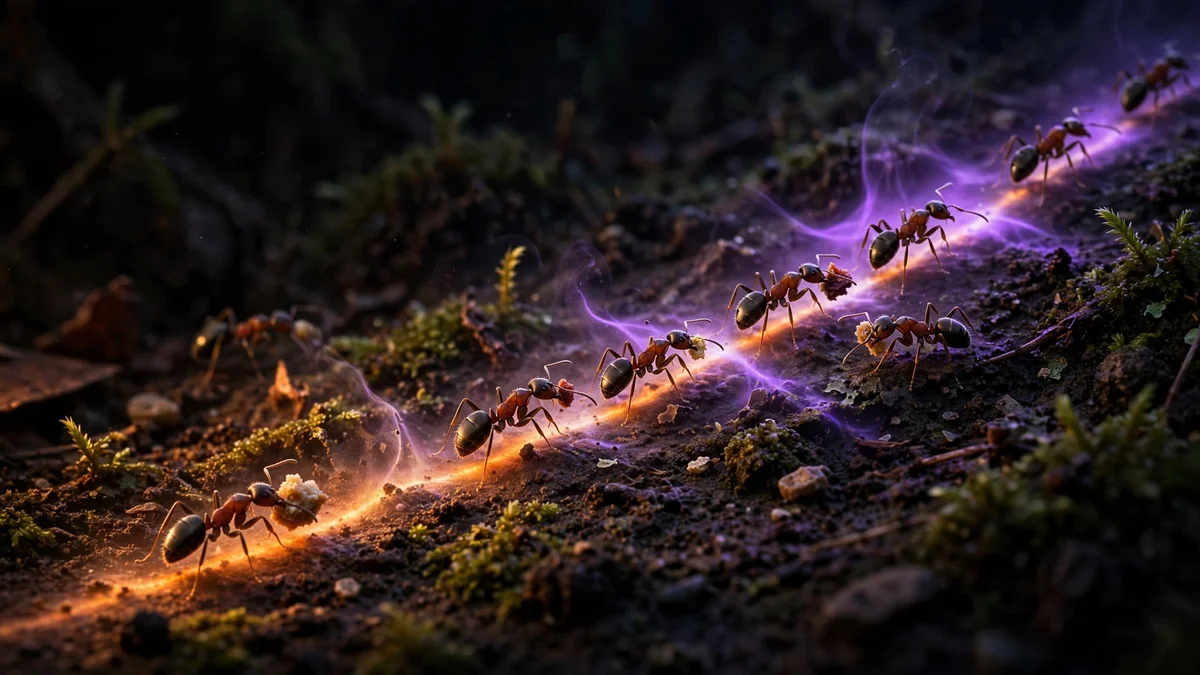
How do ants find food so fast? Learn how scout ants and pheromone scent trails guide the whole colony to crumbs — explained in simple words.
Quick Answer: Ants find food through scout ants and a chemical message system. Scouts wander randomly until they find crumbs or sugar. Then they walk home, leaving a scent trail called a pheromone path. Other ants follow that smell, and the trail grows stronger as more ants join. When the food runs out, the scent fades and the trail disappears.
You drop a tiny crumb on the floor. An hour later, there is a line of ants marching to it. It looks like magic. But it is really science.
Ants do not have maps. They do not have phones. They cannot shout directions. Yet somehow, hundreds of ants find the same tiny piece of food.
The secret is teamwork plus smell. One ant finds the food first. That ant is called a scout. On its way back to the nest, the scout leaves a chemical trail on the ground. This trail is made of special smell chemicals called pheromones.
Other ants smell this trail with their antennae. They follow it like a treasure map. When they reach the food, they carry some home. On their way back, they add more smell to the trail. Soon, the whole colony knows where the food is. A single colony can grow enormous — see how many ants are in a colony.
This simple system helps ants survive. A single ant is small and weak. But a colony working together can move mountains of food.
Every ant colony has explorers. These are the scout ants. Their job is simple: walk out and search.
Scouts leave the nest and wander in random directions. They have no plan. They just walk, turn, and check everywhere. It looks messy, but it works. With hundreds of scouts searching at once, they cover a lot of ground.
When a scout finds something tasty, everything changes. The scout tastes the food first. If it is good, the scout grabs a piece and heads home. But here is the clever part: the scout does not walk straight home.
On the way back, the scout touches its belly to the ground every few steps. Each touch leaves a tiny drop of pheromone — a chemical scent marker. This creates a dotted line of smell from the food back to the nest.
The scout is not just carrying food home. It is drawing a map that other ants can read with their noses. One ant alone could never carry a whole cookie crumb. But one ant can invite the whole colony.
Pheromones are the most important tool an ant has. These are special chemicals that ants make in their bodies. Different pheromones send different messages.
Trail pheromones say “food this way.” Alarm pheromones say “danger, run!” Queen pheromones say “I am the mother of this colony.” Ants can also leave pheromones that mark territory or point to a new nest site.
Ants smell these chemicals with their antennae. Antennae are the two bendy feelers on an ant’s head. They work like super-sensitive noses. Ants can detect pheromones in amounts so small that humans could never smell them.
What makes pheromones so smart is that they fade over time. The smell slowly disappears into the air. This is not a flaw — it is a feature. If the smell never faded, old trails to empty food would confuse the colony forever.
Because pheromones fade, only fresh, busy trails stay strong. The colony always follows the newest and most useful information. It is like a live update system, written in smell.
Let us walk through exactly how an ant trail appears from nothing.
Step one: a scout ant leaves the nest and wanders randomly. It may walk for a long time and find nothing. Most scouts fail most of the time. That is normal.
Step two: one lucky scout finds a crumb of bread. It eats a little to test it. Good food means it is worth sharing.
Step three: the scout picks up a piece and walks home, dabbing pheromone drops along the way. The trail is weak at first — just one ant’s worth of smell.
Step four: the first ant to smell the trail follows it. It finds the food, grabs a piece, and walks home — adding its own pheromone drops on top. Now the trail is twice as strong.
Step five: more and more ants follow and add their smell. The trail gets stronger and stronger. Within an hour, a busy highway of ants stretches from nest to crumb.
Step six: the food runs out. Ants stop adding pheromone. The old smell fades away. The highway disappears as if it was never there.
This whole process needs no boss ant giving orders. No ant is in charge. The trail builds itself through simple rules each ant follows.
The fading smell is what makes the ant system so clever. Think about it: what happens when the food is gone?
If pheromone trails lasted forever, ants would keep marching to empty spots for days. They would waste time and energy. The colony would starve while following ghost trails.
Instead, pheromones evaporate. Scientists say most trail pheromones last from a few minutes to a few hours, depending on the ant species and the weather. Hot, windy days erase trails faster. Cool, calm days keep them longer.
This means a trail only survives if ants keep refreshing it. Every ant walking home adds fresh drops. As long as food remains, the trail stays strong. The moment food runs out, the refresh stops, and the trail dies.
It is a perfect feedback loop. Success keeps the trail alive. Failure lets it die. The colony never has to decide anything — the chemistry decides for them.
Some scientists call this “collective memory.” The colony remembers where food is, not in one brain, but in the smell on the ground. When the smell is gone, the memory is gone too.
Here is something truly amazing: ants often find the shortest route to food. Scientists have tested this many times, and the results are always the same.
In one famous experiment, scientists put food on one side and an ant nest on the other, with two bridges of different lengths between them. At first, ants used both bridges. But within an hour, almost all ants were using the shorter bridge.
How did they know? No ant measured anything. The answer is in the fading smell.
Ants on the shorter bridge finish their round trip faster. So they lay fresh pheromone more often. The shorter path gets more smell per minute than the longer one. Ants choosing between the two bridges smell more pheromone on the short one, so more of them pick it.
Those ants then add even more smell to the short bridge. The long bridge gets less and less traffic. Its smell fades. Soon, the whole colony has switched to the shortest path.
Nobody planned this. Nobody did math. The shortest path just emerges from simple rules. Computer scientists have even copied this trick to solve real problems, like planning delivery routes. They call it the “ant colony algorithm.”
Ants are not picky eaters. Most ant species eat almost anything they can carry. But they do have favorites.
Sugar is the number one ant food. Honey, syrup, fruit juice, and candy all drive ants wild. Sugar gives them quick energy for all that marching. That is why ants swarm your spilled soda so fast.
Protein comes second. Dead insects, meat scraps, and pet food are rich in protein. The colony needs protein to feed growing baby ants, called larvae. Worker ants often carry protein straight to the nursery.
Fats and oils are also popular. Butter, cooking oil, and greasy crumbs attract many ant species. Some ants, called grease ants, prefer fats over sugar.
Ants also drink water. They need it just like we do. In dry weather, a dripping tap can attract a whole trail of thirsty ants.
Different species have different tastes. Leafcutter ants do not eat leaves at all — they carry leaf pieces home to grow fungus, which they eat. Some ants “farm” tiny insects called aphids, protecting them in exchange for sweet honeydew they produce.
So when you see ants in your kitchen, they are not just being pests. They are grocery shopping for thousands of hungry family members.
An ant colony is one of the best teams in nature. A single ant is small and simple. But a colony of thousands acts almost like one giant living thing.
The queen ant is the mother of the colony. She can live for many years and lays all the eggs. But she does not give orders. Nobody does.
Worker ants are all female, and they do every job. Some are nurses, caring for eggs and larvae. Some are builders, digging tunnels and chambers. Some are soldiers, guarding the nest. And some are foragers — the scouts and carriers that find food.
Workers switch jobs as they age. Young workers usually stay inside, caring for babies. Older workers take on riskier jobs outside, like foraging. This way, the colony protects its youngest members.
When a big piece of food is found, ants team up to carry it. They grip it from all sides and pull together. Ants can carry 10 to 50 times their own body weight. That is like a human carrying a car.
They also build living bridges with their own bodies. Army ants link together to cross gaps. Weaver ants pull leaves together and stitch them with silk from their larvae. No architect designed this — it all comes from simple instincts working together.
Ants cannot speak, but they communicate all the time. They use three main channels: smell, touch, and vibration.
Smell is the biggest one. We already learned about trail pheromones. But ants also release alarm pheromones when attacked. One ant in danger can warn the whole colony in seconds. Some species release a “come help” pheromone when they find food too big to carry alone.
Touch matters too. Ants constantly tap each other with their antennae. This tapping can pass information about food quality or direction. When two ants meet on a trail, they often stop and touch antennae for a moment — like a quick handshake before continuing.
Some ants also make sounds. They rub body parts together to create tiny vibrations. Scientists call this stridulation. These vibrations can travel through the ground or through nest walls. Queen ants use special sounds to tell workers who is in charge.
Recent research even shows that ant pupae — the stage between larva and adult — can make sounds. Worker ants respond to these baby sounds by paying more attention to them. The babies are literally calling for care.
Put it all together, and ants have a rich communication system. It is just written in chemistry and touch instead of words.
Ants have abilities that would make superheroes jealous. Let us look at their greatest powers.
First, strength. Ants are among the strongest creatures on Earth for their size. As we said, many can lift 10 to 50 times their body weight. Their muscles are packed tightly into their small bodies, giving them incredible power.
Second, numbers. A single colony can hold from a few hundred to millions of ants. Some supercolonies of Argentine ants stretch for thousands of miles and contain billions of workers. With numbers like that, no crumb is safe.
Third, endurance. Ants work around the clock. Foragers march for hours without rest. Inside the nest, nurses tend babies day and night. The colony never sleeps as a whole, even if individual ants take tiny naps.
Fourth, farming and ranching. Leafcutter ants grow fungus gardens. Other ants herd aphids like tiny cattle, milking them for sweet honeydew and protecting them from predators. Some ants even keep “pets” — beetles that live in the nest and are fed by workers.
Fifth, toughness. Ants survived the asteroid that killed the dinosaurs. They live on every continent except Antarctica, in deserts, rainforests, and cities. There are over 12,000 known ant species, and scientists think many more are waiting to be discovered.
If ants keep appearing in your home, now you know exactly why. Your kitchen is a treasure chest of sugar, protein, and water — everything a colony needs.
It usually starts with one scout. That brave explorer slips through a tiny crack under the door or around a window. Cracks as thin as a credit card are wide enough for many ant species.
The scout finds a crumb, a spill, or an open sugar jar. It lays its pheromone trail home. Within an hour, the highway appears. The ants are not being rude — they are just following a smell map to food.
To stop them, break the trail. Wiping the path with soapy water or vinegar removes the pheromone smell. Without the scent map, the ants get lost and give up.
Sealing food in tight containers removes the reason to visit. Fixing cracks and gaps removes the doorway. And finding the nest — often outside near the house — lets you deal with the source.
But remember: those marching ants are doing something remarkable. With no leader, no map, and no words, they found your crumb across a huge distance. That tiny line of ants is one of nature’s smartest systems at work.
Scout ants search randomly until one finds food. That scout leaves a pheromone scent trail on its way home. Other ants follow the smell, and each adds more scent. The trail grows strong fast, so hundreds of ants can arrive within an hour.
A pheromone trail is a path of chemical scent markers that ants lay on the ground. Ants smell these markers with their antennae and follow them to food or back to the nest. The smell fades over time unless ants keep refreshing it.
Not in their brains the way we remember things. Instead, the colony “remembers” through the pheromone trail on the ground. As long as the smell is fresh, ants keep coming. When the smell fades, the memory is gone.
They are following the pheromone trail left by earlier ants. The line looks straight because every ant walks exactly where the smell is strongest — right on top of the trail.
No. Most ants have poor eyesight. They find food by smell and touch, not sight. Their antennae detect food odors and pheromone trails, which guide them step by step.
Ants have very strong neck and jaw muscles packed into their small bodies. They can lift 10 to 50 times their body weight. For big items, many ants grip together and pull as a team.
No. Only forager ants leave the nest to find food. Other workers stay inside as nurses, builders, or guards. The queen stays deep in the nest laying eggs and never forages.
Pheromone chemicals evaporate into the air. When food runs out, ants stop adding fresh scent to the trail. Without refreshment, the old smell fades and the trail vanishes within minutes or hours.