Physical Address
4676 Railroad Street Marquette
MI 49855
Physical Address
4676 Railroad Street Marquette
MI 49855
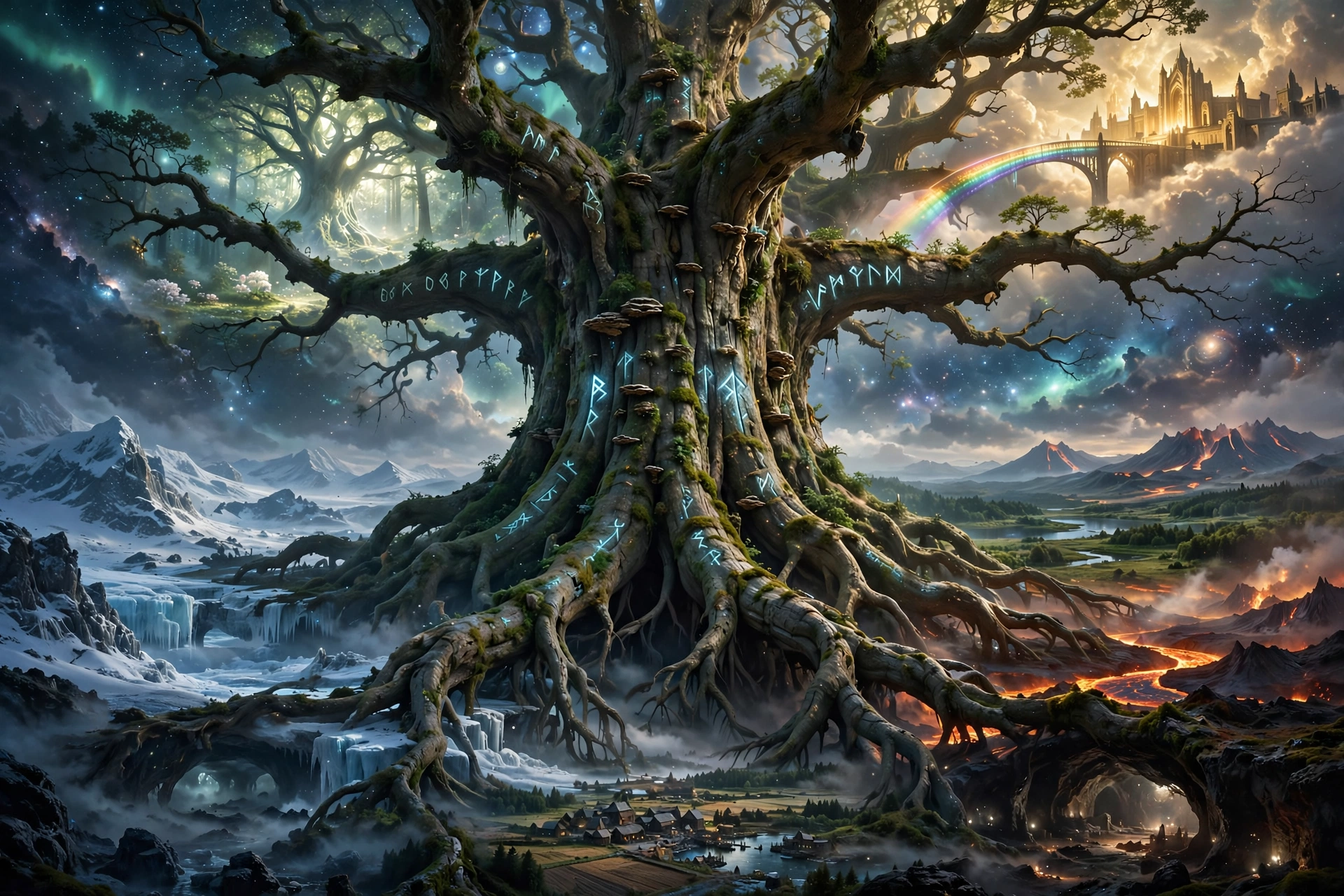
A symbol is an image that means more than what it shows. A heart shape means love. A dove means peace. Yggdrasil — the giant World Tree of Norse mythology — is one of the richest symbols ever created. It is not just a big tree. It is a picture of how the Norse people understood everything: life, death, the gods, nature, time, and the connections between them all.
To understand what Yggdrasil symbolizes, we need to look at it from several angles. Like a real tree with many branches, its meaning spreads in many directions at once.
The most basic symbolism of Yggdrasil is connection. The tree’s branches reach into the heavens, its trunk passes through the human world, and its roots go down into the underworld. The Nine Worlds — Asgard, Midgard, Jotunheim, and the rest — do not float separately. They are all attached to the same tree.
This tells us something important about how the Norse saw the world. In their view, gods and humans were not totally separate. The world of the dead was not far away. Nature, the divine, and everyday life were all part of one connected system. What happened in one world affected the others. When Nidhogg chewed the roots, the whole tree suffered. When the Norns watered the roots, the whole tree was healthy.
Many religions picture the universe as a ladder — humans at the bottom, gods at the top, with a one-way climb upward. Yggdrasil is different. It is more like a web. Things move up and down: the squirrel Ratatoskr runs both ways, Odin travels between worlds, the dead go down while the gods look up. Connection goes in every direction.
This reflects a worldview where everything affects everything else. The Norse did not believe humans were separate from nature or the gods were separate from fate. All were tangled together in the branches of one great tree.
Yggdrasil is constantly being damaged. The dragon Nidhogg chews its roots. Four deer eat its leaves. Countless snakes bite at it. The squirrel spreads conflict. And yet the tree stands. Every day, the Norns pour sacred water on its roots, and every day the damage continues — but the tree endures.
This is a powerful symbol of resilience. Life, the tree says, is not about avoiding damage. Damage is constant and unavoidable. Life is about enduring anyway — about being watered, healed, and continuing to stand despite everything chewing at your roots.
For the Norse people, who lived in one of the harshest climates on earth, this symbolism would have felt deeply personal. They survived long winters, poor harvests, dangerous sea voyages, and constant warfare. Like Yggdrasil, they were always under attack — and like Yggdrasil, they endured.
The tree’s endurance also points forward to Ragnarok. When the end of the world comes, Yggdrasil will shake and groan — but it will not fall. It will shelter the last two humans inside its trunk. Endurance is not just surviving the everyday; it is surviving even the end of everything.
Look at where Yggdrasil’s parts reach. Its highest branches touch Asgard, home of the gods — the realm of power and light. Its deepest roots reach into Helheim and Niflheim — realms of the dead, ice, and darkness. The tree spans the full range from life to death.
This symbolizes the Norse understanding that life and death are not opposites — they are connected parts of one cycle. The tree draws nourishment from the dark places below (the wells of the dead and of wisdom) and grows upward toward the light. Death feeds life. The past feeds the future.
The three Norns who water Yggdrasil represent the past, present, and future. Every day they pour water over the roots — a daily renewal, a daily act of care. This symbolizes that the universe needs constant maintenance. Time does not just pass; it must be tended. The past (the roots, the wells) must be honored for the present (the trunk) to stand and the future (the branches) to grow.
The ultimate symbol of rebirth is what happens after Ragnarok. The world is destroyed — but Yggdrasil survives, and from inside it come Lif and Lifthrasir, who start humanity over. The tree is literally a womb for the new world. Death is not the end. From the oldest living thing comes the newest life.
Yggdrasil is deeply connected to wisdom. Odin hung himself from its branches to learn the runes. He gave up his eye at the well beneath its roots. The tree is where the greatest knowledge is won — but only through sacrifice.
This symbolizes an important truth: wisdom is not free. The tree does not hand out answers. It demands that you climb, suffer, and reach. The branches are high. The roots are deep. Getting to either requires effort and courage.
The tree’s vertical shape — roots below, branches above — symbolizes the journey of learning. You must go deep (into the roots, the past, the hidden things) and also reach high (toward the branches, the future, the divine). True wisdom, the tree suggests, requires both: understanding where things come from and where they are going.
Yggdrasil is alive. It grows, it suffers, it is watered, it shelters creatures. This symbolizes the Norse view that the universe itself is a living thing — not a machine, not an empty stage, but a growing, breathing organism.
Every creature on the tree matters: the eagle, the hawk, the squirrel, the deer, the dragon, the snakes, the goat. They are not decorations. They are part of the tree’s life. This reflects a worldview where humans are not separate from nature but part of it — one creature among many on the great tree.
The Norse did not need temples to find the sacred. A tree — something they saw every day — became the image of the entire cosmos. This symbolizes the idea that the divine is not far away in some unreachable heaven. It is right here, in the living world around us, if we know how to look.
| Tradition | World Tree | What It Connects |
|---|---|---|
| Norse | Yggdrasil (ash) | Nine Worlds |
| Hindu/Buddhist | Bodhi tree / Mount Meru | Earth and heavens; enlightenment |
| Mayan | Ceiba tree | Underworld, earth, sky |
| Siberian shamanic | World pillar/tree | Spirit worlds |
| Biblical | Tree of Life / Tree of Knowledge | Eden; life and moral knowledge |
The idea of a world tree appears in cultures around the globe. This suggests it taps into something universal in human thinking: the image of a tree — rooted in darkness, reaching toward light, connecting earth and sky — feels true across cultures. Yggdrasil is the Norse version of an idea that belongs to all humanity.
You do not have to believe in Norse gods for Yggdrasil to mean something. The tree works as a personal symbol too:
When life is difficult — when you feel like Nidhogg is chewing at your roots — Yggdrasil offers a different way to think. The tree does not panic. It does not give up. It stands, it endures, and every day it is watered. Damage is part of life, but so is healing. And like the tree after Ragnarok, you can survive even the worst and grow again.
Learn more about the tree itself in our guide to what Yggdrasil is, and the story of Odin’s sacrifice on its branches. For more Norse legends, see King Arthur: myth vs. reality.
Spiritually, Yggdrasil represents the interconnectedness of all existence, the endurance of life through suffering, and the cycle of death and rebirth. It teaches that everything — gods, humans, nature — is part of one living whole.
Yggdrasil is the structural center of the Norse universe. Without it, the Nine Worlds would have nothing holding them together. It is also the site of Odin’s greatest sacrifice and the shelter that preserves life through Ragnarok.
The Norse Tree of Life (Yggdrasil) symbolizes cosmic order, the link between worlds, resilience, and the idea that life continues through death. It is both a physical structure of the universe and a spiritual teaching.
Yggdrasil works on multiple levels — it is described as a real tree in the myths, but it also functions as a rich metaphor for connection, endurance, time, wisdom, and the relationship between life and death.
During Ragnarok, Yggdrasil shakes violently but does not fall. After the world’s destruction, the last two humans emerge from inside its trunk to begin the new world — making the tree a symbol of hope and continuity.
The three roots represent connections to different realms of existence: the divine (Asgard), the wild and ancient (Jotunheim), and death and the deep past (Niflheim). Together they show that life draws from all levels of reality.
No. World trees or cosmic trees appear in Hindu, Buddhist, Mayan, Siberian, and other traditions. The image of a great tree connecting heaven, earth, and underworld seems to be a universal human symbol.
Many people use Yggdrasil as a personal symbol for grounding (roots), presence (trunk), and growth (branches). Its message of endurance through hardship resonates far beyond its mythological origins.