Physical Address
4676 Railroad Street Marquette
MI 49855
Physical Address
4676 Railroad Street Marquette
MI 49855

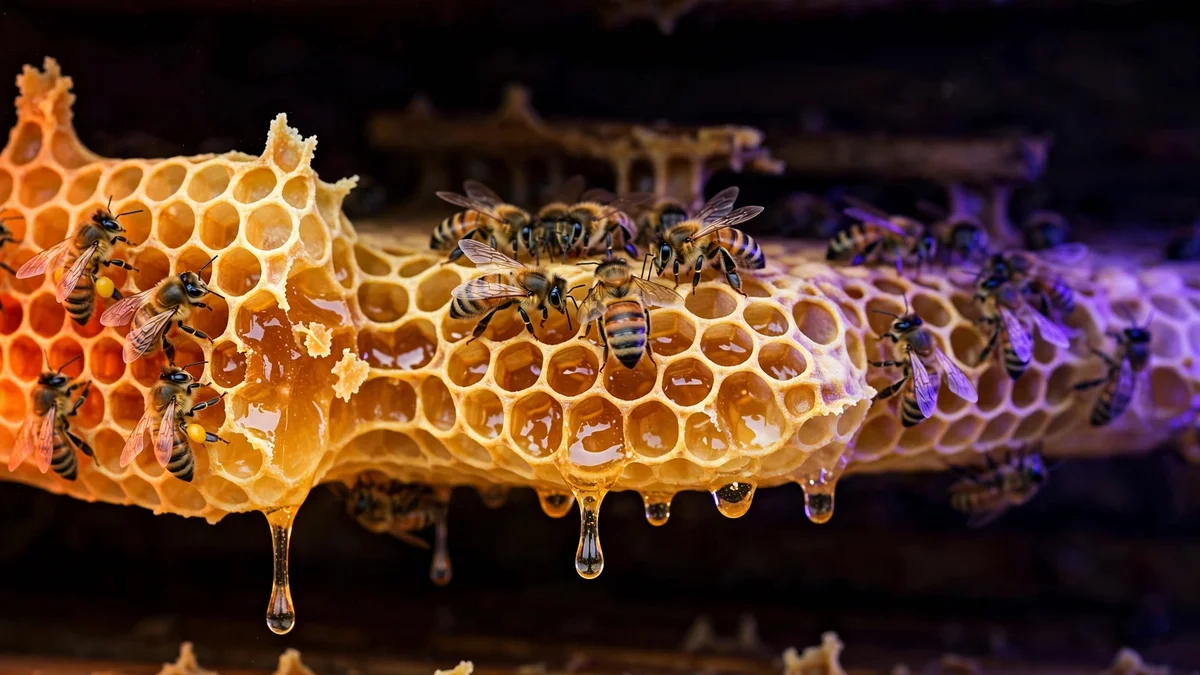
How do bees make honey? Follow the simple steps: nectar collection, enzymes, fanning, and wax capping — explained in plain words.
Quick Answer: Bees make honey by collecting flower nectar, then carrying it home in a special stomach. Inside the hive, they pass nectar bee-to-bee, add enzymes that break down sugars, then fan it with their wings to dry it. When the honey is thick enough, they seal it with wax. A full honeycomb cell takes days of teamwork.
Every drop of honey begins inside a flower. Flowers make a sweet, watery liquid called nectar. They do this on purpose. Nectar is a bribe. The flower wants bees to visit, because a visiting bee carries pollen from flower to flower and helps the plant make seeds.
A worker bee lands on a blossom and drinks the nectar with her long, straw-like tongue. Her tongue is called a proboscis, but you can just think of it as a tiny built-in straw. The nectar goes into a special storage pouch in her body. She may visit 50 to 100 flowers on a single trip before her pouch is full.
Not all flowers make the same nectar. Nectar from orange blossoms tastes different from nectar from clover or wildflowers. That is why honey from one place tastes nothing like honey from another. The flowers a bee visits decide the honey’s color and flavor. Light honey comes from mild flowers like clover. Dark honey comes from stronger flowers like buckwheat.
The bee does not swallow the nectar into her real stomach. She stores it in a separate pouch called the honey stomach, or crop. Think of it as a delivery tank. The honey stomach sits in front of her digestive stomach, and a small valve keeps the two apart.
Why does this matter? Because the bee needs fuel for the flight home. The valve lets her send a little nectar into her real stomach to burn as energy. The rest stays untouched in the honey stomach, ready to become honey for the hive.
Inside the honey stomach, something important already starts to happen. The bee’s body adds a first dose of natural chemicals called enzymes to the nectar. These enzymes begin breaking down the nectar’s sugars right away. So the change from nectar to honey really starts during the flight home, before the bee ever reaches the hive.
When the forager bee returns to the hive, she does not pour the nectar straight into a honeycomb cell. Instead, she hands it off to a younger house bee. The forager opens her mouth and passes the nectar to the house bee, who drinks it up.
This handoff can happen several times. One house bee passes the nectar to another, and another. Scientists call this mouth-to-mouth sharing trophallaxis, but it is really just teamwork. Each pass gives the nectar more time to mix with enzymes, and it lets the older foragers head back out to collect more.
You can think of it like a bucket brigade. When firefighters pass buckets of water down a line, the water moves fast because no one walks far. Bees do the same thing with nectar. The bucket brigade keeps the honey-making line moving while the foragers keep flying.
Enzymes are the true magic in honey-making. An enzyme is a natural substance that causes a chemical change. Your own saliva has enzymes that start digesting food the moment you chew. Bees use their enzymes to transform nectar.
The most important enzyme is called invertase. Nectar’s main sugar is sucrose — the same sugar in your sugar bowl. Invertase breaks sucrose into two simpler sugars: glucose and fructose. This matters because glucose and fructose dissolve more easily and resist crystallizing too fast, which keeps honey smooth and stable.
A second key enzyme is glucose oxidase. When this enzyme touches glucose, it creates a mild acid and a tiny amount of hydrogen peroxide. That sounds scary, but it is actually nature’s preservative. It keeps bacteria and mold from growing in the honey. This is one reason honey almost never spoils.
The house bees chew the nectar for 20 to 30 minutes, working it like dough. Every chew mixes in more enzymes. Without this step, honey would just be sweet water that rots.
Fresh nectar is about 70 to 80 percent water. It is thin and runny, more like fruit juice than honey. If you left nectar in a jar, it would ferment and spoil within days. Yeast in the air would eat the sugars and turn them sour.
Honey is only about 17 to 18 percent water. That is the whole difference. Thick honey has so little water that germs cannot survive in it. They simply dry out. This is called low water activity, and it is why honey lasts for years without going bad.
So the bees’ main job is really a drying job. They must remove most of the water from the nectar. Everything they do — the passing, the chewing, the fanning — serves this one goal. When the water level drops low enough, the nectar has officially become honey.
Scientists can test this. Beekeepers use a small tool called a refractometer to measure the water content. If it reads around 18 percent or lower, the honey is done. Bees do not have refractometers, but as we will see, they have their own clever way of checking.
After the chewing is done, the house bees spread the nectar in thin drops inside the honeycomb cells. Then comes the drying. Hundreds of bees line up near the hive entrance and inside the hive, and they beat their wings fast.
This is called fanning. The wing-beating creates a steady breeze that flows across the open cells. Warm air from the hive picks up the water and carries it out of the hive. The hive stays warm on purpose — about 95 degrees Fahrenheit (35 degrees Celsius) — because warm air holds more water and dries the nectar faster.
A single bee beats her wings about 200 times per second when fanning. Multiply that by hundreds of bees, and you get a powerful drying machine made entirely of living insects. The fanning can go on for hours or even days, depending on how wet the nectar was and how humid the air is outside.
On a hot summer day, you can sometimes hear a hive humming louder than usual. That is often the sound of thousands of tiny wings working overtime to dry the day’s nectar haul.
Bees cannot read a refractometer, but they can still tell when honey is done. They check with their mouthparts and antennae. Experienced house bees can taste and feel when the honey has reached the right thickness.
The rule is simple: when the water content drops to about 18 percent, the honey is finished. At that point it is thick, sticky, and safe from germs. The bees then move on to the final step — sealing it.
Interestingly, bees almost never cap a cell too early. Capping wet honey would trap the extra water inside and let it ferment. The colony’s survival depends on getting this right, because honey is their winter food. Bad honey means a hungry winter. So the bees are careful, patient quality-checkers.
If you watch a hive, you will see bees walking over the comb, pausing at open cells, and tasting. They are the quality control team. Only when a cell passes inspection does it get its wax seal.
Once the honey is thick enough, the bees cover each full cell with a thin lid of beeswax. This is called capping. The cap keeps moisture out and locks the honey in for months.
The cap is not fully airtight — tiny amounts of air can pass through — but it is good enough to keep the honey safe until the colony needs it. Capped honey is finished honey. Beekeepers know this too: they only harvest frames where most of the cells are capped, because that guarantees ripe, low-water honey.
Making the caps takes wax, which the bees produce from their own bodies (you can read all about that in our guide to how bees make wax). A strong colony in a good season can cap thousands of cells per day.
The sight of a fully capped frame is beautiful — a smooth sheet of pale wax, every cell sealed like a tiny jar. Underneath each lid sits golden honey, waiting for winter.
Honey is stored in honeycomb, and honeycomb deserves its own moment of praise. Bees build it from wax in rows of six-sided cells called hexagons. The hexagon shape is no accident. It is the most efficient shape in nature: it holds the most honey while using the least wax, and the cells fit together with zero wasted space.
A single frame of honeycomb can hold several pounds of honey. The comb hangs vertically, and the cells tilt slightly upward so the honey does not drip out before it is capped.
Bees also use comb for other jobs. Some cells hold pollen, the bees’ protein food. Others are nurseries where baby bees grow. But the deep, golden cells filled edge to edge are the honey pantry — the colony’s savings account for hard times.
A healthy hive in summer is a construction site. Bees are constantly building new comb, filling it, capping it, and starting over. The pantry never stops growing while flowers bloom.
Now for the number that amazes everyone. To make just one pound of honey — about one and a half cups — bees must visit around two million flowers. Together, the foragers of a hive fly roughly 55,000 miles for that single pound. That is more than twice around the entire Earth.
A single bee makes only about one-twelfth of a teaspoon of honey in her whole life. Her wings beat about 200 times per second, and she may fly up to five miles from the hive on one trip. She does all of this in a life that lasts only six weeks in summer.
When you hold a jar of honey, you are holding the lifetime work of hundreds of bees. It took thousands of flower visits, miles of flying, hours of chewing, and days of fanning. No factory on Earth matches that level of teamwork.
This is also why bees make far more honey than they need. A strong hive can produce 60 to 100 pounds of surplus honey in a good year. That extra is what beekeepers harvest — and the bees never miss it.
Archaeologists once found pots of honey in ancient Egyptian tombs. The honey was 3,000 years old — and still perfectly edible. No other food on Earth lasts that long. Here is why.
First, honey is too dry for germs. With only about 18 percent water, bacteria and mold simply cannot grow. They need water to live, and honey gives them almost none.
Second, honey is acidic. Its pH sits around 3.9, similar to orange juice. Most germs hate acidic places.
Third, the glucose oxidase enzyme keeps working even in the jar. Whenever honey touches a little moisture, the enzyme makes tiny amounts of hydrogen peroxide — the same stuff used to clean cuts. It is far too weak to hurt you, but it is plenty strong to stop germs.
So honey does not spoil. It may darken over time, and it may crystallize into a grainy solid — but crystallized honey is still perfectly good. A gentle warm-water bath melts the crystals right back.
Bees make honey in spring and summer, when flowers bloom. But they eat it in fall and winter, when flowers are gone. Honey is the colony’s stored sunshine — summer energy saved for dark months.
In winter, the bees form a tight cluster around the queen. They shiver their flight muscles to make heat, keeping the cluster around 95 degrees Fahrenheit even when it is freezing outside. That shivering burns enormous energy, and honey is the fuel.
A colony needs 50 to 60 pounds of honey to survive a cold winter. The bees eat it slowly, month by month, never leaving the hive. Come spring, the survivors raise new workers, the flowers open, and the whole beautiful cycle starts again.
This is the real reason bees make honey. Not for us — for themselves. We are just lucky they make extra.
Is honey bee vomit?
No. Vomit comes from the digestive stomach, but nectar is stored in a separate honey stomach that is only for carrying. The bee never digests it. A better word is regurgitation, which just means bringing stored food back up.
Do bees poop in honey?
No. Bees are very clean about their food. They never relieve themselves inside the hive or near the honey. On cleansing flights outside the hive, they take care of that business far away from home.
How long does it take bees to make honey?
From flower to capped cell usually takes one to three days. Filling a whole frame can take a strong colony about a week in a good nectar flow. Slow seasons take longer.
Do bees die when they make honey?
No. Making honey is normal daily work for bees. Worker bees do eventually wear out — a summer worker lives about six weeks — but honey-making itself does not kill them.
Can bees make honey without flowers?
They need some sweet source. If flowers are scarce, bees may collect honeydew (a sweet liquid made by aphids) or even sugary spills. Honeydew honey is darker and less sweet but still real honey.
How much honey does one hive make?
A strong hive makes 60 to 100 pounds of honey per year in a good location. The colony needs about half of that for winter, so beekeepers harvest only the surplus.
Is the honey we eat stolen from bees?
Responsible beekeepers only take the extra honey the colony does not need, and they leave enough for winter. Many beekeepers also feed their bees sugar syrup if stores run low. The bees are not harmed.
Why does some honey crystallize and some stay liquid?
It depends on the flower source. Honey high in glucose (like clover honey) crystallizes fast. Honey high in fructose (like tupelo honey) can stay liquid for years. Crystallization is natural and does not mean the honey went bad.
Bees work from sunrise to sunset — but do bees sleep at night?