Physical Address
4676 Railroad Street Marquette
MI 49855
Physical Address
4676 Railroad Street Marquette
MI 49855

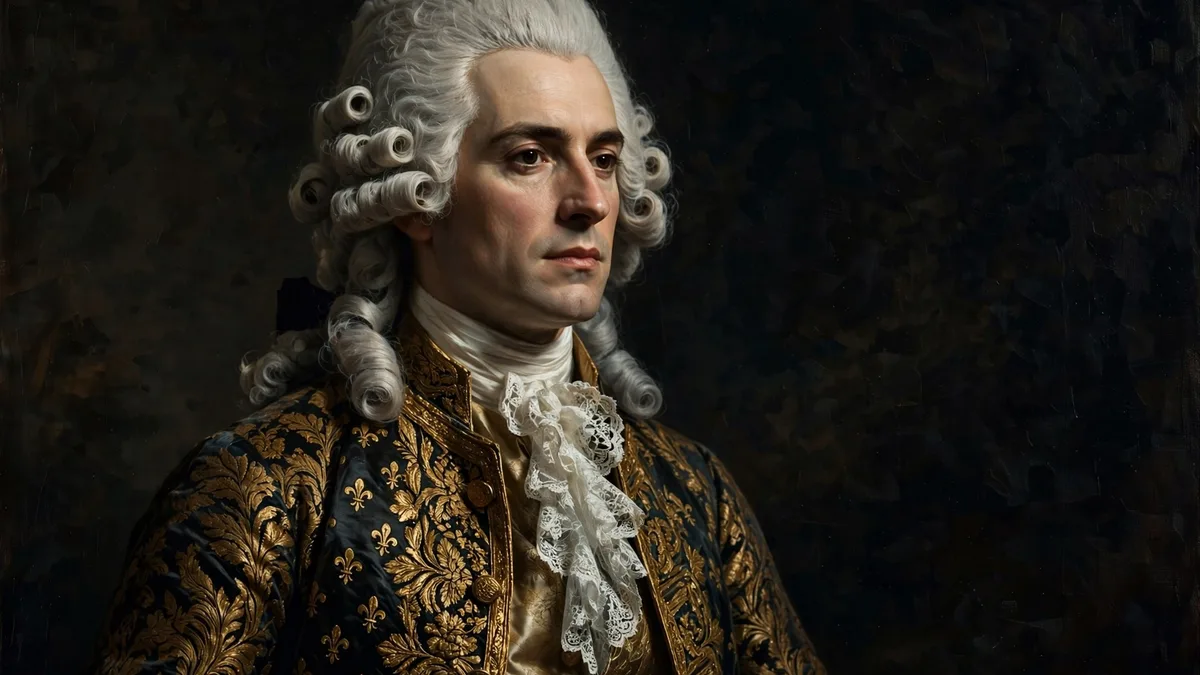
Look at any portrait of a gentleman from the 1700s and you will see it: towering white wigs, powdered to perfection, cascading in curls. For over a hundred years, this strange headgear was as normal as a necktie is today. Judges, politicians, and aristocrats all wore them. For over a century, no respectable man left the house without one.
But why did people wear powdered wigs in the 1700s? The answer is less about fashion than you might think. The real reasons involve head lice, a devastating disease, royal vanity — and one of history’s strangest taxes.
Quick answer: Powdered wigs began as a cover for hair loss — partly from syphilis, partly from shaved heads meant to fight lice. French kings made them fashionable, and soon no man of status dared appear without one. The powder (scented starch) whitened the wig and masked odors. The fashion died when Britain taxed hair powder in 1795 and revolutionaries in France rejected aristocratic excess.
The 1700s were full of strange customs. For more odd history from the era of big celebrations, see our history of New Year’s Eve. For a very different kind of history, try the history of Black Friday.
The wig craze began at the top — literally. In the early 1600s, King Louis XIII of France began losing his hair young. For a monarch, image was everything. A balding king looked weak. So he did what any 17th-century king would do: he covered it up with a wig.
His son, Louis XIV, took the trend stratospheric. The Sun King was obsessed with appearance and grandeur. He wore enormous, flowing wigs — the “full-bottomed peruke” — with long curls cascading past his shoulders. Portraits show wigs so large they nearly doubled the size of his head.
When the most powerful man in Europe wears something, everyone copies it. Beauty standards have always flowed from the top — see Cleopatra’s beauty secrets for an ancient example. French nobles adopted wigs. Then English nobles. Then judges, officers, merchants, and colonial governors — the same colonial America behind Thanksgiving. Within decades, the wig was the uniform of respectable manhood across the Western world.
Royal fashion explains how wigs spread. But there were practical reasons ordinary wealthy men embraced them — and those reasons were disgusting.
Head lice were a fact of life in the 1600s and 1700s. Bathing was rare. Houses were crowded. Lice spread easily through families and servants’ quarters alike.
The wealthy solution was drastic: shave your head completely, then wear a wig. A shaved scalp was easy to keep clean. The wig itself could be removed, powdered, aired out — even boiled — to kill parasites. Treating lice in natural long hair, by contrast, was a miserable, losing battle.
Wigs were not lice-free, of course. Museum specimens from the period still contain louse eggs. But a wig could be deloused far more easily than a head of hair, and that was enough.
The uglier reason was disease. Syphilis swept through Europe from the late 1400s onward. One of its cruelest symptoms was patchy hair loss — clumps of hair falling out, leaving the scalp scarred and bare.
For a man of status, this was catastrophic. Visible hair loss invited whispers about why it was happening. A wig hid the evidence completely. No bald patches, no questions, no shame.
Historians debate exactly how many wig-wearers were hiding syphilis versus simple baldness. But the disease was common enough — and feared enough — that the wig’s concealing power was a major selling point.
Once the practical reasons faded into the background, the wig became pure signal. A large, well-powdered wig announced: I am wealthy, I am educated, I am important. The bigger the wig, the bigger the man — socially speaking.
Professions adopted their own wig codes. Judges wore specific styles. Clergymen wore others. Military officers had theirs. The wig became a uniform that told strangers exactly where you stood in the hierarchy before you said a word.
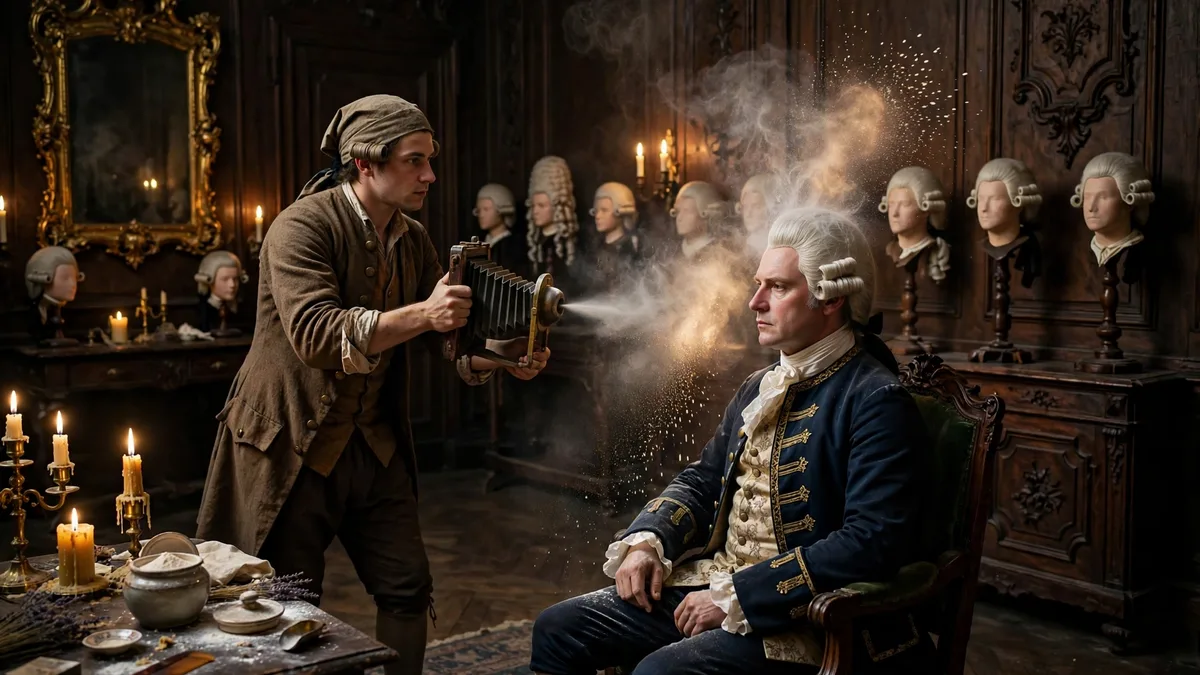
The “powdered” in powdered wigs was exactly what it sounds like: fine powder, dusted or puffed onto the wig to whiten it and absorb odors. But the details are surprising.
The powder was usually made from starch — often wheat flour — mixed with scent. Popular scents included violet, rose, lavender, clove, and lemon. The goal was twofold: achieve the fashionable white or gray color, and mask the smell of old hair, sweat, and scalp oils.
Applying it was a production. Wealthy men had dedicated “powder rooms.” These were small chambers where a servant puffed powder over the wig with bellows. The gentleman held a cloth over his face. The term “powder room” survives today, long after the wigs vanished.
The powder was not always white. Fashionable colors included gray, and occasionally even pink, blue, or violet. But white remained the prestige color — the visual shorthand for wealth and cleanliness, however ironic that now seems.
Wigs were ruinously expensive. A fine human-hair wig could cost the modern equivalent of thousands of dollars. The grandest ones used hair from as many as ten people’s heads. Poorer wig-wearers made do with goat hair, horsehair, or wool.
The hair trade was its own economy. Much of the human hair came from poor women who sold their locks to wigmakers. In Paris, the number of wigmakers quadrupled within a century — even small villages had at least one.
Men were not the only ones. By the mid-1700s, aristocratic women’s hairstyles reached absurd heights — literally. Towers of hair, sometimes a meter tall, were built over wire frames stuffed with wool and padding, then powdered and decorated.
These constructions were adorned with ribbons, jewels, feathers, and even miniature ships and birdcages. Sleeping required special arrangements. Doorways had to be ducked through. And like men’s wigs, they were rarely washed — making them, historians note, excellent real estate for mice and insects.
The fashion drew mockery even at the time. Caricaturists skewered towering hairdos as symbols of aristocratic vanity and waste — resentment that would soon turn revolutionary.
No fashion lasts forever. The powdered wig was killed by two forces: politics and a tax.
In France, the wig had become the ultimate symbol of aristocratic excess. During the bread shortages of the 1780s, the sight of nobles dusting their wigs with flour — actual food — while the poor starved was politically explosive.
When the Revolution came in 1789, the wig marked a man for the mob. Aristocrats shaved their powdered towers off to avoid the guillotine. Natural hair became a statement of republican virtue. The fashion died in France almost overnight.
Across the Channel, the end came by ledger book. In 1795, Prime Minister William Pitt the Younger needed money for Britain’s wars against revolutionary France. His solution: a tax of one guinea per year on hair powder. A local history study of one wig-wearer’s tax certificate shows how the system worked parish by parish.
The effect was immediate. Powdered wigs had always been expensive; now they carried an annual fee that advertised the wearer’s vanity. In protest, the Duke of Bedford cut his hair short and abandoned powder entirely. The bureaucracy was almost comic. Powder users had to buy a certificate from the local Justice of the Peace. The list of payers was pinned to the parish church door. Turning up powdered when your name was not on the list meant a fine. The tax was meant to fund war, but it worked as fashion police. His natural “Bedford Crop” became fashionable overnight.
Within a few years, the powdered wig was finished in Britain too. It survived only where tradition demanded it: British judges and barristers still wear wigs in court today — the last echo of a 200-year fashion. Counsel Magazine traces how the wig became the barrister’s uniform.
| Era | What men wore | What it signaled |
|---|---|---|
| 1600s–1740s | Large powdered wigs | Wealth, status, conformity to court fashion |
| 1750s–1780s | Smaller wigs, some natural hair powdered | Respectability, with fashion starting to simplify |
| 1789–1795 | Wigs abandoned in France; taxed in Britain | Revolutionary virtue / protest against vanity tax |
| 1800s onward | Natural short hair (“Bedford Crop”) | Modernity, democracy, practicality |

For three main reasons: to hide hair loss (from baldness or syphilis), to manage head lice (shaved heads plus removable wigs were easier to keep clean), and to display wealth and status. French royal fashion made them mandatory for respectable men.
Mostly starch — often wheat flour — mixed with perfumes like violet, rose, lavender, or lemon. It whitened the wig and covered up odors from unwashed hair.
Yes, often. But a wig could be removed, powdered, aired, or boiled to kill lice — far easier than delousing natural long hair. Shaving the head underneath was the real defense.
Partly fashion, partly image. Following his father Louis XIII (who wore wigs for thinning hair), Louis XIV made enormous wigs central to his majestic public image. When the Sun King wore something, all of Europe followed.
British Prime Minister William Pitt the Younger imposed a one-guinea annual tax on hair powder to fund wars against France. It made powdered wigs unfashionable almost overnight — the Duke of Bedford’s short natural “Bedford Crop” became the new look.
No — surprisingly, Washington never wore a wig. He powdered his own natural (reddish) hair white, which was fashionable. Several later presidents, including John Adams and Thomas Jefferson, did wear wigs.
Tradition. Court wigs survived the fashion’s death because the legal profession prized continuity and ceremony. They are the last institutional holdout of the powdered-wig era.
Yes — and they were even more extreme, sometimes a meter tall, built over wire frames and decorated with jewels, feathers, and ornaments. They drew heavy satire as symbols of aristocratic excess.