Physical Address
4676 Railroad Street Marquette
MI 49855
Physical Address
4676 Railroad Street Marquette
MI 49855
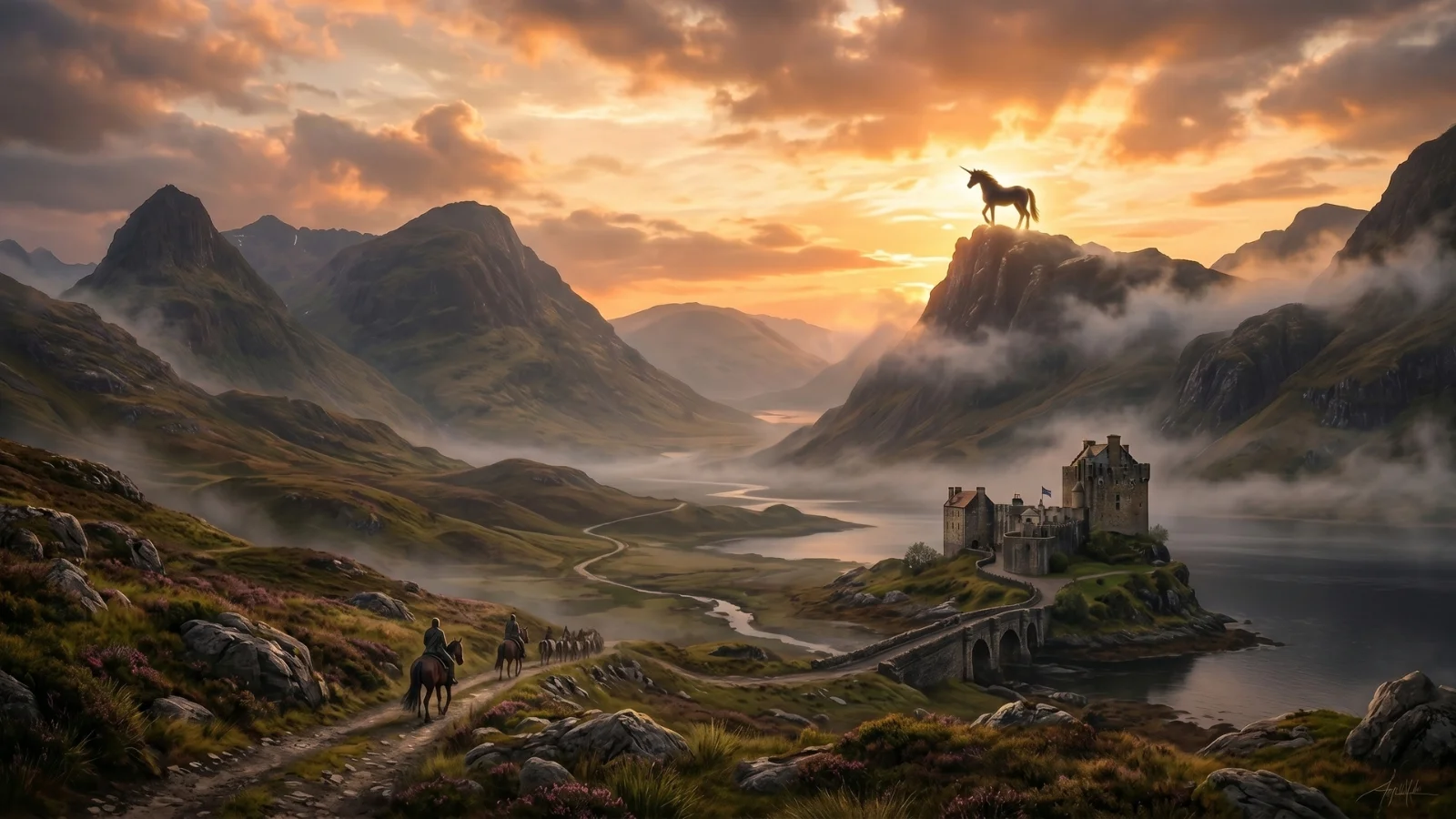
Quick Answer: Scotland’s national animal is not a real animal at all, it’s a Unicorn.
Yes, a mythical creature represents an entire country. But there is a real historical reason behind this unusual choice, and it goes back hundreds of years into Scottish royalty, Celtic beliefs, and symbolism of power and independence.
If you were asked to guess Scotland’s national animal, you might think of a red deer, a golden eagle, or even the Loch Ness Monster. The last thing most people expect is a unicorn.
To understand why Scotland chose such a mythical symbol, we need to go back into its ancient cultural roots. You will find it on royal buildings and ancient coins, on modern passports and city monuments. Far from being a random choice, the unicorn was selected for deeply symbolic reasons that say a great deal about Scotland’s identity, independence, and spirit.
To understand why, we need to go back to the very roots of Celtic mythology and heraldic tradition.
Long before the unicorn became Scotland’s national animal, it carried enormous symbolic weight across the ancient world. One-horned, horse-like creatures appear in Mesopotamian art dating back around 6,000 years. The ancient myths of India, China, and Persia all describe similar beasts: wild, fast, and impossible to tame.
The Greek physician Ctesias wrote about fierce one-horned wild asses roaming India more than 2,300 years ago. As European travellers ventured further across the globe, reports of unicorn sightings continued, from Tibet to the Congo, consistently describing the creature as powerful, proud, and elusive.
In Celtic mythology, the unicorn held a particularly revered place. It was a symbol of purity and innocence, masculinity and raw power, healing and protection. Its horn was believed to purify poisoned water and cure illness. Above all, it represented freedom. No creature could be captured or conquered against its will.
These qualities made the unicorn the perfect emblem for Scotland. A nation known for its fierce independence and resistance to conquest would naturally gravitate toward an animal that symbolised exactly those traits.
The unicorn’s connection to Scottish royalty stretches back to at least the 12th century. Legend holds that King William I, known as William the Lion, first incorporated the unicorn into the Scottish royal coat of arms around this time, making it one of the earliest known uses of the unicorn as a national symbol.
By the early 15th century, King James II had formally adopted the unicorn, and through the 15th and 16th centuries, it appeared on coins, shields, and royal seals throughout Scotland.
By the reign of James VI of Scotland, the Royal Coat of Arms featured two chained unicorns standing on either side of a rampant lion, a powerful image of guarded strength and royal authority.
One of the most interesting and often misunderstood details of Scottish heraldry is the chain. In depictions across Scotland, unicorns are almost always shown bound with a gold chain.
This was not a sign of defeat or submission. Quite the opposite.
In Celtic folk tradition, only a Scottish king or a pure, noble virgin had the power to tame a unicorn. The chains represented the extraordinary power of the Scottish monarchy: that only the greatest of rulers could subdue the most untameable creature in existence.
The chained unicorn was therefore a statement of royal might, not captivity.
The most significant change to the unicorn’s role in heraldry came in 1603, when James VI of Scotland inherited the English throne and became James I of England. This event is known as the Union of the Crowns.
Creating a unified British identity required a new Royal Coat of Arms. James replaced one of the two Scottish unicorns with England’s national animal, the lion, placing the two creatures side by side as supporters of the shield.
This arrangement was loaded with symbolism. In Celtic mythology and medieval folklore, the lion and the unicorn had long been portrayed as arch-enemies, locked in an eternal battle to be named king of beasts. The lion ruled by force and valour; the unicorn, by harmony and grace.
The famous nursery rhyme captures this rivalry perfectly:
The lion and the unicorn were fighting for the crown, The lion beat the unicorn all around the town.
Some interpret the chained unicorn in the British coat of arms as a symbol of Scotland’s subjugation by England. Others see it as a continuation of the pre-1603 Scottish tradition, where the chains always signified the taming of a wild, powerful force. The interpretation often depends on your politics.
Even in the modern world, the qualities associated with the unicorn remain deeply resonant with Scottish culture and national identity.
Scotland’s long history of resisting conquest mirrors the unicorn’s refusal to be tamed. The unicorn represents a dignified, noble strength rather than brute force. And Scotland’s landscape, mythology, and storytelling tradition have always embraced the extraordinary, the magical, and the wondrous.
The collective nouns for a group of unicorns say it all: a blessing of unicorns, a glory of unicorns, a marvel of unicorns. These words could just as easily describe Scotland itself.
Scotland takes its national animal seriously, and once you start looking, unicorns appear everywhere. Here are some of the best places to spot them.
Edinburgh
The gates of the Palace of Holyroodhouse feature a prominent unicorn on a heraldic shield. Edinburgh Castle has a unicorn in the Royal Apartments, and St Giles’ Cathedral hides several unicorns among its Victorian woodcarvings.
Stirling
Stirling Castle is home to the famous Hunt of the Unicorn tapestries, which are among the most stunning unicorn artworks in existence.
Dundee
HMS Unicorn, one of the oldest surviving warships in the world, proudly displays a unicorn as its figurehead.
Mercat Crosses
Across Scotland, traditional market crosses known as mercat crosses are topped with unicorn figures. Look for them in Edinburgh, Culross, Prestonpans, Dunfermline, and Falkland.
Historic Castles and Palaces
Falkland Palace displays Mary, Queen of Scots’ coat of arms, showing two unicorns with saltires. Crathes Castle, Brodick Castle, and Fyvie Castle all feature unicorn motifs in their historic collections.
National Unicorn Day is celebrated every year on 9 April, making it a perfect excuse to explore Scotland’s unicorn heritage.
For centuries, people genuinely believed unicorns existed. The confusion likely arose from real animals seen at a distance or described second-hand.
The most likely candidates include the Elasmotherium Sibericum, a massive prehistoric rhinoceros-like creature that roamed alongside early humans, as well as the Indian Rhinoceros and the Tibetan Chiru.
Perhaps the most fascinating contender is the narwhal, a whale whose long, spiralling tusk grows up to three metres in length. From the 1200s onwards, narwhal tusks were traded across Europe as genuine unicorn horns. They were so prized for their supposed healing properties that they were used to make cutlery and ground into medicine. Denmark’s 17th-century coronation throne was constructed entirely from narwhal tusks.
It was not until the 1800s that most people accepted that unicorns, as they had been imagined, did not exist. But by then, the unicorn had been Scotland’s national animal for centuries, and its symbolic power had only grown stronger.
What is Scotland’s national animal? Scotland’s national animal is the unicorn, a mythical horned creature that has been associated with Scottish royalty and Celtic mythology for over 600 years.
Why did Scotland choose a mythical animal? The unicorn was chosen for its symbolic qualities in Celtic mythology: purity, power, independence, and the inability to be tamed or conquered. These were values that resonated deeply with Scottish national identity.
When did the unicorn become Scotland’s national animal? The unicorn first appeared on the Scottish Royal Coat of Arms in the 12th century under King William I. It was formally adopted by King James II in the early 15th century and has remained Scotland’s national animal ever since.
Why is the Scottish unicorn in chains? The chains are a symbol of royal power, not captivity. In Celtic tradition, only a Scottish king could tame a unicorn. The chains demonstrate the extraordinary strength and authority of the Scottish monarchy.
What other national symbols does Scotland have? Scotland’s other national symbols include the thistle (national flower), the Saltire (national flag, a white diagonal cross on blue, believed to be the oldest flag in Europe), and St Andrew as the patron saint.
Where can I see unicorns in Scotland? Notable locations include the Palace of Holyroodhouse, Edinburgh Castle, St Giles’ Cathedral, Stirling Castle, HMS Unicorn in Dundee, and the mercat crosses in towns such as Culross and Falkland.
Is there a National Unicorn Day? Yes. National Unicorn Day is celebrated on 9 April every year, with events, social media activity, and plenty of unicorn-themed fun across Scotland and beyond.
So, what is Scotland’s national animal? It is the unicorn, a mythical creature that has represented Scotland’s fierce independence, noble spirit, and rich cultural heritage for more than six centuries.
From its roots in Celtic mythology to its place on the Royal Coat of Arms and its appearance at Scotland’s most iconic landmarks, the unicorn is far more than a fairy-tale figure. It is a powerful symbol of everything Scotland stands for: untameable, proud, and utterly unique.
Next time you visit Scotland, keep your eyes open. Unicorns are everywhere. You just have to know where to look.
Discovered something fascinating? Share this article and help spread a little Scottish magic.