Physical Address
4676 Railroad Street Marquette
MI 49855
Physical Address
4676 Railroad Street Marquette
MI 49855

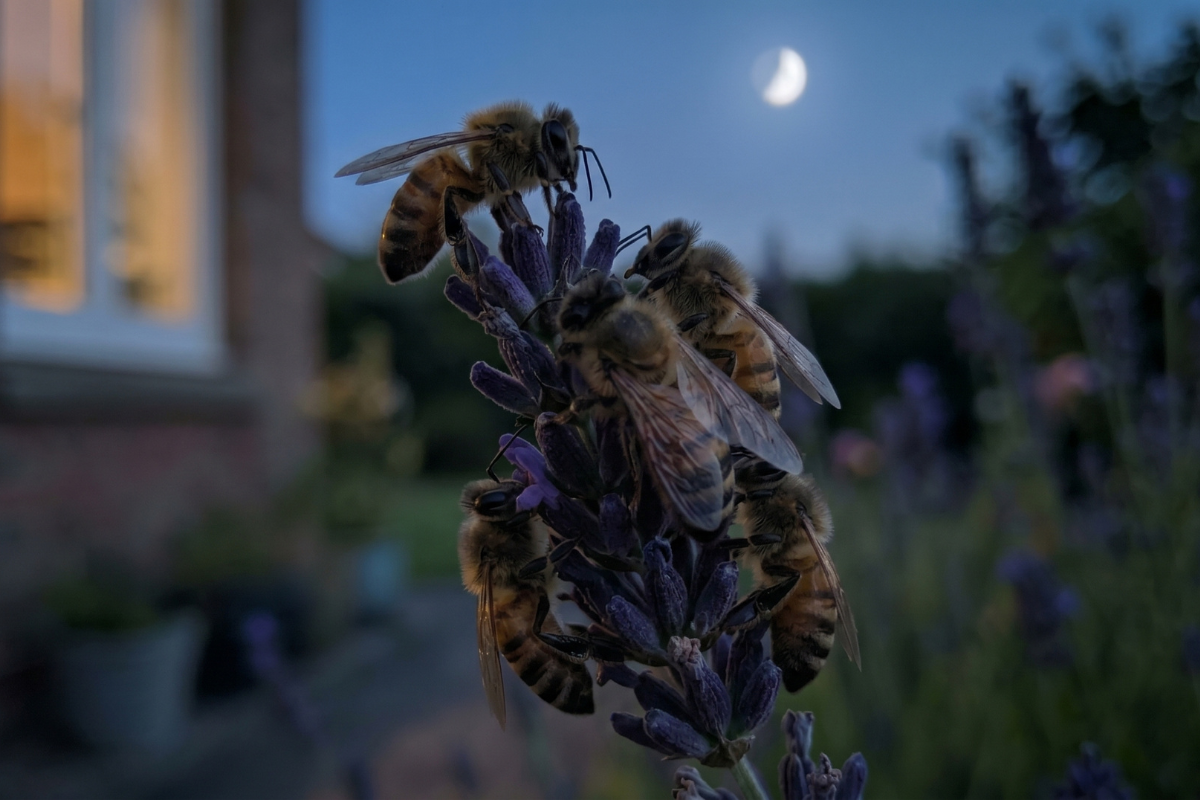
Have you ever watched a beehive at night and wondered — do bees sleep at night? Most people assume bees are always busy. The truth is more interesting: bees have real sleep needs, body clocks, and rest patterns that affect the whole colony.
Quick Answer: Yes, bees sleep at night. Honey bee workers rest 5–8 hours daily — antennae drooping, bodies still — mostly inside the hive. Sleep-deprived bees navigate poorly and miscommunicate food locations, so rest is critical to colony survival. Understanding their rest helps beekeepers keep hives calm, healthy, and productive.
Tired bees can’t navigate, communicate, or gather food well. Studies show that sleep-deprived bees do the waggle dance – the dance bees use to share food locations – with big errors. Bad directions mean less food and a weaker hive. As social insects, bees depend on rest to keep the whole colony running smoothly.
For beekeepers, timing matters too: opening a hive during rest hours stresses the colony. And for scientists, bee sleep hints at how sleep first evolved — bees have far simpler brains than mammals, yet they clearly sleep.
Most bees sleep when darkness falls. Honey bee workers stop moving, lower their antennae, and lie still for hours. Researcher Walter Kaiser first documented this rest state back in 1988 — it closely resembles sleep in other animals.
Honey bees are active by day and asleep by night. But some species — like the Eastern carpenter bee and certain tropical bees — are active at dawn and dusk or even at night. Solitary bees, free of hive duties, keep simpler rest patterns.
Worker bees usually sleep five to eight hours a day. Older foragers sleep more than young nurse bees — foraging needs complex memory, which depends on good rest. Young hive bees take short naps around the clock instead.
Inside the hive, bees rest in empty brood cells or hang in clusters from the comb like tiny hammocks. Outdoor solitary bees and bumblebees sleep on flower petals, inside hollow stems, or under leaves. Male bees, barred from the hive, often sleep on nearby plants.
Antennae droop. The body goes still. Legs loosen their grip. In deep sleep, bees are hard to wake — much like deep sleep phases in humans.
Yes, but differently: queens rest in short bursts, not long stretches. She is never truly alone — attendant workers surround her constantly, grooming and feeding her even at rest.
Bees have internal body clocks, just like us. Light and temperature set them. Disturbing them causes real harm: artificial light at night harms learning and shortens lifespans.
The waggle dance breaks down in sleep-deprived bees. Fewer bees find flowers. Less nectar comes in. The whole colony suffers. Sleep is tied directly to colony survival.
In winter, honey bees cluster together and enter torpor — a drowsy, low-energy state (not true hibernation). In summer’s long days, they sleep less, but they never skip it.
Streetlights and garden lights confuse bees’ body clocks. Colonies near bright urban areas forage less and show more stress. Shielding lights or using motion-sensitive lamps near hives truly helps.
The single most disruptive thing you can do — bees are very defensive after dark. Inspect from mid-morning to early afternoon instead.
Artificial light wrecks body clocks. Point garden lights away from hives, or switch to amber/red bulbs.
Honey bee rules don’t automatically apply to mason, leafcutter, or bumblebees. Study your specific species.
You cannot ask a bee if it slept well. So researchers look for the same clues doctors use in human sleep labs: stillness, raised arousal threshold (harder to wake), and a rebound effect — sleeping longer after being kept awake.
Walter Kaiser’s 1988 work set the standard: he filmed honey bees around the clock and found long motionless stretches with drooping antennae. Later teams went further, recording bee brain activity. Sleeping bees show distinct neural patterns, including bursts that resemble the deep-sleep waves of mammals — remarkable in a brain smaller than a sesame seed.
The cleverest experiments test memory. Bees trained to find sugar water, then kept awake, forget the route the next day. Rested bees remember. It is the same test given to tired humans — and bees fail it the same way we do.
| Feature | Honey Bees | Humans |
|---|---|---|
| Daily sleep | 5–8 hours (workers); short naps (young bees) | 7–9 hours (adults) |
| Sleep posture | Still, antennae drooped, sometimes hanging from comb | Lying down, eyes closed, relaxed muscles |
| Brain activity | Distinct rest patterns, deep-sleep-like bursts | REM and deep-sleep stages |
| Effect of deprivation | Bad navigation, broken waggle dance, shorter life | Poor memory, bad decisions, health decline |
| Circadian clock | Set by light and temperature | Set mainly by light |
The parallels are striking. Sleep seems to be one of evolution’s oldest inventions — so old that insects and mammals, separated by 600 million years, still do it the same way. If you find animal rest fascinating, you may also enjoy learning whether sharks sleep — their answer is even stranger.
Wasps rest at night much like bees, tucking into sheltered spots. Hornets quiet down after dark, though the colony’s guards stay alert. Ants take a different approach entirely: instead of long nightly sleep, many ants take hundreds of tiny power naps — about a minute each — around the clock, so the colony never fully shuts down. It is a completely different solution to the same problem, and ant colonies can number in the millions running on this nap system.
Solitary wasps and bees, with no colony to protect, sleep wherever the day ends — curled in a flower, clamped onto a grass stem with their jaws. Without hive duties, their rest is simpler but no less real.
Artificial light. The biggest modern threat. Bees near streetlights and porch lights show confused body clocks, worse learning, and shorter lives. Fixes: motion-sensor lights, warm-colored bulbs, and shields that point light downward.
Pesticides. Certain chemicals scramble bee navigation and rest patterns even at doses that do not kill. Planting untreated flowers and avoiding sprays during foraging hours helps.
Vibration and noise. Hives near roads or machinery rest poorly. A sheltered, stable stand makes a measurable difference.
Varroa mites and disease. Parasites stress the colony around the clock. Regular, well-timed hive checks — never at night — catch problems early. Just as hibernating animals need undisturbed winter rest, bees need their nights left alone.
So, do bees sleep? Yes. From honey bees tucked into brood cells to solitary bees napping on petals, sleep is vital to every bee’s life — and to the pollination the world depends on.
Yes, bees sleep — but “bee” covers about 20,000 species, and they do not all rest the same way. The honeybee in a managed hive, the bumblebee in your garden, and the solitary mason bee in a hollow stem each have their own version of sleep. Here is how the main types compare.
Honeybee workers: the shift sleepers. A worker honeybee’s sleep depends on her job. Young “nurse” bees, who care for larvae around the clock, take short naps scattered through the day and night — they cannot afford a full night off when babies need feeding. Older forager bees, who fly out to collect nectar, sleep in longer stretches at night, often 5 to 8 hours. Researchers have observed foragers lying motionless in empty honeycomb cells, antennae drooping, completely unresponsive — the insect equivalent of being dead to the world. Total sleep for a forager can reach 30 minutes of deep rest per bout, and they are noticeably groggy and clumsy if woken early, just like a person dragged out of deep sleep.
Honeybee drones and queens: the luxury sleepers. Drones (the males) do no foraging and no nursing, so their schedule is far more relaxed — they rest frequently and at length. The queen, meanwhile, is the most pampered sleeper in the hive. Attended constantly by workers who feed and groom her, she can rest whenever she chooses, free from the labor that fragments everyone else’s sleep. It is the closest thing the insect world has to royalty napping on demand.
Bumblebees: the cold-weather nappers. Bumblebees sleep too, but their patterns shift with the temperature. On cool evenings, bumblebees may become too sluggish to fly home and will simply sleep where they are — often curled inside a flower, legs tucked, holding on with their jaws. Gardeners sometimes find them motionless on blossoms at dawn and mistake them for dead. They are not dead; they are waiting for the sun to warm their flight muscles. A bumblebee needs its body temperature around 30°C (86°F) before it can fly, so a chilly morning means an extended lie-in.
Solitary bees: the hidden sleepers. Most bee species are solitary — no hive, no queen, no workers. Mason bees, leafcutter bees, and carpenter bees each sleep alone, tucked into hollow stems, abandoned beetle tunnels, or small ground burrows. Male solitary bees, which do not even build nests, often sleep clinging to plant stems or grass blades, jaws locked on, legs dangling. Some species return to the very same sleeping perch night after night, like a commuter with a favorite seat. Their sleep is lighter and more fragmented than a honeybee’s, since there is no colony to stand guard while they rest.
Why does any of this matter? Sleep-deprived bees are measurably worse at their jobs. Experiments show that bees kept awake navigate poorly, communicate less precisely through their waggle dances, and learn new flower locations more slowly. In other words, a well-rested bee is a better pollinator — and given that bees pollinate roughly a third of the food we eat, their sleep is quietly propping up human agriculture. It is one more reminder that rest is not laziness; it is maintenance. Even ants, the famously tireless workers, take hundreds of tiny naps a day — and your dog dreams through the night much like you do.
Yes. Most honey bees retreat into the hive at night and enter a rest state. Worker bees sleep in empty cells or hang in clusters on the comb. The hive becomes noticeably quieter and activity slows dramatically after sunset.
Honey bees generally do not fly at night. They need warmth and light to navigate efficiently. However, on unusually warm nights or near bright artificial lights, some bees may emerge briefly. Certain other bee species such as some native sweat bees are partially nocturnal.
Bees do not have eyelids, so they cannot close their eyes the way humans do. Their sleep shows in their stillness, relaxed antennae, and lowered muscle tone. They also respond less to stimuli. Brain activity also changes in sleeping bees, similar to sleep stages in other animals.
At night, guard bees maintain a reduced but active watch at the hive entrance. Most worker bees stop moving and rest. The temperature inside the hive is regulated by the cluster of bees. The queen continues to rest surrounded by her attendants.
No. Like virtually all animals, bees require sleep to survive. Sleep-deprived bees have worse memory. They struggle to navigate and do poorly in their waggle dance. Plus, they tend to live shorter lives. Sleep is essential for maintaining the complex behaviors that make a honey bee colony function. Like bees, ants are colony insects too — but ant colonies work on a whole different scale: how many ants are in a colony?
Yes. Solitary bees do not live in colonies, so their sleep is less socially regulated. They typically sleep alone inside nesting tubes, hollow stems, or flower petals. Male solitary bees, in particular, are often found sleeping on plants in a very visible and relaxed posture.
We cannot know for sure, but sleeping bees show brain-activity bursts similar to deep-sleep waves in mammals. Since bees form memories during the day and consolidate them at night, something dream-like may occur — though it would be nothing like a human dream.
Most honey bees settle down around sunset as light fades and temperatures drop. Foragers return to the hive, activity winds down over 30–60 minutes, and the colony rests until dawn. The exact timing shifts with the seasons.
Yes. Young nurse bees inside the hive take short naps around the clock because larvae need constant care. Forager bees mostly sleep at night, but on dark or rainy days they will rest in the hive during daylight hours too.
Queens can rest whenever they want, since workers feed and groom them constantly. Worker bees — especially nurses — get fragmented, on-duty sleep, while foragers get longer nighttime rest. The queen’s life is the least interrupted.
Yes. Bumblebees often sleep inside flowers, especially on cool evenings when they become too sluggish to fly home. They clamp onto the petals with their jaws and wait for morning warmth. Finding a motionless bumblebee at dawn is normal — it is sleeping, not dead.
Alone, in sheltered spots: hollow plant stems, abandoned beetle burrows, small ground tunnels, or simply clinging to a grass blade. Males of many solitary species sleep outdoors every night, gripping vegetation with their jaws. Some return to the same perch nightly.