Physical Address
4676 Railroad Street Marquette
MI 49855
Physical Address
4676 Railroad Street Marquette
MI 49855

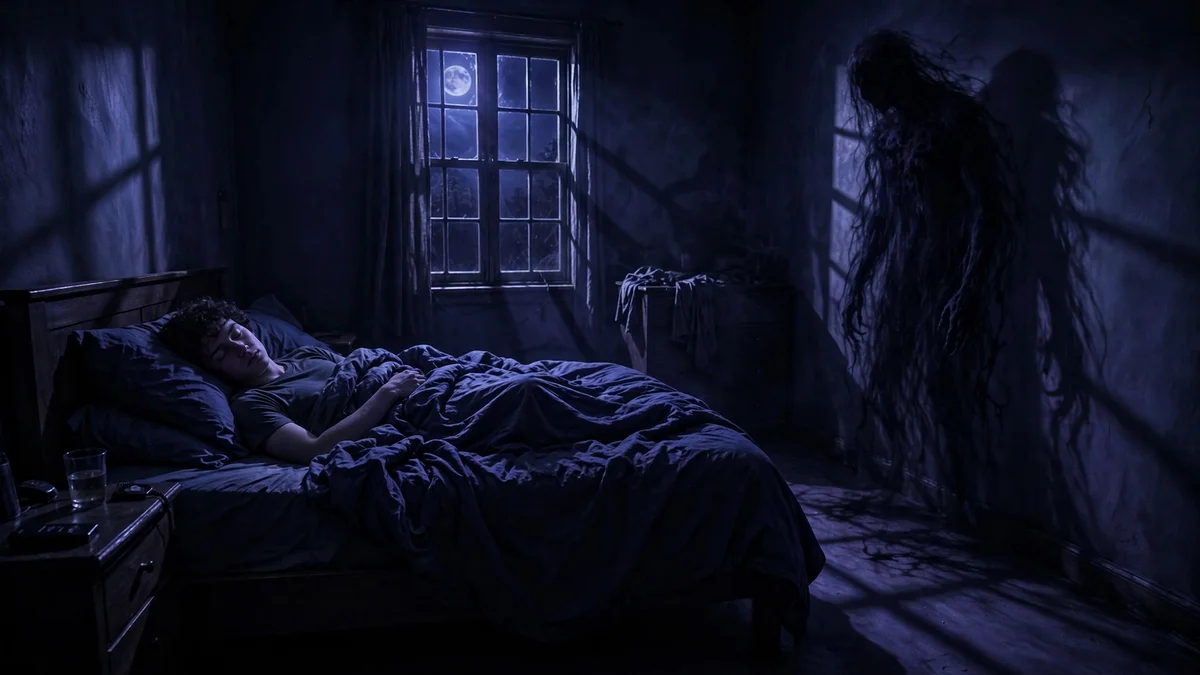
Quick Answer: Sleep hides genuinely creepy phenomena: sleep paralysis leaves you awake but frozen, often hallucinating intruders; “exploding head syndrome” makes people hear phantom explosions; night terrors cause screaming without waking; and fatal familial insomnia is a real disease where the brain loses the ability to sleep entirely — always fatal.
Every night, you hand control of your body to an organ that spends a third of your life running strange programs you’re not aware of. Sleep looks peaceful from the outside. Inside, it’s one of the most complex — and occasionally disturbing — things your brain does. Scientists are still discovering just how weird it gets.
Sleep paralysis happens when your mind wakes up before your body does. During REM sleep, your brain paralyzes your muscles so you don’t act out your dreams. Normally, this paralysis switches off when you wake. In sleep paralysis, it doesn’t — and you lie there, conscious, unable to move or speak.
That’s frightening enough. But up to 75% of people who experience it also hallucinate. The most common hallucination is a presence in the room — often described as a demon, a shadow figure, or an “old hag” sitting on the chest. Across cultures and centuries, people have described nearly identical intruders.
In Newfoundland folklore, it’s the “Old Hag.” In Japan, it’s kanashibari — being bound by metal. In Egypt, it’s a jinn attack. In medieval Europe, it was a demon or witch. Modern neuroscience says it’s the brain’s threat-detection system misfiring while the body is locked down. But knowing the science doesn’t make the experience less terrifying at 3 a.m.
Exploding head syndrome sounds like a horror movie invention, but it’s a real, documented sleep disorder. People with it hear sudden, extremely loud noises as they’re falling asleep or waking up — explosions, gunshots, cymbals crashing, doors slamming.
There is no actual sound. The “explosion” happens entirely inside the brain. Researchers believe it’s caused by the brain’s auditory neurons misfiring during the transition between wake and sleep — like a computer glitching during shutdown.
The name was coined by British neurologist J.M.S. Pearce in 1988, but descriptions of the phenomenon go back to at least 1876. It’s harmless, but sufferers consistently describe it as one of the most frightening experiences of their lives. Imagine being jolted awake by a bomb blast that never happened.
Night terrors are not nightmares. A nightmare wakes you up, and you remember it. A night terror happens during deep non-REM sleep — the person screams, thrashes, sweats, and looks terrified, but doesn’t wake up. In the morning, they remember nothing.
They’re most common in children aged 3 to 7, affecting up to 15% of kids. Watching a child have a night terror is deeply disturbing for parents: the child’s eyes are open, they’re screaming as if in mortal danger, but they’re unreachable. Trying to wake them often makes it worse.
Adults can get them too, though it’s rarer. Adult night terrors are sometimes linked to stress, trauma, or sleep deprivation — and they can involve the person getting out of bed and moving around, still asleep, still terrified of something only they can perceive.
This is the most frightening sleep fact on this list because it’s real, it’s genetic, and it’s always fatal. Fatal familial insomnia (FFI) is a prion disease — the same family as mad cow disease — that destroys the thalamus, the brain’s sleep-regulating center.
It begins with increasing insomnia. Then the autonomic nervous system goes haywire: sweating, rapid heartbeat, high blood pressure. Then hallucinations, dementia, and eventually a state where the person is trapped between sleep and wakefulness, unable to enter either fully. Death follows, usually within 7 to 36 months of onset.
There is no cure and no treatment. The disease is caused by a mutation in the PRNP gene, inherited in an autosomal dominant pattern — meaning a child of a carrier has a 50% chance of inheriting it. Fewer than 100 families worldwide are known to carry it. In 2001, researchers discovered that a man who died of FFI in the 1700s was the common ancestor of many affected families.
Beyond FFI, extreme sleep deprivation alone can kill. The current scientific understanding is that total sleep deprivation in humans leads to death within weeks — though no ethical experiment has tested this directly.
The closest documented case is Randy Gardner, a 17-year-old who stayed awake for 11 days in 1964 as a science fair project. By the end, he was hallucinating, couldn’t concentrate, and had paranoia. He recovered after sleeping — but researchers monitoring him noted the experience may have caused lasting changes.
In animal studies, rats deprived of sleep die within 2-3 weeks, typically from immune system collapse and organ failure. Their bodies simply stop maintaining themselves without sleep. The human equivalent has never been ethically tested, for obvious reasons.
Most sleepwalking is harmless — a drowsy trip to the kitchen. But in rare cases, it becomes genuinely frightening. There are documented cases of people driving cars while asleep, cooking full meals, and even committing violent acts with no memory afterward.
In 1987, Kenneth Parks, a Canadian man, drove 23 kilometers to his in-laws’ house while asleep and attacked them, killing his mother-in-law. He was acquitted after sleep experts testified he was in a genuine sleepwalking state — the first known acquittal on “sleepwalking defense.”
Sleep researchers call these episodes “confusional arousals” — the brain partially wakes but consciousness doesn’t fully engage. The person can perform complex actions while essentially unconscious. It’s rare, but it happens.
During sleep, particularly in deep sleep and REM, your brain replays the day’s experiences to consolidate memories. This is normal and healthy. But it means your brain also replays traumatic or frightening experiences — which is why nightmares cluster around stressful periods.
What’s creepy is that this replay isn’t passive. Studies using brain imaging show that during REM sleep, the emotional centers of the brain are highly active while the rational prefrontal cortex is suppressed. Your brain is reprocessing emotions at full intensity with no logical oversight. That’s why dreams feel so real and so emotionally overwhelming — your brain is literally experiencing them without the usual filters.
You’ll spend roughly 26 years of your life asleep. That’s more time than you’ll spend doing almost anything else — working, eating, talking to people you love. A third of your existence happens in a state where you’re unconscious, paralyzed, hallucinating, and completely vulnerable.
Our ancestors slept in groups, in caves, with fires burning — because sleeping alone in the dark got you killed. The unease many people feel sleeping alone in a dark house isn’t irrational. It’s an ancient survival instinct, still running in a modern brain, in a world where the predators are mostly gone but the fear remains.
Almost everyone has experienced this: you’re drifting off to sleep when suddenly your whole body jerks, and you feel like you’re falling. It’s called a hypnic jerk, and up to 70% of people experience them regularly.
Scientists think it’s a misfire between the brain and muscles during the transition to sleep. One leading theory is evolutionary: as early primates slept in trees, the brain developed a “check” system — when muscles relaxed for sleep, the brain sometimes interpreted it as falling and jolted the body awake as a protective reflex.
You’re not actually falling. But for a split second, your ancient brain is convinced you are.
Obstructive sleep apnea causes a person’s airway to collapse during sleep, stopping their breathing — sometimes hundreds of times per night. Each pause can last from seconds to over a minute. The brain eventually panics and jolts the person partially awake to resume breathing, usually without full consciousness.
Many sufferers have no idea it’s happening. They just feel exhausted every day, no matter how long they sleep. Their partners, however, hear the pattern: snoring, silence, gasping, snoring again — all night, every night.
Untreated severe apnea is linked to heart disease, stroke, and significantly increased mortality. Millions of people have it and don’t know. They’re slowly suffocating in their sleep, night after night, and their brain is too asleep to tell them.
Here’s a genuinely unsettling thought that sleep researchers take seriously: there is no definitive test, from inside an experience, to prove you’re awake rather than dreaming. Dreams can be completely convincing. People in lucid dreams have performed “reality checks” that failed — they were sure they were awake, and they weren’t.
Philosophers have chewed on this for centuries (Descartes’ “evil demon,” Zhuangzi’s butterfly dream). Neuroscience hasn’t resolved it either. The brain constructs your entire experience of reality from electrical signals. Dreams use the same hardware. From the inside, there’s no watermark that says “this one is real.”
You’re probably awake reading this. Probably.
Sleep paralysis combined with hallucinations is widely considered the creepiest — being conscious but frozen while your brain generates the vivid sensation of an intruder in the room. Fatal familial insomnia is the most objectively terrifying, as a real disease that permanently destroys the ability to sleep.
No. Sleep paralysis is frightening but harmless. The paralysis always wears off within minutes. No one has ever died from an episode, though the panic it causes can feel life-threatening in the moment.
Researchers believe it’s caused by the brain’s auditory neurons misfiring during the transition between sleep and wakefulness. It’s harmless and relatively common, though underreported because people are embarrassed to describe it.
Yes. It’s a rare genetic prion disease affecting fewer than 100 known families worldwide. It destroys the thalamus, making sleep impossible, and is always fatal. There is no cure.
This is a hypnic jerk — a sudden muscle twitch during the transition to sleep. The leading theory is that it’s an ancient primate reflex: as muscles relax, the brain briefly misinterprets it as falling from a tree and jolts you awake protectively.
Usually it’s harmless, but rare cases involve driving, cooking, or violence while asleep. These are called confusional arousals — the brain partially wakes without consciousness engaging. Anyone who sleepwalks dangerously should see a sleep specialist.
That’s sleep paralysis — your brain woke up before the REM muscle paralysis switched off. It’s temporary and harmless, though often accompanied by frightening hallucinations. It usually passes within a few minutes.
Yes. An 80-year lifespan includes roughly 26 years of sleep. It’s the single largest block of time in a human life — more than work, eating, or any other activity.
Dreams are not just for adults — can newborns have bad dreams?





[…] Creepy Facts About Sleep […]
[…] Creepy Facts About Sleep […]
[…] Creepy Facts About Sleep […]
[…] Creepy Facts About Sleep […]