Physical Address
4676 Railroad Street Marquette
MI 49855
Physical Address
4676 Railroad Street Marquette
MI 49855

Category: Mysteries
Quick Answer: The wilderness produces genuinely frightening true stories: hikers vanishing without a trace in national parks, campers hearing impossible sounds at night, encounters with wildlife that shouldn’t be there. Cases like the Dyatlov Pass incident, missing persons in the woods, and documented predator encounters remind us that nature is beautiful — and indifferent.
Humans spent most of their history afraid of the dark forest, and for good reason. For thousands of years, the treeline was the boundary between safety and death. Predators hunted at night. Getting lost meant dying. The dark hid things with teeth.
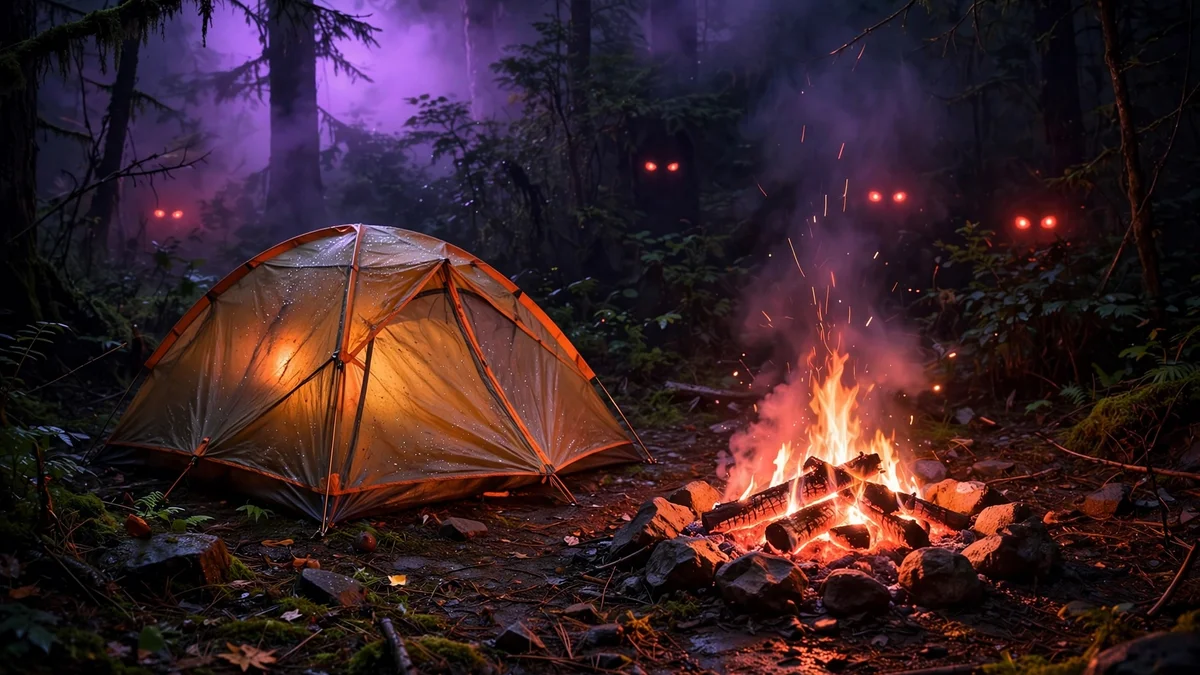
Modern camping recreates those ancient conditions: you’re in a thin fabric shelter, in the dark, surrounded by sounds you can’t identify, far from help. Your brain — running million-year-old software — responds accordingly. Every snap of a twig gets full threat assessment. It’s not irrational. It’s your ancestors keeping you alive.
No camping story is more disturbing than what happened to nine Soviet hikers in February 1959. They pitched their tent on a Ural mountainside. Sometime in the night, they cut their way out from the inside and fled into minus-30 cold, barely dressed.
Their bodies were found over the following months, scattered down the slope. Skull fractures. Crushed ribs. One woman missing her tongue. The tent, the cut fabric, the footprints leading away — everything suggested sudden, overwhelming terror.
Theories range from avalanches to military tests to infrasound-induced panic. A 2019 Russian investigation blamed an avalanche, but researchers continue to dispute the injury patterns. Nine experienced outdoorspeople died fleeing their own tent, and nobody knows exactly why.
Former police detective David Paulides has documented thousands of missing persons cases in national parks and wilderness areas that share disturbing patterns. Hikers — often experienced — vanish from established trails. Search teams find nothing. When bodies are eventually found, they’re frequently in areas already searched, sometimes without shoes or clothing, sometimes in impossible locations.
Paulides identified strange clusters: disappearances near water and boulder fields, victims found at higher elevations than expected, cases where tracking dogs lose the scent immediately. He’s careful not to claim a single explanation, but the patterns are unsettling.
Skeptics argue he’s cherry-picking from the enormous number of wilderness disappearances (most explained by exposure, falls, or animal encounters). But some individual cases genuinely defy easy explanation — experienced hikers vanishing from the middle of groups, children found miles away over impossible terrain.
In February 1978, five men with mild intellectual disabilities attended a basketball game in California, then drove home. They never arrived. Their car was found abandoned on a remote mountain road — 19 miles off their route, in the opposite direction from home.
Months later, searchers found the remains of three of the men. One had apparently starved to death in a Forest Service trailer 19 miles from the car — despite the trailer containing food and survival supplies he never touched. Another was found mostly consumed by animals. The fifth man was never found.
Like Dyatlov Pass, the case involves people abandoning safety for no clear reason, in conditions that killed them. The trailer victim’s behavior — starving surrounded by food — is the detail that haunts investigators most.
Ask experienced campers about the strangest thing they’ve heard at night, and you’ll get stories that raise the hair on your neck. The wilderness produces sounds that don’t match any known animal:
Most have natural explanations. But in the moment, at 2 a.m., in a tent, with no one else for miles — explanation doesn’t matter. Fear does.
The statistics are reassuring: fatal wildlife attacks on campers are extremely rare. But the rare cases are nightmare fuel precisely because they remind us of our place in the food chain.
In 2016, a grizzly bear attacked campers in Montana, dragging one from a tent. In 2015, a black bear in New Jersey killed a hiker — the state’s first fatal bear attack in over 150 years. Mountain lions stalk hikers in California with disturbing regularity; most encounters end without incident, but the big cats are watching far more often than people realize.
The truly frightening encounters aren’t the attacks — they’re the near-misses. Campers waking to find bear tracks circling their tent. Hikers realizing a mountain lion has been following them for miles. The knowledge, afterward, that something was deciding whether you were food.
One of the strangest recurring wilderness reports — popularized by online communities but with roots in older folklore — is the phenomenon of staircases found deep in forests, far from any structure. Hikers describe finding full flights of stairs, sometimes carpeted, standing alone in the woods with no building attached.
Search-and-rescue workers have shared accounts of being trained never to approach or climb such stairs if found. The stories describe overwhelming feelings of wrongness, electronic equipment malfunctioning nearby, and in some accounts, people who climbed the stairs and were never seen again.
There’s no verified documentation of the stairs themselves — no confirmed photographs from reliable sources. They’re likely a modern folk legend, a digital-age campfire story. But the fact that the story resonates so widely says something about how the deep woods make us feel: that the rules might be different in there.
Between 1945 and 1950, five people vanished in the wilderness around Glastenbury Mountain, Vermont — an area locals called the Bennington Triangle. The disappearances shared no obvious pattern: a veteran hiking guide, a college student, a young boy, an elderly woman, a woman on a hiking trail.
The strangest was 8-year-old Paul Jepson, who vanished from his family’s farmyard in 1950. His mother turned away for less than an hour. Despite massive searches, no trace was ever found — except that tracking dogs reportedly followed his scent to a road and then lost it completely, as if he’d been picked up by a vehicle on a road no one saw.
The area has Native American legends about cursed land and “man-eating stones.” Whether the cluster is coincidence or something stranger, five vanishings in five years in one small wilderness area is statistically remarkable.
Norway’s Hessdalen valley is famous for unexplained lights — but campers there report more than lights. Visitors describe being watched, equipment malfunctioning, and an overwhelming sense of presence. The valley’s phenomena have been scientifically monitored for decades, yet remain unexplained.
What makes Hessdalen relevant to camping stories is the combination: documented anomalous phenomena plus the vulnerability of being outdoors at night in a remote valley. Researchers with scientific instruments have recorded the lights reacting to their presence. Campers without instruments just experience the fear.
Before modern technology, fire lookouts spent entire summers alone in towers deep in wilderness areas. Their journals and memoirs contain some of literature’s eeriest solitude writing — weeks without human contact, strange sounds, the feeling of being observed.
Jack Kerouac’s account of his summer as a fire lookout on Desolation Peak is famous for its beauty and its loneliness. But lesser-known lookout journals describe genuinely frightening experiences: footsteps on the tower stairs with no one there, voices in the wind, the slow erosion of the boundary between imagination and perception during months of isolation.
Real wilderness dangers, in order of actual risk: hypothermia, dehydration, falls, getting lost, lightning, then — far down the list — wildlife and other people. The things that actually kill campers are mundane: bad weather, poor preparation, bad decisions.
But the human brain doesn’t rank fears by statistics. It ranks by vividness. A bear attack is vivid; hypothermia is abstract. That’s why scary camping stories work — they give shape to the formless anxiety of being small, soft, and alone in a big dark place that doesn’t care about you.
The Dyatlov Pass incident is widely considered the most disturbing — nine experienced hikers fleeing their tent into deadly cold for reasons still debated. The Yuba County Five case is its American counterpart, equally baffling.
Yes — hundreds go missing in wilderness areas each year. The vast majority are found or explained (exposure, falls, disorientation). A small number remain genuinely puzzling, which is what David Paulides’s Missing 411 research documents.
A modern folk legend about staircases found deep in forests with no building attached. There are no verified photographs from reliable sources — it’s likely a digital-age campfire story, though it draws on older folklore about wrongness in deep wilderness.
In 1959, nine Soviet hikers died under bizarre circumstances in the Ural Mountains — fleeing their tent from the inside into extreme cold, with unusual injuries. A 2019 investigation blamed an avalanche, but the case remains disputed.
Five people vanished around Glastenbury Mountain, Vermont, between 1945-1950. Whether it’s a genuine cluster or coincidence is debated, but the individual cases — especially 8-year-old Paul Jepson’s — remain unsettling.
Statistically, it’s not predators — it’s insects (disease) and then large mammals in rare encounters. Moose injure more people than bears in North America. The real killers are weather, falls, and getting lost.
Evolutionary psychology: humans spent millennia as prey animals after dark. The brain’s threat-detection systems are tuned for exactly the conditions of night camping — darkness, unfamiliar sounds, isolation, vulnerability. The fear is ancient software running on modern hardware.
No — with preparation, camping is very safe. The actual risks (weather, dehydration, getting lost) are all manageable with basic precautions. The fear is mostly your brain doing its job: keeping you alert in an unfamiliar environment.